Nasa is ready to proceed with the final design and construction of its next Mars rover, targeted to be launched in the year 2020, which will probe for evidence of past life on the Red Planet and help prepare for future manned missions.
Set to arrive on the planet in February 2021, the rover will study a region of Mars where the ancient environment may have been favourable for microbial life.
It will collect samples of soil and rock and cache them on the surface for potential return to Earth by a future mission.
“The Mars 2020 rover is the first step in a potential multi-mission campaign to return carefully selected and sealed samples of Martian rocks and soil to Earth,” said Geoffrey Yoder, from Nasa’s Science Mission Directorate.
“This mission marks a significant milestone in Nasa’s Journey to Mars to determine whether life has ever existed on Mars, and to advance our goal of sending humans to the Red Planet,” said Yoder.
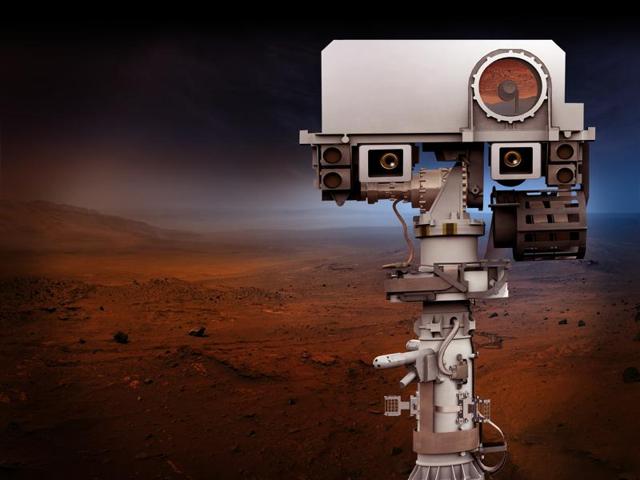
To reduce risk and provide cost savings, the 2020 rover will look much like its six-wheeled, one-tonne predecessor, Curiosity, but with an array of new science instruments and enhancements to explore Mars as never before.
{{/usCountry}}To reduce risk and provide cost savings, the 2020 rover will look much like its six-wheeled, one-tonne predecessor, Curiosity, but with an array of new science instruments and enhancements to explore Mars as never before.
{{/usCountry}}The rover will conduct the first study into the usability and availability of Martian resources, including oxygen, in preparation for human missions.
Mars 2020 will carry an entirely new subsystem to collect and prepare Martian rocks and soil samples that includes a coring drill on its arm and a rack of sample tubes.
About 30 of these sample tubes will be deposited at select locations for return on a potential future sample-retrieval mission.
In laboratories on Earth, specimens from Mars could be analysed for evidence of past life on Mars and possible health hazards for future human missions.
Two science instruments mounted on the rover’s robotic arm will be used to search for signs of past life and determine where to collect samples by analysing the chemical, mineral, physical and organic characteristics of Martian rocks.
On the rover’s mast, two science instruments will provide high-resolution imaging and three types of spectroscopy for characterising rocks and soil from a distance, also helping to determine which rock targets to explore up close.
Sensors on the mast and deck will monitor weather conditions and the dust environment, and a ground-penetrating radar will assess sub-surface geologic structure.
The rover will use the same landing system as Curiosity, but will have the ability to land in more challenging terrain, making more rugged sites eligible as safe landing candidates.
There will be a suite of cameras and a microphone that will capture the never-before-seen or heard imagery and sounds of the entry, descent and landing sequence.
“This will be a great opportunity for the public to hear the sounds of Mars for the first time, and it could also provide useful engineering information,” said Mars 2020 Deputy Project Manager Matt Wallace of Nasa’s Jet Propulsion Laboratory.