
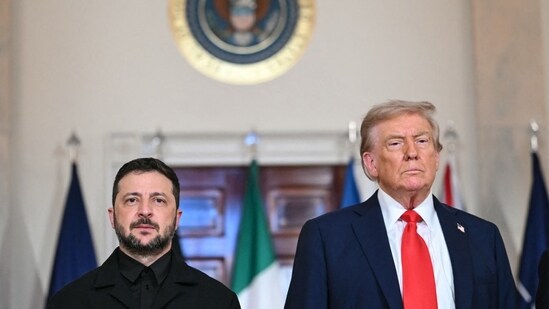
The Alaska summit between Vladimir Putin and Donald Trump on Friday, followed by President Trump’s meeting Monday with Volodymyr Zelensky, stunned the world. Commentators railed against what they saw as Mr. Trump’s pusillanimous concessions to Mr. Putin in Alaska. They were then shocked by the U.S. president’s warm welcome to Mr. Zelensky at the White House, and shocked again by the Euro-American lovefest that followed the bilateral summit.
That shouldn’t surprise us. The relationship between Russia and the U.S., like
The Alaska summit between Vladimir Putin and Donald Trump on Friday, followed by President Trump’s meeting Monday with Volodymyr Zelensky, stunned the world. Commentators railed against what they saw as Mr. Trump’s pusillanimous concessions to Mr. Putin in Alaska. They were then shocked by the U.S. president’s warm welcome to Mr. Zelensky at the White House, and shocked again by the Euro-American lovefest that followed the bilateral summit.
That shouldn’t surprise us. The relationship between Russia and the U.S., like the one between the U.S. and Israel, is important, emotionally charged and widely misunderstood.
Except for the Lend-Lease era during World War II, when American assistance was a matter of life and death for the Soviet Union, the two countries have historically not mattered much to each other as economic partners. A mix of geopolitics, culture and ideology have largely driven relations. Rivalry with Great Britain led Russia to tilt toward the Americans during our Revolution. That rivalry also helped persuade Russia to sell Alaska to the U.S. as a way of keeping Britain from adding the territory to its North American domains. Opposition to Germany’s drive to dominate Europe brought the U.S. and Moscow together during the two world wars. American resistance to the Soviet Union’s efforts to dominate both Europe and Asia drove the two countries into the Cold War.
Currently, the geopolitical dimension of the relationship is debated in both capitals. In Washington, the bipartisan foreign-policy establishment argues that Russia’s threat to the European Union and the North Atlantic Treaty Organization imperils American security. A minority view values Russia’s potential as a counterweight against China more than any Russian threat to Europe. In Moscow, Mr. Putin’s critics whisper that better economic and political relations with the West and especially the U.S. could help Russia deal with the greater long-term threat arising from Beijing.
Culture and ideology also play a role. Except during rare periods of relatively liberal governance in Russia (the reign of Alexander II, the brief interlude between the democratic February Revolution of 1917 and Vladimir Lenin’s Bolshevik Revolution later in the year, and the Gorbachev-Yeltsin era toward the end of the 20th century), autocratic Russian rulers and liberal Americans have usually occupied opposite ideological poles in world affairs. Many Americans remain skeptical both of Russia generally and of Mr. Putin personally. But some American hard-right “postliberals” see him as an ideological ally in their battle against what they regard as the moral, intellectual and political decadence of the West.
Further poisoning and polarizing the American debate over Russia policy are the controversies over Russia’s alleged actions in the 2016 U.S. presidential election and the efforts of Obama administration officials to weaponize these allegations against President Trump.
The geopolitics of U.S.-Russian relations are fiendishly complex. Much Western commentary on the Alaska summit reflected an assumption that the Trump administration was making massive concessions to the Russian side. That probably isn’t how Mr. Putin sees things when he looks at America’s Russia policy in a global context. The Trump administration’s recent intervention in the Armenia-Azerbaijan dispute was a direct shot at the heart of Russian power and at Mr. Putin’s strategy to recover territories controlled by Moscow in the Soviet era.
By convening the leaders of Armenia and Azerbaijan in the White House to ratify an agreement that could end Russia’s ability to block the flow of Central Asian oil and gas to Western markets, the Trump administration embarrassed Mr. Putin and threw a wrench in his plans to restore Russian power in the Caucasus. Further, the agreement potentially weakens Moscow’s position across Central Asia, a region that was once part of the Soviet Union but where China now plays a growing role.
The Kremlin must also analyze recent signals from the White House that Washington is interested in improving U.S.-China relations. Chinese support for Russia’s war effort in Ukraine at least partially reflects Beijing’s search for bargaining chips in trade negotiations with the U.S. Would a Washington-Beijing thaw that provided relief for China’s troubled economy diminish Xi Jinping’s enthusiasm for his Russian allies?
Mr. Trump has again imposed his will on his European allies. European leader after leader effusively praised the his leadership. They clearly understand that they can affect events only by persuading Mr. Trump to take their side.
“Emmanuel,” Mr. Trump said, calling on President Macron by his first name. “Mr. President,” the French leader responded, like a schoolboy speaking to his teacher. That’s how President Trump likes his allies to behave, and although the leaders were still meeting as this column went to press, he appears to have whipped them into shape.
One Subscription.
Get 360° coverage—from daily headlines
to 100 year archives.
Archives
HT App & Website