The ‘Gateway to Hell’, an enormous fire that has been raging in Turkmenistan for more than 50 years, has been tamed.
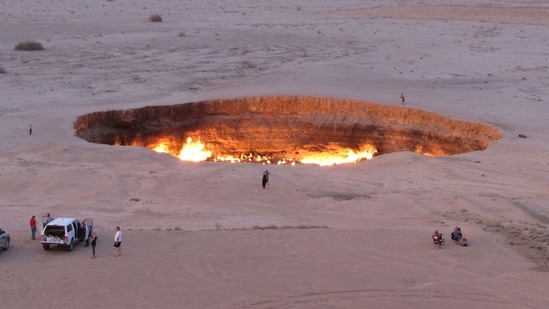
The Turkmenistan government said that the authorities have been able to ‘significantly reduce’ the giant gas field fire at the Darvaza Gas Crater in the Karakum desert, which has been raging for more than half a century since 1971.
According to the officials, the fire has been "reduced threefold." However, they did not specify the time frame within which this feat was achieved.
"Whereas before a huge glow from the blaze was visible from several kilometres away, hence the name 'Gateway to Hell', today only a faint source of combustion remains,” Irina Luryeva, a director at state-owned energy company Turkmengaz, told news agency AFP.
"Numerous wells have been drilled around the fire to capture methane," she said.
Turkmenistan is one of the world's most closed countries. It is also estimated to have the world's fourth-largest gas reserves. Along with so much gas reserve, it is also the world's biggest emitter of methane through gas leaks, according to the International Energy Agency. The claim is denied by the local authorities.
What is the Darvaza Gas Crater, or the ‘Gateway to Hell’?
The Darvaza Gas Crater is a massive gas well that was ignited in 1971, when Turkmenistan was part of the Soviet Union.
{{/usCountry}}The Darvaza Gas Crater is a massive gas well that was ignited in 1971, when Turkmenistan was part of the Soviet Union.
{{/usCountry}}The crater, also known as the ‘Gateway to Hell’, ignited when Soviet scientists tried to experiment with it while looking for a solution to the region's excessive methane problem. A group of scientists travelled into the Karakum desert and dug a gigantic hole to study the methane leaks in the area. But what they didn't realise at the time was that they had accidentally drilled right into an underground gas field.
The group decided to ignite the methane, hoping to solve the leakage problem by burning the gas off. But that simple decision created the longest continuously burning man-made fire in the world's history. The crater became a boon for Turkmenistan's economy by becoming a big tourist attraction, bringing in much-needed cash into the country. But the rightly named 'Gateway to Hell' also became a cause of severe environmental damage.
While the fire was ignited in hopes of solving the methane problem in the area, it became a source of massive quantities of the gas, which is a big contributor to the global problem of climate change.
According to a report by The Guardian, Methane leaks alone from Turkmenistan's two main fossil fuel fields cause more global heating a year than the entire carbon emissions of the UK.