At least a third of the world’s schoolchildren, which works to around 463 million, could not access remote learning since schools have been shut down because of the raging coronavirus disease (Covid-19) outbreak since early this year, according to a new report released by the United Nations Children’s Fund (Unicef) on Thursday.
Also read: Covid-19 spreading fast as billions don’t have water to wash hands, says UN
The report has been released amid several states in India have started taking steps on reopening schools, despite the contagion.
Around 1.5 billion schoolchildren are affected by closures during lockdown across the world, said Unicef’s Remote Learning Reachability report, which underlines the limitations of remote learning and exposes deep inequalities in access and prioritise reopening schools safely.
In India, at least 1.5 million schools are closed because of the pandemic, which is affecting 286 million students from pre-primary to secondary levels, of which 49% are girls.
Another 6 million girls and boys were already out of schools prior to the Covid-19 pandemic, according to Unicef.
“Schools are closed, parents are out of work and families are under a growing strain. An entire generation of children have seen their education and learning interrupted. Access to digital education is limited and by itself cannot solve the learning gap. Blended approaches are needed involving communities, parents, volunteers to reach out to these children and support their learning activities,” said Dr Yasmin Ali Haque, India Representative, Unicef.
{{/usCountry}}“Schools are closed, parents are out of work and families are under a growing strain. An entire generation of children have seen their education and learning interrupted. Access to digital education is limited and by itself cannot solve the learning gap. Blended approaches are needed involving communities, parents, volunteers to reach out to these children and support their learning activities,” said Dr Yasmin Ali Haque, India Representative, Unicef.
{{/usCountry}}Globally, 49% of schoolchildren are in their primary classes.
Reopening of schools is a challenge in India because of the large size of classrooms and poor infrastructure at several institutions. Many of these schools have limited washrooms and cramped canteens, where maintaining social distancing norms is not always possible.
“It’s difficult for children to wear masks and follow hygiene and social distancing norms, whether it is at school, on their way to school, or in the playground. This makes reopening of schools safely a massive challenge. The central and state governments are using the online portal Diksha; TV channels like Doordarshan and Swayam Prabha and the National Repository of Open Education Resources; and other platforms for continuing education at home. Radio is also a great way to reach children in remote areas and should be used for distance learning,” said Dr Rajesh Sagar, a professor of psychiatry at All India Institute of Medical Sciences (AIIMS) in New Delhi.
Around 24% households in India have access to the internet, but connectivity is patchy across states. The situation is likely to be far worse for children at home, according to experts.
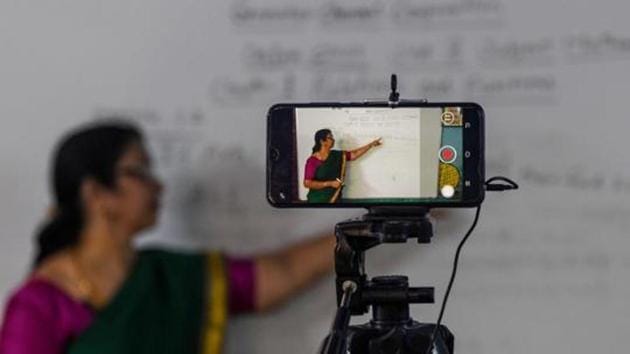
Access to technology and tools at home is a challenge and children may not be able to use them to learn remotely. This is because of several competing factors such as sharing the gadgets with parents and other siblings, additional pressure to do home tasks, and also because of the absence of online curriculum support for quality education content in many Indian languages.
The Unicef report found that a country’s choice of remote learning technology appears to be influenced by their income group.
For example, radio-based instruction is implemented at much higher rates by low-income countries (80%) than lower middle-income (56%) and upper-middle-income (46%) countries.
Internet- and TV-based instruction is much less common among low-income countries (47% and 60%, respectively), while these methods are implemented by a much larger share of lower middle-income countries (79% and 82% cent, respectively) and upper-middle-income countries (95% and 92%, respectively), the report stated.
The report, which compiled data from over 100 countries, used a globally representative analysis on the availability of home-based technology and tools needed for remote learning among pre-primary, primary, lower-secondary and upper-secondary schoolchildren.
The data included access to TV, radio and internet, and the availability of curriculum delivered across these platforms during school closures.
The report found students in sub-Saharan Africa are the most affected, as remote learning proved elusive to at least 50% of them.
“For at least 463 million children whose schools closed due to Covid-19, there was no such a thing as remote learning. The sheer number of children whose education was completely disrupted for months on end is a global education emergency. The repercussions could be felt in economies and societies for decades to come,” said Henrietta Fore, executive director, Unicef, at the launch of the report on Thursday.
.