An upgrade to an ageing telecommunications network in the United States led to the longest flight stoppage in 25 years, disrupting thousands of flights and leaving passengers stranded across the country beginning Friday, officials said. Federal authorities said airlines that had to divert flights were expected to return to normal operations by late Sunday.
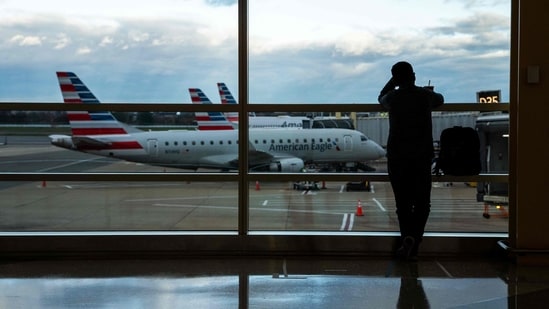
President Donald Trump-led administration blamed the disruption on a botched attempt to replace decades-old copper wire communication lines.
What led to the chaos?
Outdated equipment in the country's air traffic control system was overwhelmed, resulting in “intermittent” communication and radar disruptions, according to officials.
Deep Dive
What caused the nationwide US flight stoppage?
How did a communications problem at one location disrupt flights across the US?
When were US flights expected to return to normal after the FAA ground stop?
Transportation secretary Sean Duffy said the issue began after L3Harris Technologies Inc replaced old copper wire at a remote location. A router later started flooding the air traffic control system with connection requests.
“Specifically, we had over 1,000 connection attempts every 4 to 5 seconds,” Duffy said. “And what that did was gave us issues with our communication with airplanes, and it also caused some disruption with our radar feeds. And when we see that, your safety is paramount, we shut down the airspace.”
Duffy said on Friday that aircraft already in the air when the halt was ordered landed safely by following “well-known procedures” designed for such situations.
{{/usCountry}}Duffy said on Friday that aircraft already in the air when the halt was ordered landed safely by following “well-known procedures” designed for such situations.
{{/usCountry}}The disruption forced airlines to make fresh arrangements for their operations. With take-offs suspended from Friday afternoon, aircraft and crew members were left out of position, making it difficult to restore flight schedules. Hundreds of thousands of passengers were also stranded on airport tarmacs and inside terminals.
Michael McCormick, a former airspace manager with the Federal Aviation Administration (FAA), told Associated Press that the incident involved a technical issue known as a rolling outage. Such failures can affect air traffic control centres at different times and without warning.
Why a problem on the ground affected flights thousands of miles away
The FAA ordered a nationwide halt to flights on Friday after problems emerged at regional air traffic control centres, according to an official notice. The US has 22 such centres, which are managed by the FAA and oversee long-distance flights between airports, McCormick said.
Airport control towers guide pilots during take-offs and landings at more than 500 airports across the country. As aircraft move away from airports, Terminal Radar Approach Control centres take charge before handing them over to regional air traffic control centres. Experts told AP that the same process takes place in reverse when planes approach their destinations.
McCormick said that regional air traffic control centres, which manage aircraft flying at high altitudes, depend on remote radio transmitter and receiver sites to communicate with pilots across the country.
These sites are linked to control centres through telecommunications networks that are being upgraded from copper cables to fibre-optic lines. The connection allows controllers and pilots to communicate in both directions and helps ensure that aircraft maintain safe distances from one another, among other things, he said.
In September, Newark Liberty International Airport temporarily lost radar communication with aircraft after railway construction workers accidentally damaged a backup fibre-optic cable. The incident forced the FAA to cancel hundreds of flights arriving at and departing from the airport.
However, aviation experts quoted in the AP report said that Friday's disruption was different. FAA Administrator Bryan Bedford told reporters on Saturday that intermittent problems with frequency stability had affected up to 17 of the 22 regional air traffic control centres in the US.
R John Hansman, an aeronautics professor at MIT whose research covers information technology in aviation, told AP: “The thing that was unique about this is that it was a type of failure that wasn’t local because it was part of the communication system. It propagated around the country.”
The US has ordered a nationwide halt to flights only once before. Following the September 11, 2001, attacks, all flights were barred from taking off for several days.
With inputs from AP, other agencies