The United States on Monday said it is open to “exploring” ways to formalise the Quad, as the group of Indo-Pacific powers it forms with India, Japan and Australia is called.
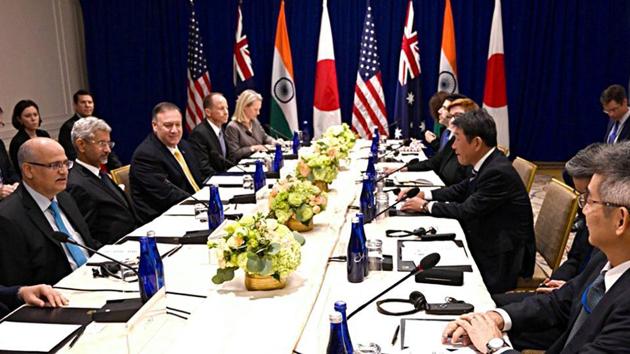
Starting in 2017, the Quad has met once or twice a year at the level of officials and ministers — New Delhi is expected to host the next ministerial in the fall — but the group has lacked the kind of institutionalised organisation that supports something like the North Atlantic Treaty Organization (NATO) of the EU.
“It is a reality that the Indo-Pacific region is actually lacking in strong multilateral structures,” Stephen Biegun, the US deputy secretary of state (he is the American counterpart of foreign secretary Harsh Shringla), said on the opening day of the annual summit of the US-India Strategic Partnership Forum (USISPF), a trade body of companies of the two countries.
“They don’t have anything of the fortitude of NATO, or the European Union,” he added, referring to the most popular models being talked about for the formalised structure. “There is certainly an invitation there at some point to formalise a structure like this.”
The top diplomat indicated a certain inevitability about the formalised structure that had not been known previously. It’s something that, he said, could happen in the “the second term of the Trump administration or, (if he doesn’t win) the first term of the next president”.
{{/usCountry}}The top diplomat indicated a certain inevitability about the formalised structure that had not been known previously. It’s something that, he said, could happen in the “the second term of the Trump administration or, (if he doesn’t win) the first term of the next president”.
{{/usCountry}}A formalised, institutionalised structure, Biegun said, would meet the need for a “sustained regular communication between countries with those shared interests and values”.
Biegun, who is not a career diplomat but a political appointee, displayed rare candour in identifying China as a unifying threat to the Quad but argued for a higher purpose: “I think responding to the threat of China in and of itself, or any potential challenge from China in and of itself, would be enough of a driver, though it also has to have a positive agenda”
The Quad has been decades in the making. But it began meeting in its intended format and spirit with some kind of predictable regularity in 2017. Its meetings started small at first, at the level of officials. But quickly graduated to the ministerial level, with the first such meeting held on sidelines of the UN general assembly meetings in September 2018.
While a summit-level meeting of the Quad hasn’t taken place yet, talk of a formalised structure has been gaining ground, starting with a core membership of the four, which could expand to include more — such as the Quad+3, addition of New Zealand, South Korea and Vietnam, which emerged as a US-led group that held weekly consultations on Covid-19.
“Remember even NATO started with relatively modest expectations and a number of countries chose neutrality over NATO membership in post-World War 2 Europe,” Biegun said, adding that the original NATO “only had 12 members, relative to its 27th today so you could start a little bit smaller and grow into your membership.”
So long as the purpose is right and as long as “we keep the ambitions checked — to start with a very strong set of members,” he said, “I think it is worth exploring”.
Although, he cautioned, “it only will happen if the other countries are as committed as the United States”.