Imagine a vine with berries in shades of lilac, green, and bright blue. It looks like something straight out of a storybook. That's roughly why it was planted. According to a 2009 U.S. Forest Service review by Melissa Waggy, porcelain berry was brought into the northeastern U.S. in 1870 as a bedding and landscape plant. Then it escaped from cultivation and began to grow wild. Today, the same vine is a serious problem along many woodland edges in parts of the eastern U.S.
A garden favorite from Asia
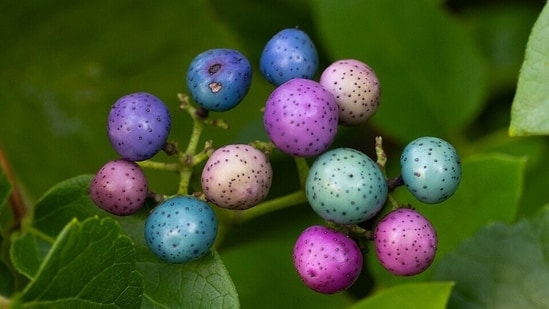
The porcelain berry is native to Asia. It is found in parts of China, Korea, Japan, and the Russian Far East. It’s a woody climber that climbs by tendrils. Back in the 1800s, it was planted for its looks. It can cover walls, fences, and arbors and carries a colorful fruit. Those same pretty qualities can end up causing problems outside the garden. It looks very much like wild grapes and can be easily mistaken for a harmless native plant.
How it spreads
Birds are a big reason this vine travels. They eat the fruit and drop the seeds far away from the parent plant. This in turn helps the vine to escape the yards and move into new spaces. The Forest Service review notes that the fruit begins to develop in late summer and matures in the fall. Porcelain berry thrives in full sun to partial shade. That's why they are often found at the edge of the forest, along the banks of streams, pond shores, and roadsides. It seems less tolerant of the deep shade of the interior of mature forests.
Why native plants struggle
Once the porcelain berry gets a foothold, it climbs over anything around it. It rises from shrubs and young trees and spreads its leaves on top of them. This blocks the sunlight needed by the plants below. If a plant doesn't get enough light, it will grow poorly, or even die. Over time, a thick blanket of this single vine can choke out a variety of native plants. That loss also means less food and shelter that wildlife gets from native species.
What research shows
{{/usCountry}}Once the porcelain berry gets a foothold, it climbs over anything around it. It rises from shrubs and young trees and spreads its leaves on top of them. This blocks the sunlight needed by the plants below. If a plant doesn't get enough light, it will grow poorly, or even die. Over time, a thick blanket of this single vine can choke out a variety of native plants. That loss also means less food and shelter that wildlife gets from native species.
What research shows
{{/usCountry}}Scientists looked at how this vine competes with other plants. In a 2013 study published in Invasive Plant Science and Management, Sherrie Emerine, Robert Richardson, and Consuelo Arellano grew cuttings of three vines separately and in combinations in a greenhouse. Porcelain berry grew similarly in speed to native Virginia creeper and produced more flower clusters than any other plant among these three. The authors called it a troublesome weed that may add intense pressure from propagules, meaning seeds and other plant parts that can start new plants. Bushkiller, another invasive vine, was a tough competitor, the study found. The study was done in a greenhouse, so it doesn’t show exactly what happens in a forest, but it helps explain why porcelain berry deserves the attention.
What you can do
You can help even if you aren't into gardening. If you garden, avoid porcelain berry and go for native vines like trumpet honeysuckle or Virginia creeper. If you find young vines, pull them out by hand, pulling out the entire root. Bag any fruit to stop the spread. Many U.S. states also list this plant as invasive, so check your local guidance as well. A plant brought in for the gardens in 1870 still haunts the edges of the forests today.