Declassified US government records have revealed that American officials investigated a bizarre 1963 report claiming a metal sphere had crashed in a Brazilian town with a dead, unidentified occupant inside.
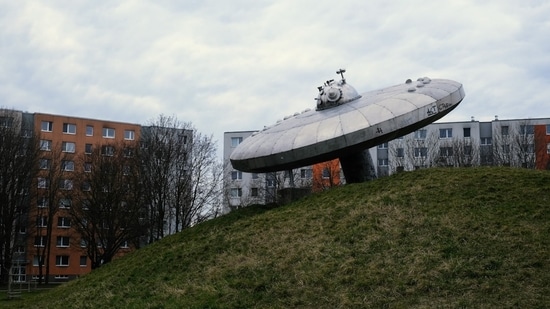
The alleged incident took place in Conde, a municipality in Brazil’s Bahia state, on November 8, 1963. A Portuguese-language broadcast by Rio de Janeiro’s Radio Tupi reported that a large metal sphere had fallen in the middle of the town, leaving a deep hole.
According to a US government transcript of the broadcast, the object allegedly contained a human body wearing heavy clothing marked with inscriptions that could not be deciphered.
The extraordinary report quickly drew the attention of US officials. American diplomats in Brazil sought information about the incident, while the details were circulated among the State Department, the Defense Department and NASA.
But the investigation soon produced a far less mysterious explanation, and ultimately found no evidence that the reported crash had occurred.
US diplomats investigate mysterious sphere
{{/usCountry}}But the investigation soon produced a far less mysterious explanation, and ultimately found no evidence that the reported crash had occurred.
US diplomats investigate mysterious sphere
{{/usCountry}}On November 14, 1963, six days after the original radio report, the US Embassy in Rio de Janeiro sent a telegram to the State Department and the American Consulate in Salvador seeking clarification.
The embassy described the reported object as a “large metal manned balloon” and the alleged occupant as a “dead crewman” wearing what was described as a uniform or spacesuit with strange markings.
Officials had also heard reports that an object had been seen flying over the area around the same time and had tentatively been identified as a weather balloon, according to the Daily Mail report.
However, the embassy stated that no such craft had been recovered from the ground.
The inquiry was subsequently passed to the Defense Department and NASA. American officials were seeking to establish whether local authorities had actually confirmed the incident or whether reports circulating in Brazilian newspapers were unfounded.
Investigation finds no witnesses or wreckage
A final diplomatic cable dated November 20 provided a starkly different picture.
Harold Midkiff, the American consul in Salvador, reported that the story had apparently been fabricated in Rio de Janeiro. According to the cable, as cited by Daily Mail, newspaper reporters and other investigators had travelled to Conde but could not find anyone who had witnessed an unusual object falling from the sky.
The local secretary of public security had suggested that the object might have been a weather balloon, but that possibility could not be independently verified either.
Midkiff also forwarded two newspaper reports from Bahia supporting the conclusion that there had been no confirmed crash.
One report said Brazil’s Ministry of Aeronautics had categorically denied that a strange object had appeared in Conde. Another carried the dismissive headline, “The Airship that wasn’t there.”
The diplomatic record said the only unusual development that could be confirmed was that a reporter had managed to send a dispatch from Conde using an old Morse code machine at a federal telegraph office.
What the newly released UFO files actually show
The records are part of a new tranche of declassified UFO material released by the US government. Their inclusion in the archive provides a glimpse into how American officials handled extraordinary reports during the Cold War.
But the documents do not establish that a spacecraft crashed in Brazil, nor do they confirm that a non-human or unidentified crew member was recovered.
Instead, they show that US officials took the report seriously enough to seek verification through diplomatic channels. Their investigation ultimately found no witnesses, wreckage or other physical evidence supporting the sensational account.
The files also leave unanswered a basic question: who originally created the story and how it reached Radio Tupi remains unclear.
According to the Daily Mail report, an apparent date error in one of the records lists the incident as occurring in November 1964, although the surrounding documents and the diplomatic correspondence place the reported event in November 1963.