"Our Earth is only one polka dot among a million stars in the cosmos. Polka dots are a way to infinity. When we obliterate nature and our bodies with polka dots, we become part of the unity of our environment.” — Yayoi Kusama
What does the quote mean?
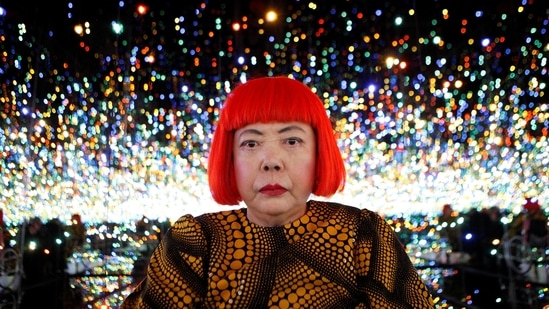
A single dot can mean something much larger than itself. And for Japanese contemporary artist Yayoi Kusama, the humble polka dot became a symbol of infinity, connection and humanity’s place in the universe.
She famously said that Earth is “only one polka dot among a million stars,” and in doing so, she captured the philosophy behind decades of her artistic practice. Kusama metamorphosed repeated patterns and organic forms into meditations on the relationship between humans, nature and the cosmos.
The Polka dots' repeating nature creates a visual sense of no beginning and no end. Kusama, as a child, experienced hallucinations where flowers and surroundings seemed to repeat infinitely. She described that these hallucinations made her feel like As a child, Kusama experienced hallucinations where flowers and surroundings seemed to repeat infinitely, making her feel like she was disappearing into the environment. She called this “self-obliteration.”
Hence, through her art, the Infinity Room, Kusama symbolizes that when you cover your body, canvas or spaces with dots, the boundaries that define you will begin to dissolve. The sense of being separate fades, and finally, you feel a deeper connection with the vastness of the cosmos and the universe around you.
{{/usCountry}}Hence, through her art, the Infinity Room, Kusama symbolizes that when you cover your body, canvas or spaces with dots, the boundaries that define you will begin to dissolve. The sense of being separate fades, and finally, you feel a deeper connection with the vastness of the cosmos and the universe around you.
{{/usCountry}}Yayoi Kusama’s Infinity Mirror Rooms are immersive art installations that use mirrored walls and LED lights to build optical illusions of endless space.
The Japanese legendary artist passed away on August 14, 2026, at 97.
From a plant nursery to the infinite universe
Kusama's relationship with nature began as a child. She grew up in her family's plant nursery in Matsumoto, Japan, where she spent her growing years observing flowers, plants, and their changing life cycles.
Those early experiences shaped the way she understood the natural world. To Kusama, plants were not isolated objects. They were connected to larger cosmic forces and reflected the continuous movement between life on Earth and the universe beyond.
Kusama has time and again described her polka dots as cosmic symbols. In her art, she has blurred the boundaries between the microscopic and the infinite. A tiny dot could become a planet. A pumpkin could become a reflection of the human soul.
The artist’s unusual yellow and black pumpkins, covered with repeated dots, have become some of the most celebrated images in contemporary art. In her work “Pumpkins” (1998–2000), Kusama presents the vegetable form with an almost living presence. She interpreted that pumpkins have a gentle spirit and connected them with her own identity and emotions.