Indian American Congressman Ro Khanna is back in the headlines as he seeks re-election to represent California’s 17th Congressional District in the US House of Representatives. A member of the Democratic Party, he will be competing against another Indian American, Ritesh Tandon. Khanna secured 62.3% of the vote in the primary elections and advanced to the general election. He is one of the most notable political figures who pushed for the release of the Jeffrey Epstein files.
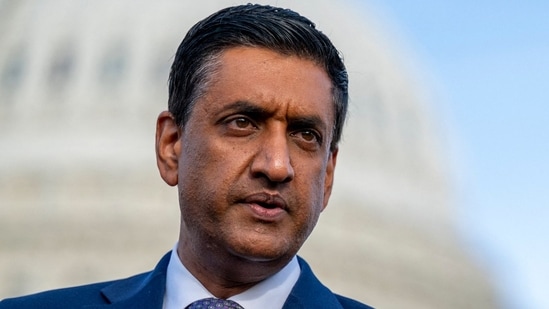
Khanna was elected to the US House of Representatives in 2016 and took office in January 2017. He has represented California’s 17th Congressional District, which includes parts of Silicon Valley as well. He also co-authored a bill that shaped the CHIPS and Science Act of 2022. Before entering Congress, he served as deputy assistant secretary of commerce under former President Barack Obama.
Early life, education and family
Khanna was born on September 13, 1976, in Philadelphia, Pennsylvania, to Indian immigrant parents. His father is a chemical engineer, while his mother worked as a substitute teacher. His grandfather, Amarnath Vidyalanker, was involved in India’s freedom struggle, worked with Lala Lajpat Rai and spent four years in jail for opposing British rule in India. Khanna has often spoken about how his grandfather’s experiences influenced his own interest in public services.
Khanna grew up in Bucks County, Pennsylvania, and attended Council Rock High School. He earned a degree in economics from the University of Chicago. He later earned a law degree from Yale Law School in 2001. Before entering politics, he worked as a lawyer, specialized in intellectual property law and taught economics at Stanford University. He is married to Ritu Khanna and lives in Fremont, California along with her and their two children.
{{/usCountry}}Khanna grew up in Bucks County, Pennsylvania, and attended Council Rock High School. He earned a degree in economics from the University of Chicago. He later earned a law degree from Yale Law School in 2001. Before entering politics, he worked as a lawyer, specialized in intellectual property law and taught economics at Stanford University. He is married to Ritu Khanna and lives in Fremont, California along with her and their two children.
{{/usCountry}}Also Read | How the Supreme Court Is Shaping the Midterm Elections
Campaign issues and political record
His campaign fiercely focuses on reducing living costs, expanding healthcare access and making education more affordable. He supports Medicare for All, a proposal to provide health coverage to all Americans. He has also backed affordable housing, childcare assistance and measures to reduce prescription drug costs. He believes that working families need more financial security and an increased access to basic services. Khanna has also called for stronger protection of workers and supports the labor unions. He is a staunch supporter of the Protecting the Right to Organize (PRO) Act, which aims to make it easier for workers to form unions and negotiate with employers.
During his time in Congress, Khanna worked on environmental issues and public health. As chair of the House Oversight Subcommittee on the Environment, he led hearings on the fossil fuel industry’s role in climate change. He questioned the CEOs of six major fossil fuel companies about allegations of climate disinformation. He has also supported clean energy investments and stronger environmental protections. Additionally, he called for a ban on congressional stock trading and urged to limit the donations from political action committees. In addition to that, he advocated to expand the student loan forgiveness program, arguing that education costs should not place a financial burden on students.
Immigration, jobs, trade and tariffs
As the son of Indian immigrants himself, Ro Khanna has supported immigration reform and believes that eligible immigrants should have a legal pathway to citizenship. He has called for reforms to the asylum system, while demanding greater accountability from federal authorities. On the H-1B visa program, Khanna has called for safeguards to prevent companies from underpaying foreign workers or using the program to replace American employees. He has criticized the Trump administration for deporting immigrant families and children and has urged to abolish the Immigration and Customs Enforcement (ICE).
Apart from immigration, Khanna has given jobs and economy a center stage in his campaign. He supports raising the federal minimum wage to at least $17 an hour, expanding paid family leave and making childcare more affordable. He has proposed to invest in vocational training, apprenticeship programs and trade schools. This way, he aims to help workers gain more skills and create more high paying jobs. He has further raised his voice to strengthen labor protection laws in order to ensure that workers receive fair wages.
Furthermore, Khanna supports strengthening American manufacturing and reducing reliance on China. He has called for action against unfair trade practices by China, while supporting the use of targeted tariffs in order to protect key US industries from unfair competition. However, he has also opposed the use of tariffs on everyday products, arguing that they can increase costs for American families.
Iran war and artificial intelligence
Khanna has opposed the US-Iran war, arguing that military action should not continue without congressional approval. In 2025, he joined Republican Congressman Thomas Massie and introduced a bipartisan War Powers Resolution, in order to prevent unauthorized US military action against Iran. He continues to argue that the president’s authority to wage a war without approval should be limited. He believes that this conflict has increased costs for American families and placed a financial burden on them.
Apart from the Iran conflict, Khanna has called for stronger regulation of artificial intelligence in order to protect workers and the economy. He has argued that companies developing AI should be held accountable for its effects on jobs and the benefits of technology should also reach ordinary Americans. He even called for more transparency around AI-generated content.
Also Read | Trump offers $1 million reward for information leading to voter fraud conviction ahead of US midterms
Controversies and disputes
In 2016, Ro Khanna's campaign faced a legal dispute when Democratic Congressman Mike Honda filed a lawsuit accusing Khanna’s campaign manager, Brian Parvizshahi, of accessing confidential information from Honda’s campaign without permission. The information included personal details of more than 10,000 donors. Honda alleged that this was a violation of federal laws. Parvizshahi later resigned from Khanna’s campaign, while Khanna clarified that he had no personal knowledge about the incident.
Khanna also faced criticism for stock trading in his household, mainly because he supported a ban on Congress members trading individual stocks. His financial disclosures showed that his household made nearly $53 million in stock purchases and sales in 2021. The transactions were made through his wife’s investment portfolio. His office said that Khanna didn’t trade stocks personally and that his investments were managed by an outside adviser. Khanna continued to support a ban on stock trading by Congress members.
Net worth and more
According to a report by San Jose Inside, Ro Khanna was the fourth richest Californian in Congress as of 2018. According to his latest financial disclosure, his household’s assets ranged from $69.2 million to more than $166.7 million. As Ro Khanna seeks another term in Congress, his record on healthcare, jobs, artificial intelligence and foreign policy will remain central to his campaign, where he will be facing fellow Indian American Ritesh Tandon.
– By Tanisha Sharma