Rob Sand has led an inquisitive life, focusing on the inner workings of his own government rather than leading it. Following his tenure as Iowa’s state auditor since 2019, the Democrat is now running for governor, having built a reputation for uncovering waste, fraud, and government overspending.Sand, 44, was born and raised in Decorah, Iowa, where his family has lived for generations. His father, Kevin Sand, is a retired doctor, while his mother, Leslie Sand, was a physical therapist. Sand has often attributed his values concerning community, public life, and political compromise to his upbringing in a small town.
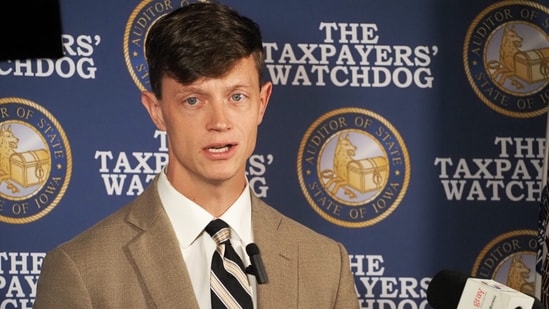
As a high school student, he spent two years campaigning for local authorities to build a skate park. He views this as his initiation into public life. He studied political science at Brown University and later attended the University of Iowa for law school.
Before becoming state auditor, Sand worked as an assistant Iowa attorney general, where he prosecuted public corruption cases. During his tenure as auditor, he investigated government programmes and spending and gained notoriety as a critic of Iowa’s privatised Medicaid system.
Deep Dive
What would Rob Sand do about Iowa’s privatized Medicaid system if elected governor?
Who is running against Rob Sand in the 2026 Iowa governor’s race, and how do their Medicaid plans differ?
What is Rob Sand’s position on data centres in Iowa?
Also read: Joe Lombardo, Nevada governor running for re-election in 2026 midterm elections
Sand is married to Christine Lauridsen, CEO of her family’s privately held Lauridsen Group, and the couple has two sons. There is no publicly available estimate of Sand’s personal net worth. His family’s wealth, however, has become a campaign issue, with Iowa campaign-finance records reporting that Christine Sand and members of her family have contributed approximately $11.52 million to his campaign committee since 2024.
As a candidate, Sand has focused on reducing costs, public education, healthcare, and government accountability. He has proposed reversing Iowa’s Medicaid privatisation through executive action and has criticised the state’s private Medicaid managers following investigations by his office into improper denials of care.
{{/usCountry}}As a candidate, Sand has focused on reducing costs, public education, healthcare, and government accountability. He has proposed reversing Iowa’s Medicaid privatisation through executive action and has criticised the state’s private Medicaid managers following investigations by his office into improper denials of care.
{{/usCountry}}He has also included AI and data centres in his economic agenda. Sand says large data centres should be responsible for their full costs and should not pass higher electricity or infrastructure costs on to Iowa households.
Also read: US midterm elections: How the outcome could impact Wall Street, AI stocks and Treasury yields
On tariffs, Sand has criticised Trump administration trade policies, arguing that they have raised costs for Iowa families and farmers. The state’s agricultural economy makes trade with international markets particularly significant to his campaign message.
The Iran war has also become part of Iowa’s economic debate, particularly through its impact on fuel prices. Sand has highlighted the impact of higher energy costs on farmers, truckers, and families rather than making foreign policy the central focus of his campaign. Recent reporting has identified the conflict and its economic effects as significant issues in Iowa’s 2026 race.
Sand’s political identity is somewhat unusual for a statewide Democrat in Iowa. He has campaigned heavily on non-partisanship and has proposed opening the state’s primary system to all voters and replacing the current system with a top-four primary and approval voting.