Pompeo provokes China with a pinprick, revokes terror tag for Xinjiang group
Mike Pompeo’s decision is seen in the context of the Donald Trump administration’s sharp criticism of China’s human rights abuses in Xinjiang, formally called the Xinjiang Uyghur Autonomous Region.
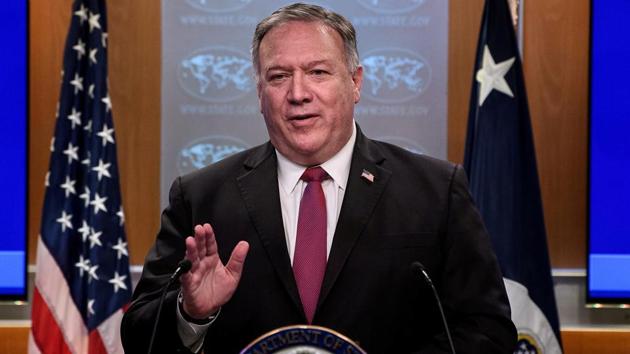
The United States has revoked the terror tag for the East Turkestan Islamic Movement (ETIM), an Islamic extremist organization that has been blamed by Beijing for attacks in its western region of Xinjiang. US secretary of state Mike Pompeo signed off on the order removing ETIM from the list of terrorist groups on October 20. The order was, however, made public on Thursday.
FILE PHOTO: U.S. Secretary of State Mike Pompeo speaks at a news conference at the State Department in Washington, DC, U.S. October 21, 2020. Nicholas Kamm/Pool via REUTERS/File Photo (REUTERS)
{{^htLoading}} {{/htLoading}}
The ETIM is a small Islamic separatist group believed to be active in Xinjiang province, home to China’s ethnic minority Uighur Muslims. It was founded by Hasan Mahsum, a Uyghur from Xinjiang’s Kashgar region, who was shot dead by Pakistani soldiers in 2003.
The group, which was once alleged to have links with al Qaeda and the Taliban, however, continues to be designated under the United Nations Security Council resolution 1822.
Pompeo’s decision is seen in the context of the Donald Trump administration’s sharp criticism of China’s human rights abuses in Xinjiang, formally called the Xinjiang Uyghur Autonomous Region.
Rights groups say China uses the ETIM threat as an excuse to impose restrictions on Uyghurs and discredit human rights activists outside China.
{{^htLoading}} {{/htLoading}}
People line up at what China calls a vocational skills education training service center at the Kunshan Industrial Park in Artux in western China’s Xinjiang region.
{{^usCountry}}
Beijing frequently blames the shadowy group for inciting violence in the country’s far west, saying the group wants to create an independent state of East Turkestan in Xinjiang.
{{/usCountry}}
{{#usCountry}}
Beijing frequently blames the shadowy group for inciting violence in the country’s far west, saying the group wants to create an independent state of East Turkestan in Xinjiang.
{{/usCountry}}
As news of Pompeo’s order move emerged on Thursday, China’s foreign ministry insisted that the ETIM had long been engaged in terrorist and violent activities and posed serious threats to the security and stability in China, the region and beyond. “China deplores and firmly opposes the US decision… Fighting the ETIM is a consensus of the international community and an important part of the international endeavour against terrorism,” foreign ministry spokesperson Wang Wenbin said.
{{^htLoading}} {{/htLoading}}
Dolkun Isa, president of World Uyghur Congress, the world International umbrella organization promoting Uyghur human rights, said China justified its mass detention of 1 to 3 million Uyghurs in concentration camps as a counter-terror measure. “Today’s revocation removes any Chinese justification that it is fighting terrorism in East Turkestan,” he told Radio Free Asia.
Shishir Gupta is Executive Editor at Hindustan Times and one of India's top journalists covering national security, strategic affairs, foreign policy and geopolitics. Over the past three decades, he has extensively reported on India's military, diplomatic and security landscape, covering every major conflict and national security challenge, from the 1999 Kargil War and the 2020 East Ladakh standoff to Operation Sindoor in 2025. He has also covered major terror attacks, including the IC-814 hijacking, the 26/11 Mumbai attacks and the 2025 Pahalgam terror strike, along with numerous Pakistan-backed terrorist incidents in the Kashmir Valley and across India. He has reported on national and state elections for more than three decades. A recognised authority on strategic affairs, Gupta has covered India's nuclear programme since the Pokhran-II (Shakti series) tests in May 1998 and has written extensively on global nuclear issues, Indian diplomacy and the country's expanding global outreach. He has also reported widely on international conflicts and terrorism, with a special focus on the Indian subcontinent. Gupta has interviewed Prime Minister Narendra Modi more than four times, including Modi's first interview with the print media after becoming Prime Minister in May 2014. His other interviews include three with the Dalai Lama, as well as conversations with Benjamin Netanyahu, Amit Shah, Yogi Adityanath, S. Jaishankar, Nirmala Sitharaman and Piyush Goyal. He is the author of Indian Mujahideen: The Enemy Within (Hachette, 2011) and Himalayan Face-off: Chinese Assertion and Indian Riposte (Hachette, 2014). He was awarded the Chevening-Wolfson Joint Scholarship at Wolfson College, University of Cambridge, UK, in 1998 and participated in the International Visitor Leadership Program (IVLP) of the US State Department in 2006. He received the Ben Gurion Prize from Israel in 2011 and the K. Subrahmanyam Prize for Strategic Studies in 2015 from the Manohar Parrikar Institute for Defence Studies and Analyses (MP-IDSA). Since 2024, he has hosted Point Blank, Hindustan Times' weekly YouTube show on global geopolitics.
Get the latest World News, breaking headlines and global updates from the US, UK, Pakistan, Bangladesh, Russia and other countries. Follow major international events on Hindustan Times.
Get the latest World News, breaking headlines and global updates from the US, UK, Pakistan, Bangladesh, Russia and other countries. Follow major international events on Hindustan Times.