
Chinese authorities have banned the use of “unauthorised” halal logos in restaurants in Urumqi, the capital of the restive Xinjiang region in the country’s far west, a move that experts say is aimed at reducing religious symbolism in everyday life.
The halal sign can only be used in restaurants that meet standards set by the China Islamic Association (CIA) for Islamic cuisine, state media reported on Tuesday.
Suggested For You
The association is the Communist Party-approved national organisation for Muslims in China. Halal food must be genuine and meet standards required by the Quran and Islamic law, the association had earlier said.
“To make sure the halal food is genuine is to protect Muslim consumers from spiritual harm. Fake halal food might not hurt their lives but will make them suffer mental trauma,” state media quoted the association as saying.
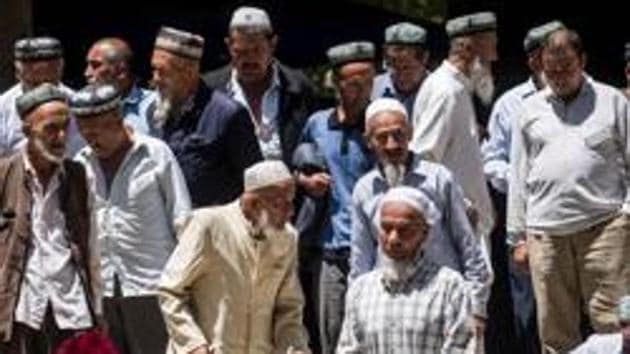
The Xinjiang Uyghur Autonomous Region, home to millions of Muslim Uyghurs, has witnessed unrest blamed by Beijing on radical extremists. Rights groups, however, say the violence is triggered by the Chinese government’s repressive policies.
Some of these policies include restrictions on wearing veils, sporting long beards and fasting during the holy month of Ramzan.
{{/usCountry}}Some of these policies include restrictions on wearing veils, sporting long beards and fasting during the holy month of Ramzan.
{{/usCountry}}The latest move to weed out unauthorised halal logos is directed at preventing the proliferation of fake Islamic cuisine.
“Only restaurants with a proper halal certificate that complies with the halal standards of the association are allowed to hang signs with halal,” an Urumqi-based official told the Global Times tabloid.
Those who do not remove the logos have been asked to cover them up, officials said.
“The order can be interpreted as a bid to downplay the religious effect in people's daily life,” Xi Wuyi, an expert on Marxism at the Chinese Academy of Social Sciences, said in a comment on Chinese social media.
“Respecting dining habits of ethnic minority groups does not mean promoting the related religious factors in social life,” Xi was quoted by a newspaper as having written on social media.
Earlier this year, the Xinjiang government passed a law banning veils and “abnormal” beards in what was officially said to be an effort to curb displays of extremism.
In 2015, a Uyghur man and his wife were sent to jail for six years and two years in jail respectively for growing a beard and wearing a veil and burqa.
Explore More
ABOUT THE AUTHOR
Follow the latest breaking news, major developments and agenda-setting stories from India and around the world with the newsdesk at Hindustan Times. Operating round the clock, the desk brings together experienced editors, reporters and correspondents to deliver fast, accurate and contextual reporting across subjects that influence public policy, governance, business, society and international affairs. The HT News Desk covers politics, elections, government policies, the economy, business and markets, science and technology, the environment, law and order, infrastructure, education, climate issues and geopolitics, while closely tracking developments across states, institutions and global capitals. The team also leads coverage of major breaking news events, policy announcements, court proceedings, natural disasters, public emergencies and significant international developments. Reports published by the newsdesk are based on information gathered from reporters on the ground, official statements, government agencies, court records, regulatory filings, recognised institutions and other authoritative sources. Stories undergo editorial scrutiny and verification processes to ensure accuracy, fairness and relevance, and are updated as events evolve and additional information becomes available. Whether covering a key political decision in New Delhi, an economic policy shift affecting millions, a landmark court ruling or a major global event, the HT News Desk aims to provide readers with reliable, fact-based journalism that delivers not only the latest developments but also the context and analysis needed to understand their wider implications.