Adoption of Covid-19 appropriate behaviour is the best way to stop transmission of the virus and its variants, Dr Poonam Khetrapal Singh, Regional Director, WHO South-East Asia Region, said here as she underlined that efforts to test, trace, isolate, and treat need to be scaled up.
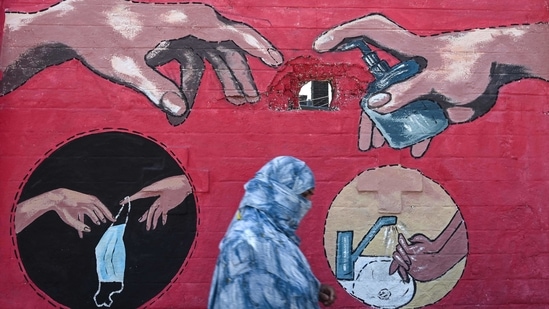
In an interview to PTI on the recent surge in coronavirus cases, Singh also spoke about the importance of communities practising cough etiquette, hand hygiene and social distancing in the fight against the disease.
India has been registering a record number of cases of coronavirus since April beginning. With a record 1,45,384 fresh cases, India's Covid-19 tally climbed to 1,32,05,926 on Saturday.
The number of active cases of the disease has breached the 10-lakh mark again after around six-and-a-half months.
Speaking to PTI, Singh said stringent implementation of public health and social measures remain the key to stop virus transmission.
Physical distancing measures and movement restrictions can slow Covid 19 transmission by limiting contact between people, she said in response to a question.
"However, a careful risk assessment and staged approach is needed to balance the benefits and potential harms of adjusting these measures. Decisions to tighten or loosen or re-institute these measures should be based on scientific evidence and real-world experience and should take into account other critical factors, such as economic factors, food security, adherence to measures etc," she added.
{{/usCountry}}"However, a careful risk assessment and staged approach is needed to balance the benefits and potential harms of adjusting these measures. Decisions to tighten or loosen or re-institute these measures should be based on scientific evidence and real-world experience and should take into account other critical factors, such as economic factors, food security, adherence to measures etc," she added.
{{/usCountry}}Asked about lockdowns, Singh said local epidemiology and risk assessment, including capacities of health systems, should guide decisions imposing such curbs.
"Regardless of lockdowns, public health and social measures remain the key to stop virus transmission. Efforts to test, trace, isolate, and treat must be scaled up along with communities practising cough etiquette, hand hygiene and social distancing," the World Health Organization (WHO) regional director added.
On variants of the virus, she said information on their occurrence is currently not systematic and universal.
"But what we know for sure is that to limit the emergence of variants of concerns, we need to do all we can to curtail virus transmission," Singh added.
She said WHO was tracking variants of interest through its Virus Evolution Working Group.
"WHO has also developed a Risk Monitoring Framework to identify, monitor and assess SARS-CoV-2 mutations, variants of interest and variants of concern. It will involve surveillance, through epi studies, molecular testing and genomic sequencing; research on variants of concern and evaluation of the impact on diagnostics, therapeutics and vaccines," Singh added.
"Virus variants need a quick and coordinated global response. WHO is leading discussions to shape an agile, global decision framework that can be activated to adapt vaccines, diagnostic tests, treatments, prevention measures and other tools if the need arises," she further said.
Replying to a query on re-infection, Singh said most people develop an immune response within one-three weeks following the infection, but "we are still learning how strong the immunity is or how long it may last".
There are studies showing that antibody response in people may last many months (possibly six or longer), but there are some differences in the strength of the response depending on the severity of the disease the person experienced (no disease, mild disease to severe disease), she said.
"There are some reports of reinfection, though this is not systematically monitored. From previous experience with other coronaviruses, we expect there to be an antibody response that declines over time. We need more research to answer this fully, especially longitudinal studies that follow the same individual over time and measure the neutralizing antibody response," Singh added.
"We urge everyone – whether they have had Covid-19 or not – to take precautions including physical distancing, hand and respiratory hygiene, wearing a mask and ensuring adequate ventilation to prevent getting or spreading Covid-19," she said.
Asked how the second wave of the virus can be expected to proceed, Singh said from the epidemiology perspective, no one can predict where it is going.
"However, from our past experience from several countries in the last one year, we have evidence that implementation of public health measures and adoption of Covid-19 appropriate behaviours are proven strategies to curtail virus transmission," she said.