British Airways flight BA295 from London Heathrow to Chicago declared an emergency over Ireland, squawked 7,700 and made a rapid descent from around 37,000 feet to 9,000 feet before turning back towards London. The Boeing 777 was then seen flying in circles as it reduced its fuel load before returning to Heathrow. It has now landed in London.
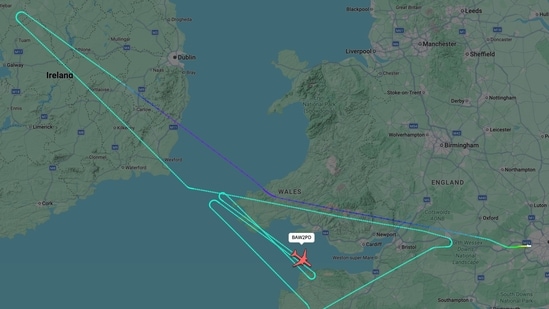
According to flight-tracking service Flightradar24, BA295 was continuing to reduce its fuel weight as it prepared to return to London Heathrow. The aircraft was seen flying in circles, likely to burn off fuel before landing.
Long-haul aircraft can carry a large amount of fuel for transatlantic journeys, and reducing the fuel load can help bring the aircraft closer to an appropriate landing weight during an early return.
ALSO READ | British Airways London-Chicago flight descends to 9,000 ft over Ireland, declares emergency
The aircraft dropped nearly 28,000 feet from its cruising altitude -- a distance equivalent to almost 10 times the height of Dubai's Burj Khalifa, the world's tallest building at 828 metres (about 2,717 feet).
What happened to BA295?
{{/usCountry}}The aircraft dropped nearly 28,000 feet from its cruising altitude -- a distance equivalent to almost 10 times the height of Dubai's Burj Khalifa, the world's tallest building at 828 metres (about 2,717 feet).
What happened to BA295?
{{/usCountry}}The aircraft was crossing over Ireland when it issued the 7700 emergency squawk and rapidly descended from its cruising altitude. It later stabilised at around 9,000 feet and reversed course towards London.
Deep Dive
Why did British Airways flight BA295 declare an emergency?
How does circling help BA295 reduce its fuel load?
What is the significance of squawking 7700 for flight BA295?
Flight-tracking data showed the aircraft losing nearly 28,000 feet within minutes. A 7700 squawk is a general emergency code and does not indicate the specific nature of the problem. The reason for the emergency declaration and rapid descent was not immediately clear.
As BA295 headed back towards Heathrow, the aircraft was seen making circles. This was likely linked to the need to reduce its fuel weight before landing.
A long-haul Boeing 777 can be carrying a substantial amount of fuel early in a transatlantic flight, and circling can allow the aircraft to burn fuel and reach a safer landing weight when circumstances permit.
Why airlines sometimes fly in circles before landing
Seeing an aircraft fly repeated circles on a flight tracker does not necessarily mean something is wrong. These loops are often holding patterns -- a standard aviation procedure used when an aircraft has to wait before it can land.
According to the US Federal Aviation Administration (FAA), air traffic controllers may place aircraft in holding when delays are expected, with the aircraft instructed to remain at a designated fix and altitude until further clearance.
There are several reasons for this. Busy airports and airspace congestion can require arriving aircraft to be spaced out, while thunderstorms, poor visibility or other weather conditions can temporarily prevent aircraft from landing.
The FAA says aircraft may be held until weather clears, with diversions used if the delay becomes too long. Aircraft can also enter a holding pattern following an operational or technical issue, giving the crew time to assess the situation.
Flightradar24 notes that holding can also be used to burn fuel before landing overweight, particularly when an aircraft needs to reduce its weight before landing.