
Last week, the Trump administration unveiled what it billed as an “Economic D-Day” aimed at forcing Iran to reopen the Strait of Hormuz and return to the negotiating table.
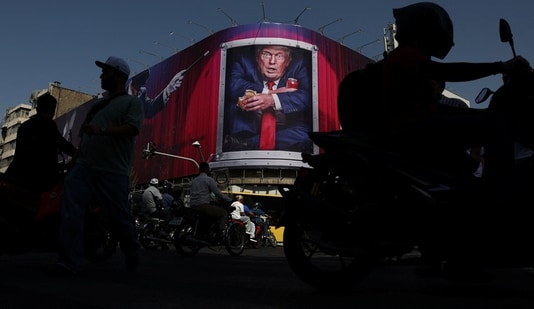
But the experience of Western sanctions and economic pressure on autocracies such as Cuba, North Korea, Venezuela and Syria shows the challenges facing Washington in trying to bend Tehran to its will. Indeed, the strongmen ruling such countries have historically used a mix of violence, economic adaptation and political suppression that
Last week, the Trump administration unveiled what it billed as an “Economic D-Day” aimed at forcing Iran to reopen the Strait of Hormuz and return to the negotiating table.
But the experience of Western sanctions and economic pressure on autocracies such as Cuba, North Korea, Venezuela and Syria shows the challenges facing Washington in trying to bend Tehran to its will. Indeed, the strongmen ruling such countries have historically used a mix of violence, economic adaptation and political suppression that enables them to withstand economic pain for years, if not decades.
Autocratic countries adapt in various ways. Sanctions typically push activity underground, creating flourishing black markets for goods, services and even people. Dictators also use outside pressure to rally their populations, especially among elites.
The government in Cuba has relied on the country’s diaspora to bring in food and medicine even as Washington raises pressure on Havana.
North Korea boosts its coffers by stealing cryptocurrency and even tricking Americans into working for them in U.S. companies. Russia has reoriented its trade flows toward China and other non-Western powers.
Tehran, which has branded the U.S. campaign “economic terrorism,” has decades of experience adapting to sanctions. Its trade has grown with countries with which it shares a land border. Iran has also created an entire parallel financial system with China, bypassing the U.S.-led banking system and weakening Washington’s enforcement powers.
“The fact that the U.S. can inflict pain is a given,” said Djavad Salehi-Isfahani, an economist at Virginia Tech. “My feeling is that these pressures aren’t going to result in more pressure on the Iranian government to compromise.”
Sometimes it requires direct military action to unseat autocrats, as when U.S. forces captured Venezuela’s former leader Nicolás Maduro in January or rebel forces in Syria pushed former President Bashar al-Assad from power in December 2024.
To be sure, there have been some successes over the decades. Nicaraguan leader Daniel Ortega was voted out in 1990 after a decade of sanctions that pummeled the economy, though he later returned to power and remains in charge today. South Africa dropped apartheid after intense global economic pressure. Libya dismantled its nuclear program in 2003 amid heavy sanctions.
Economic pressure needs to be coupled with diplomatic campaigns to squeeze an autocratic regime, said Aaron Arnold, a former expert on the United Nations panel monitoring sanctions enforcement against North Korea.
“These kinds of levers by themselves may not be the most effective tools,” said Arnold, who is now at the Royal United Services Institute, a London think tank.
The Trump administration has said the moves against Iran, called “Operation Economic Outcast,” are the biggest-ever financial offensive leveled against a U.S. adversary. Iran’s inflation has soared past 80% and it has shifted to a survival economy.
After announcing the latest wave of economic pressure, President Trump has said the Strait of Hormuz is open and all mines have been cleared.
“The naval blockade remains in full force and effect, and Operation Economic Outcast is under way to sever every remaining economic lifeline sustaining the regime,” White House spokeswoman Anna Kelly said in a statement.
Entrenched power
The U.S. has imposed an embargo against Cuba for more than six decades. As the Trump administration has increased pressure, Cuba’s economy has withered, suffering from power outages and food shortages. But top officials, including leader Miguel Díaz-Canel, have remained defiant even as Trump threatens a “friendly takeover” of the island country.
Díaz-Canel, in a recent interview with Brazilian media, said his government won’t make any concessions and isn’t afraid of being captured, like Maduro. “If it comes for me, it comes,” said Díaz-Canel.
Havana, having learned from the Soviet Union’s KGB and East Germany’s Stasi secret police during the Cold War, keeps close tabs on residents, schools, unions and the media to detect and stamp out any dissent.
North Korea has for decades defied some of the harshest sanctions in the world aimed at forcing its leaders to give up its nuclear and long-range missiles. In the past, the economic pressure was such that Pyongyang had signaled a willingness to sacrifice its nuclear program for relief. But no longer.
Now, North Korean leader Kim Jong Un rules a country that has found myriad ways to survive—and even thrive—economically. In recent years, Pyongyang has deployed troops to the Russian front lines for payment and has created an elite army of cyberoperatives able to steal billions in cryptocurrency.
Kim recently spurned overtures by Trump to meet, having said the U.S. can choose between “peaceful coexistence or eternal confrontation” with his regime.
The North Korean leader has responded to international pressure by urging his population to tighten their belts.
Yang Il-cheol, 31, who defected from North Korea last year, said citizens are focused on survival, having lived through fuel outages, starvation and chronic shortages of fertilizer, rice and electricity. People have developed workarounds, like using car batteries to provide emergency power during blackouts, Yang said.
“I think North Koreans’ ability to respond to crises is the best in the world,” he said. “If a car accident happened once, you would panic. But if it happens all the time, nobody is surprised anymore.”
The sweeping sanctions imposed on Russia over its 2022 invasion of Ukraine generated bold predictions of success, including by then President Joe Biden, who claimed Russia’s economy would be cut in half. Instead, the country’s gross domestic product fell just 1.4% that first year, then recovered at a torrid pace.
More than four years later, Russian President Vladimir Putin’s grip on power remains tight and he shows no signs of slowing the assault on Ukraine. Addressing lawmakers in late July, Putin mocked the sanctions as futile. “We are setting goals for technological leadership and, strange as it may seem, are achieving the results we need, despite all these external constraints,” Putin said.
Forced removal
Venezuela and Syria experienced deep financial woes from the U.S.-led sanctions campaign. But, in the end, overthrowing the leadership required both extraordinary circumstances and military force.
Before his capture, Maduro had survived roughly seven years of economic and financial sanctions. During Trump’s first term, Washington vastly expanded a network of sanctions that sought to punish Maduro’s regime, which was accused of election-rigging, corruption and rampant human-rights abuses. More than eight million Venezuelans, or a quarter of the population, fled during Maduro’s reign.
The U.S. Treasury blacklisted more than 200 Maduro aides and military figures in an effort to sow divisions within the regime, but it failed. Instead, Maduro and his inner circle banded together. The economy shrank by almost 75%—the deepest contraction ever seen in the world outside of wartime. Maduro held on until U.S. elite forces stormed his compound.
Both Washington and Caracas officials privately say that unwinding the sanctions and encouraging businesses to return has proven difficult, thus delaying economic recovery and making it harder for Maduro’s successor, Delcy Rodríguez, to maintain stability.
Even with Maduro gone, Venezuelans like Naiara Patiño, 26, don’t see themselves going back. She earned a physics degree in Venezuela in 2023—schooling that took about 18 months longer than normal because so many professors had left the country. Now she’s getting her astronomy doctorate at Boston University.
“There are no job opportunities,” she said, “even with a PhD.”
In Syria, the U.S. started applying sanctions in 1979. That included designating Syria as a state sponsor of terrorism, which restricts foreign direct investment, global trade and access to the world’s financial system.
In the end, the December 2024 downfall of Assad’s regime coincided with extraordinary geopolitical events. After more than a decade of civil war, his two main international backers, Russia and Iran, were bogged down in wars elsewhere. Neighboring Lebanon was suffering an economic collapse that spilled over into Syria.
But Assad remained in power until rebel forces launched an offensive in late 2024. His support then folded, with some government soldiers dropping their weapons, removing their uniforms and fleeing.
The sanctions imposed during Assad’s time weren’t quickly removed despite a newly elected government and warming ties with the U.S. and Europe. It took nearly two years of diplomatic effort.
But last week, the State Department removed Syria’s designation as a state sponsor of terrorism.
Write to Timothy W. Martin at Timothy.Martin@wsj.com, Jared Malsin at jared.malsin@wsj.com and Kejal Vyas at kejal.vyas@wsj.com
One Subscription.
Get 360° coverage—from daily headlines
to 100 year archives.
Archives
HT App & Website