Sri Lanka has a long and hard economic grind ahead with newly appointed Prime Minister Ranil Wickremesinghe tasked to negotiate a potentially tough loan from the IMF to save the Island Nation from financial collapse and instability.
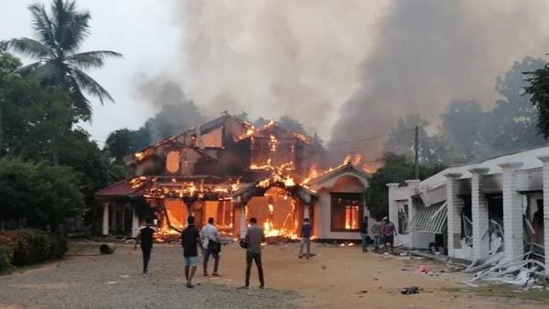
The appointment of political survivor Wickremesinghe, whose party UNP has just one MP in the Sri Lankan Parliament, comes hardly as a surprise to Colombo watchers as no politician wants to take the hot seat of PM at a time when the nation is facing violent public protests over mismanagement of the economy by the Rajapaksas. Opposition leader Sajith Premadasa was apparently offered the job by President Gotabaya Rajapaksa but his condition that the younger brother of Mahinda Rajapaksa must resign, and the executive presidency must be dissolved was not acceptable to the Rajapaksa regime.
Fact is as of now no politician wants to be in power or has the stomach for a general election as the successor of Rajapaksa will have to deal with an economic crisis not of his or her creation, and yet earn the wrath of the public at large. Even the abstemious image of Gotabaya Rajapaksa has taken a hit due to the shenanigans of his elder brother and now discredited Mahinda.
While India is supportive of Sri Lanka in securing some USD four billion dollar loan from the IMF, it is also bracing for the fall-out of a serious economic crisis in the Island Nation as the conditionalities of the loan will be tough to enforce fiscal discipline. With only 54.8 kilometre distance separating India’s southern state of Tamil Nadu and Sri Lanka’s Jaffna peninsula, India knows the political ramifications of the economic crisis faced by Colombo. The speed at which the Sri Lankan rupee is depreciating against the US dollar (1 USD is equal to 373 Sri Lankan rupees) paints a very grim picture of theIsland nation’s economy with very high interest rates and double-digit inflation.
Although Wickremesinghe has become Sri Lankan PM for the sixth time, Colombo’s road to economic recovery will be very hard as the world is facing high inflation due to the Russian invasion of Ukraine and its impact on the oil, energy and food prices. As Kyiv has become a pawn in the fight between Russia and the US geopolitical play, the chances for an early end to the war are receding with Nordic nations like Finland deliberating on joining NATO.
{{/usCountry}}Although Wickremesinghe has become Sri Lankan PM for the sixth time, Colombo’s road to economic recovery will be very hard as the world is facing high inflation due to the Russian invasion of Ukraine and its impact on the oil, energy and food prices. As Kyiv has become a pawn in the fight between Russia and the US geopolitical play, the chances for an early end to the war are receding with Nordic nations like Finland deliberating on joining NATO.
{{/usCountry}}Sri Lanka’s mentor China also facing stagnancy in growth due to mismanagement of covid in Beijing and Shanghai. Colombo’s other partners like Japan and India are also being hit by high inflation rates because of which both countries will be very wary of putting their money in Sri Lanka as the two countries themselves steer their countries out of the global economic mess. “ Sri Lanka will have a very tough time walking out of the economic crisis ahead with nearly a decade required for recovery due to fiscal profligacies and economically unviable white elephant infrastructure projects of the ruling party in power,” said a former foreign secretary.
Even though Wickremesinghe is a political survivor and close to the Rajapaksas, the public mood is Sri Lanka is taking a violent left turn with the present regime being accused of looting the nation on counts of misgovernance and corruption. Clearly, the situation in Sri Lanka will get a lot worse before it gets better.