The deliberations held by South Asian countries at the Idyllic Nepalese town of Pokhara last week have yet again showed how India-Pakistan rivalry continues to impede the cause of regional integration.
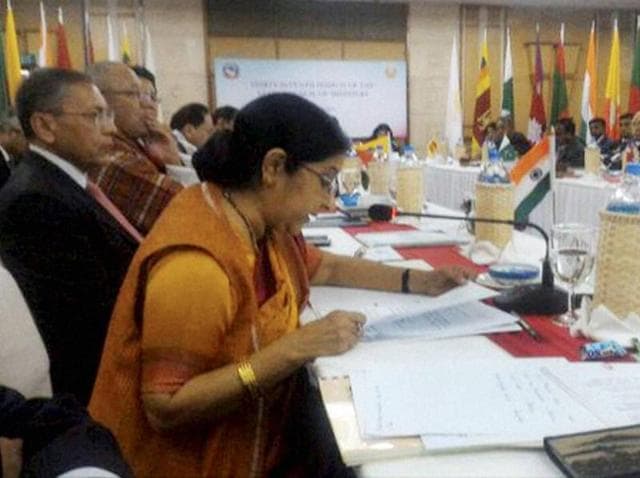
After scuttling a long-awaited motor vehicle agreement, Pakistan clamped down on the SAARC (South Asian Association for Regional Cooperation) satellite project – a venture that Prime Minister Narendra Modi had announced at the 2014 Nepal SAARC summit as India’s gift to South Asia.
“SAARC is not a forum for taking up bilateral issues anymore. It doesn’t discuss issues like Kashmir. It has, instead, become a forum where bilateral nagging issues between India and Pakistan stall regional projects and ideas,” a South Asian diplomat said on the condition of anonymity.
The satellite project was meant to help countries in the fields of education, health and emergency communication during disasters. Pakistan, however, felt that it could be an attempt by India to access information on its vital installations and resources.
An Indian official involved with the project said that the allegation was unwarranted. “One can raise a political objection to anything. This is exactly what has happened here. It’s not as if countries like Bangladesh or Sri Lanka didn’t raise what they thought were genuine concerns. We engaged them on these issues and allayed their doubts. Pakistan was simply not interested in the project.”
{{/usCountry}}An Indian official involved with the project said that the allegation was unwarranted. “One can raise a political objection to anything. This is exactly what has happened here. It’s not as if countries like Bangladesh or Sri Lanka didn’t raise what they thought were genuine concerns. We engaged them on these issues and allayed their doubts. Pakistan was simply not interested in the project.”
{{/usCountry}}Read: Pakistan throws spanner in SAARC road connectivity plans again
“As Pakistan has decided to opt out of the satellite project, it cannot be called a SAARC satellite. It will be a South Asia satellite,” said external affairs ministry spokesperson Vikas Swarup.
Thanks to the issues between India and Pakistan, two of its largest economies, SAARC remains one of the least integrated groupings in the world. The intra-regional trade in goods of the association – founded in 1985 – accounts for 5% of the total trade, as opposed to 26% among ASEAN (South East Asian) countries. Less than 10% of the region’s commerce is conducted in the SAARC Free Trade Area.
The SAARC satellite project is the second in recent times to have gone the sub-regional way, after being projected as a signature venture for the subcontinent.
After Pakistan refused to join the South Asian road connectivity initiative under the SAARC rubric, India bypassed the neighbouring country by forming a separate pact with Bangladesh, Bhutan and Nepal.
The Pokhara talks were held in the run-up to the SAARC summit in Islamabad later this year.