...
...
Next Story

One word made the difference: How Paris climate pact was won

One little word stood in the way of a historic climate accord in Paris for several hours, bringing years of preparations and weeks of negotiations between nearly 200 countries to a screeching halt.

Updated on: Dec 14, 2015 12:27 PM IST
Hindustan Times | By , Paris
Prefer HTon Google
Advertisement

One little word stood in the way of a historic climate accord in Paris for several hours, bringing years of preparations and weeks of negotiations between nearly 200 countries to a screeching halt. A late-night switch of “shall” with “should” in a paragraph of the text paved the way for the deal that offers hope to billions of people across the world against the mounting threat from global warming.
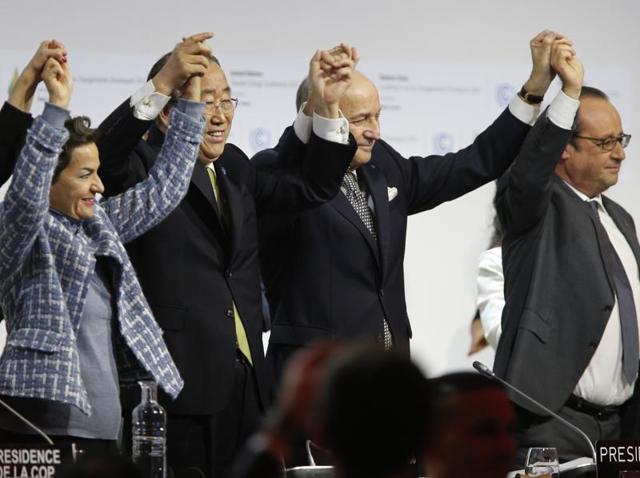
Foreign affairs minister and president-designate of COP21 Laurent Fabius (C), raises hands with secretary general of the United Nations Ban Ki Moon (2-L) and France's President Francois Hollande (R) after adoption of a historic global warming pact at the COP21 Climate Conference. (AFP)

The shall-to-should change made economy-wise emission reduction targets non-obligatory for rich nations, putting them almost at par with the developing world on achieving a zero-emission goal by the turn of the century.

The developments also demonstrated the might of the United States diplomatic machinery that got the word changed, identified as an error by the UN secretariat, to take home a deal exactly the way President Barack Obama had envisaged. The deal commits countries to hold the global average temperature to “well below 2°C” above pre-industrial levels and to “pursue efforts to limit the temperature increase to 1.5°C”.

The first Paris Outcome paper had decisions of the Conference of Parties as an annexure of the Paris agreement, making the COP decisions binding.

The US had from beginning opposed a fully legally binding agreement. So, something was required to be done to get the US on board after it walked out of the only other climate treaty, the Kyoto Protocol.

The paper was turned upside down with the agreement becoming an annexure to the COP decisions. This meant that while the accord was binding it could be easily altered through COP resolutions, which were no more obligatory. Also, the most critical targets of the Paris Outcome, from $100 billion as the finance floor, are in the COP decisions but not in the agreement.

Watch | Decoding the Paris climate change agreement

Backroom renegotiations led by Obama, who personally called up heads of governments of India, China, Brazil and South Africa, ensured that all countries were in agreement. The US also cobbled together a last-minute high ambition coalition of over 100 rich and most-vulnerable nations, pushing India and China to near isolation.

Read | Paris deal: Climate scientists, green groups sound note of caution

If many at Le Bourget commune, the venue for the talks, are to be believed, the concept of the pact was prepared by the French president’s office with the US delegation having a battery of top experts on international law. It was later discussed at the Indaba (Zulu word for “meeting of elders”) headed by French foreign minister Laurent Fabius with ministers from 196 nations.

As the discussions went on, senior members of the US delegation led by secretary of state John Kerry rushed to representatives of one country after another to get agreement on every point they wanted. “In fact, they had a draft on which discussions with us was conducted. We were surprised but it addressed all our issues,” said a negotiator from a developing country.

An hour before the final Paris agreement was tabled, the US team was in the Indian office, explaining the rationale behind getting “shall” in Article 4 of the agreement altered to “should”.

The change meant that the burden on rich nations to reduce emissions would be non-obligatory like the developing world, diluting the firewall between the two.

While the French got all the applause for the Paris agreement, the US showed real brinksmanship to get an agreement of its choosing. The rest had no option but to fall in line.

Read | COP21 agreement: All you need to know about Paris climate change deal

 
ABOUT THE AUTHOR
Chetan Chauhan

Chetan Chauhan is the National Affairs Editor looking into all aspects of news and features from across India. A Chevening scholar with over three decades of experience in reporting and news management, Chetan has extensively covered all important aspects of the social sector, political economy, environment and climate change nationally and internationally. He did a journalism course at the Reuters Institute of Journalism in Oxford and Digital Media training at Nanyang Technological University in Singapore. He started as a reporter with The Statesman in 1996 and joined the Hindustan Times in 2000 in the metro bureau covering environment, crime and Delhi politics. He covered hot local news, from the Jessica Lal murder case to the rebellion of Delhi Congress MLAs against then Chief Minister Sheila Dikshit, to the replacement of toxic vehicle fuel with cleaner compressed natural gas (CNG) in the national capital. Some of his stories on air pollution became part of the Supreme Court’s landmark MC Mehta versus Government of India case in the National Capital Region (NCR), forcing the government to take corrective measures. As part of the national political bureau since 2004, he covered important central sectors such as environment, education, social justice, labour, rural development, water resources, renewable energy, agriculture, broadcasting and the Planning Commission for more than a decade producing several exclusive and investigative breaking stories. His specialisation is the environment, having covered at least a dozen United Nations global conferences on climate change, biodiversity and wildlife including climate summits in Paris, Copenhagen and Bali. He also covered India’s two five-year plans ---11th and 12th and reported on drafting and execution of right based laws such as Right to Education, Right to Information and rural job guarantee law, MG-NREGA, now being introduced in new format as VG-RAM-G Act. He has in-depth knowledge of social sector issues. He was one of the first to report on tigers vanishing from Sariska and Panna wildlife reserves in 2004 and 2008, respectively, leading to the setting up of the National Tiger Conservation Authority (NTCA) and the introduction of stringent penal provisions for poaching. He has written extensively on the rising human-animal conflict in India and the degradation of India’s biodiversity hotspots because of mining and other activities. Since 2004, Chetan has covered Parliament comprehensively and participated in training on the nuanced coverage of Parliament proceedings. He has travelled extensively across India to cover national and provincial elections since 1998, especially in the Hindi heartland states, considered India’s road to power. He writes a regular column for Hindustan Times, Ecostani, on important national politics, economy, Himalayan ecology and environmental issues. His other responsibilities include providing inputs for edits and edit page articles for the publication, apart from managing news flow from across India.

Get the latest headlines from US news and global updates from Pakistan, Nepal, UK, Bangladesh, Russia and US Iran war Live, get all the latest headlines in one place on Hindustan Times.
SHARE THIS ARTICLE ON
Hindustantimes wants to start sending you push notifications. Click allow to subscribe