
Sign in

Odd-even will work only if implemented in entire NCR: Pollution watchdog

According to the pollution board, pollution levels in Delhi rose during the period when the scheme was tried out because of overcast conditions that prevented quick dispersal of pollutants.

Updated on: Jan 27, 2016, 01:34:06 IST
Hindustan Times | By , New Delhi
Share
Share via
  • facebook
  • twitter
  • linkedin
  • whatsapp
Copy link
  • copy link

The odd-even road rationing formula tried out for a fortnight in Delhi could have a visible impact on air quality if similar experiments were carried out in the entire national capital region (NCR), according to the Central Pollution Control Board.
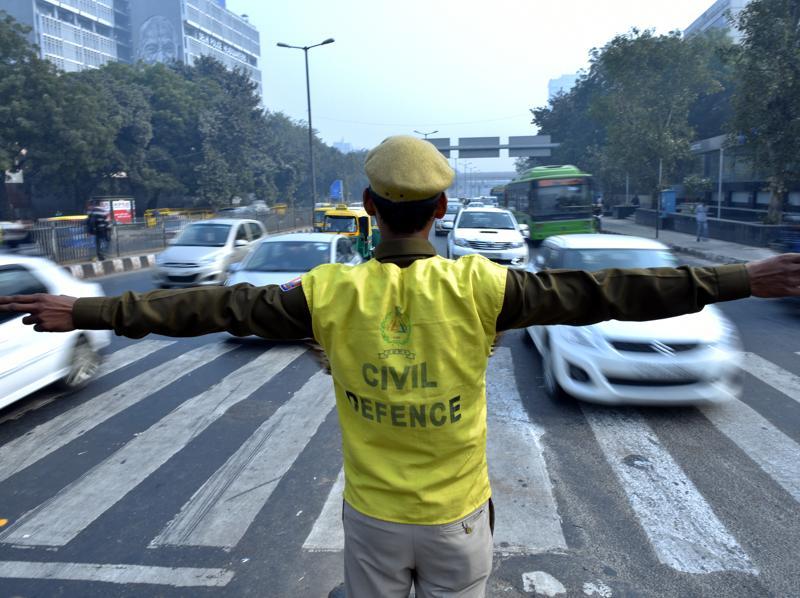
Civil defence personnel stand at Vijay Chowk to promote odd- even formula on cars in New Delhi. (HT File Photo)

The pollution watchdog reached this conclusion after analysing the Capital’s air pollution for a month, including the 15 days from January 1 when road trials of the scheme were conducted.

It deduced from data that pollution levels couldn’t have gone down more than 5-10% — that too in Delhi’s central zone — even if the scheme to allow vehicles to ply on odd and even dates based on the last number of their licence plates was implemented under favourable weather.

Its findings were noteworthy since the Arvind Kejriwal government has plans for another go at the scheme from mid-February to clean up the city’s foul air by reducing the volume of toxic car exhaust fumes.

According to the pollution board, pollution levels in Delhi rose during the period when the scheme was tried out because of overcast conditions that prevented quick dispersal of pollutants.

Air pollution in areas outside the outer Ring Road and closer to satellite towns Ghaziabad, Noida, Gurgaon, Faridabad and Sonepat was almost twice as much as in congested central Delhi areas such as Mandir Marg and ITO.

“The gains were lost on the city’s outskirts,” a CPCB scientist said, blaming high air pollution levels in the NCR towns.

In fact, air pollution level in NCR towns saw a substantial increase when the odd-even scheme was on and Delhi felt the impact. On some days, Noida, Ghaziabad and Gurgaon breathed far fouler air than ITO, where the car curb scheme’s effect was clearly visible.

This has pushed the pollution board to conclude that a “comprehensive set of actions following an integrated approach is required to make substantial improvement in air quality” and suggest a slew of measures for the entire region to “effectively” combat deteriorating air quality.

It circulated a 40-point plan in the last week of December to combat air pollution in Haryana, Uttar Pradesh and Delhi. The board reinforced the action plan with the Air (Prevention and Control of Pollution) Act, 1981, thereby making its implementation legally binding.

The CPCB asked the states to get diesel vehicles retrofitted with particulate filters, put an early alarm system for commuters about congested roads, create intelligent traffic systems, place a vapour recovery mechanism in fuelling stations and develop foundations at roundabouts. All these have to be acted upon in a time-bound way.

Most of the state pollution boards have not responded to the plan, a month after it was issued. Some said it couldn’t be implemented unless the Centre provided financial assistance.

“The question is who will foot the bill. Most municipal bodies in our state do not have adequate funds to bring this transformational change,” said a Haryana government functionary, who attended a meeting on air pollution called by environment minister Prakash Javadekar in Delhi.

An official of the Uttar Pradesh pollution authority wondered how diesel vehicles could be “immediately” retrofitted with filters.

Given the constraints, experts feared the CPCB action plan would never take off unless a strong political will pushed it through to improve NCR’s air quality.

  • Chetan Chauhan
    ABOUT THE AUTHOR
    Chetan Chauhan

    Chetan Chauhan is the National Affairs Editor looking into all aspects of news and features from across India. A Chevening scholar with over three decades of experience in reporting and news management, Chetan has extensively covered all important aspects of the social sector, political economy, environment and climate change nationally and internationally. He did a journalism course at the Reuters Institute of Journalism in Oxford and Digital Media training at Nanyang Technological University in Singapore. He started as a reporter with The Statesman in 1996 and joined the Hindustan Times in 2000 in the metro bureau covering environment, crime and Delhi politics. He covered hot local news, from the Jessica Lal murder case to the rebellion of Delhi Congress MLAs against then Chief Minister Sheila Dikshit, to the replacement of toxic vehicle fuel with cleaner compressed natural gas (CNG) in the national capital. Some of his stories on air pollution became part of the Supreme Court’s landmark MC Mehta versus Government of India case in the National Capital Region (NCR), forcing the government to take corrective measures. As part of the national political bureau since 2004, he covered important central sectors such as environment, education, social justice, labour, rural development, water resources, renewable energy, agriculture, broadcasting and the Planning Commission for more than a decade producing several exclusive and investigative breaking stories. His specialisation is the environment, having covered at least a dozen United Nations global conferences on climate change, biodiversity and wildlife including climate summits in Paris, Copenhagen and Bali. He also covered India’s two five-year plans ---11th and 12th and reported on drafting and execution of right based laws such as Right to Education, Right to Information and rural job guarantee law, MG-NREGA, now being introduced in new format as VG-RAM-G Act. He has in-depth knowledge of social sector issues. He was one of the first to report on tigers vanishing from Sariska and Panna wildlife reserves in 2004 and 2008, respectively, leading to the setting up of the National Tiger Conservation Authority (NTCA) and the introduction of stringent penal provisions for poaching. He has written extensively on the rising human-animal conflict in India and the degradation of India’s biodiversity hotspots because of mining and other activities. Since 2004, Chetan has covered Parliament comprehensively and participated in training on the nuanced coverage of Parliament proceedings. He has travelled extensively across India to cover national and provincial elections since 1998, especially in the Hindi heartland states, considered India’s road to power. He writes a regular column for Hindustan Times, Ecostani, on important national politics, economy, Himalayan ecology and environmental issues. His other responsibilities include providing inputs for edits and edit page articles for the publication, apart from managing news flow from across India.Read More

Catch every big hit, every wicket with Crickit, a one stop destination for Live Scores, Match Stats, Infographics & much more. Explore now!

Stay updated with all top Cities including, Bengaluru, Delhi, Mumbai and more across India. Stay informed on the latest happenings in World News along with Delhi Election 2025 and Delhi Election Result 2025 Live, New Delhi Election Result Live, Kalkaji Election Result Live at Hindustan Times.