The terrorist attack against vice-presidential candidate and president Ashraf Ghani’s running mate, Amrullah Saleh, on July 28 in Kabul was a part of an attempt to eliminate strong Afghan leaders opposed to the Taliban and its patron, Pakistan. Last October, another formidable and outspoken critic of the Taliban and Pakistan and Kandahar’s police general, Abdur Raziq, was killed. Fortunately, for Afghanistan — but not for the Taliban or Pakistan — Saleh escaped only with a minor injury.
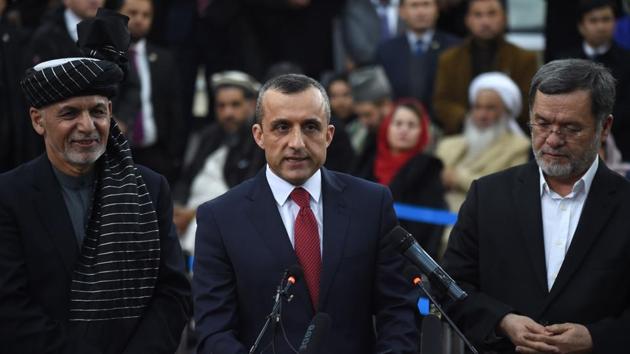
At 46, Saleh embodies the hopes of thousands of young Afghans for a forward-looking country which continues to be rooted in its moderate Islamic and national cultural traditions. A fearless and astute security professional, he became the head of Afghan intelligence at 32. That assignment, and his earlier association with Ahmed Shah Masood, gave Saleh an insight into Pakistan’s relentless interference in Afghanistan through the Taliban and other groups. It also instilled in him a fierce desire to defeat these machinations.
Saleh will not be deterred by this terrorist attack, but these are difficult days for leaders of his persuasion. The Afghan enterprise that was put in place with international assistance after the United States (US), with the help of Northern Alliance forces, ousted the Taliban regime in November 2001, is unravelling. The Taliban and Pakistan are clearly in an advantageous position. President Donald Trump’s silly bombast of the US’ capacity to win the war if it was willing to kill 10 million people is true in terms of US power. But are such wars ever waged and won only with raw power? The fact is that the US allowed the war to grind on because it refused to cross the Durand Line to destroy Taliban safe havens. It is, now, in the process of managing a strategic defeat.
Over the past nine months, the US has been negotiating with the Taliban, and the insurgent group backed by Pakistan is behaving like a victor. It has compelled the US to abandon its vital negotiating positions on ceasefire and direct Taliban-Afghan talks. Worse, despite threats to Pakistan to give up its deviousness or face US wrath, Trump has been compelled to seek its help to erode Taliban obduracy. Zalmai Khalilzad, the US envoy negotiating with the Taliban, is hopeful of reaching an agreement soon with the Taliban on the issues of US troop withdrawal and Taliban assurances that it will not allow the presence of international terrorist groups on territories under its control. The US is willing to go along with vague Taliban guarantees on the latter issue; perhaps, it hopes that a continuing intelligence presence will enable it to monitor what is happening in the country. The current sticking point is the time frame of US troop pull-out. The US wants to do it over a year, while the Taliban is insisting that it should be much quicker. It is likely that both sides will reach a compromise on this point, for the US has agreed to quickly close down a majority of its Afghan bases.
{{/usCountry}}Over the past nine months, the US has been negotiating with the Taliban, and the insurgent group backed by Pakistan is behaving like a victor. It has compelled the US to abandon its vital negotiating positions on ceasefire and direct Taliban-Afghan talks. Worse, despite threats to Pakistan to give up its deviousness or face US wrath, Trump has been compelled to seek its help to erode Taliban obduracy. Zalmai Khalilzad, the US envoy negotiating with the Taliban, is hopeful of reaching an agreement soon with the Taliban on the issues of US troop withdrawal and Taliban assurances that it will not allow the presence of international terrorist groups on territories under its control. The US is willing to go along with vague Taliban guarantees on the latter issue; perhaps, it hopes that a continuing intelligence presence will enable it to monitor what is happening in the country. The current sticking point is the time frame of US troop pull-out. The US wants to do it over a year, while the Taliban is insisting that it should be much quicker. It is likely that both sides will reach a compromise on this point, for the US has agreed to quickly close down a majority of its Afghan bases.
{{/usCountry}}After the US-Taliban agreement, the focus will shift to intra-Afghan talks, which will have to be inevitably held amid continuing violence. The Afghan government, political groups, and civil society as well as the international community have already conceded primacy to the Taliban in this dialogue process. In all the interactions which have taken place so far among the Afghans, whether in Doha or Moscow or elsewhere, only the Taliban have been represented as a group — the rest have participated only as individuals. It remains to be seen if the Taliban will agree to sit with the government as part of a larger intra-Afghan dialogue, involving other political actors and civil society representatives, including women.
The Taliban is aware that Afghanistan has moved on since its time in Kabul. Neither vast sections of the Afghan people, nor the major powers, will agree to another Islamic emirate. What is uncertain is how far the Taliban will push for its version of Islam in future Afghan governance. This is creating great uncertainty, and many Afghans with means are once again looking to foreign shores. Along with continuing Taliban and ISIS violence, criminality, too, has become a major national issue.
The government is pressing ahead with presidential elections scheduled for September 28. The leading candidates are Ghani, chief executive Abdullah, and the former national security adviser, Hanif Atmar. Even if a credible election takes place in prevailing uncertainties, it is doubtful if a new president will be taken more seriously by the Taliban, for it will insist on an interim arrangement.
The downside of a flawed election will be political breakdown in Kabul, with adverse implications for the cohesion of the Afghan forces. Ethnic relations, already strained by the prospect of the inclusion of the Taliban in formal governance structures, will come under strain. It is in these confusing times that leaders like Saleh will have to work to preserve the gains of the past two decades and keep Pakistan at bay. Pakistani generals are exulting at perceived Indian discomfiture in Afghanistan. Indian diplomacy has to be proactive and reach out to all in Afghanistan, including the Taliban, to safeguard the country’s interests.
Vivek Katju is a former Indian ambassador to Afghanistan
The views expressed are personal