Prime Minister (PM) Narendra Modi recently stated that 20 jawans were martyred but not before they taught a lesson to those who had dared to raise an eye towards “Bharat Mata”. PM assured the nation that, today, it has the capability that no one could eye even an inch of its territory. He suggested that the infrastructure in the border areas had improved greatly, leading to heightened patrolling and close monitoring of movements at the border. PM also made it clear that India would respond firmly to any attempts to transgress the Line of Actual Control (LAC).
China has always made a creeping annexation part of its policy towards India. The Congress, when in power, turned a blind eye to the encroachment on India’s territories by the Chinese through continuous transgressions and border violations. Though the country entered into as many as six bilateral agreements in 1988, 1993, 1996, 2005, 2012 and 2013, it did not address the dispute over LAC. When the Chinese intruded and pitched tents deep inside India’s territory at Depsang, in 2013, the then Prime Minister Manmohan Singh merely spoke in Parliament about the Chinese having a different perception about LAC. Confidence-Building Measures (CBMs) were misused by the Chinese to resort to psychological warfare and “salami slicing”. This is because, after 1962, defence forces were neglected and infrastructure was shoddy.
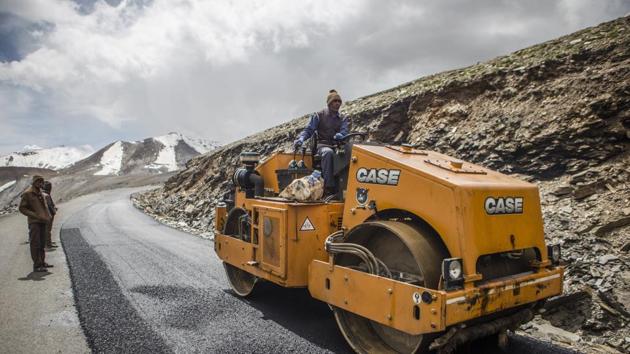
After Modi assumed power, strengthening infrastructure became a national priority. Today, there has been a great leap in infrastructure development at the Indo-China border on the Indian side which has served as a deterrent to China. Had the infrastructural development started in past regimes, India would have been in a more dominant position today. After 2014, India created a strong road network through the Border Roads Organisation and the Central Public Works Department despite the small window, during the year, for construction, due to the harsh winter. The Border Area Development Programme (BADP) has been allocated ~784 crore in the fiscal year 2020-2021. BADP stipulates that “10% of the total allocated funds will be additionally allocated to the states/Union territories abutting Indo-China Border (Arunachal Pradesh, Himachal Pradesh, Ladakh, Sikkim and Uttarakhand) for taking up works in the districts abutting Indo-China border”. The creation of infrastructure “would help integrate these area with the hinterland, create a positive perception of care by the country and encourage the people to stay or in the border areas leading to safe and secure border” as per the ministry of home affairs.
{{/usCountry}}After Modi assumed power, strengthening infrastructure became a national priority. Today, there has been a great leap in infrastructure development at the Indo-China border on the Indian side which has served as a deterrent to China. Had the infrastructural development started in past regimes, India would have been in a more dominant position today. After 2014, India created a strong road network through the Border Roads Organisation and the Central Public Works Department despite the small window, during the year, for construction, due to the harsh winter. The Border Area Development Programme (BADP) has been allocated ~784 crore in the fiscal year 2020-2021. BADP stipulates that “10% of the total allocated funds will be additionally allocated to the states/Union territories abutting Indo-China Border (Arunachal Pradesh, Himachal Pradesh, Ladakh, Sikkim and Uttarakhand) for taking up works in the districts abutting Indo-China border”. The creation of infrastructure “would help integrate these area with the hinterland, create a positive perception of care by the country and encourage the people to stay or in the border areas leading to safe and secure border” as per the ministry of home affairs.
{{/usCountry}}Infrastructure has developed on all borders through the comprehensive Integrated Border Management Systems — be it border out posts, border fencing, mobile towers, the use of technology at the border and lighting. On the Indo-Tibet border, roads, helipads, tunnels and bridges have been built.
At the same time, there has been an increase in patrolling — be it long-range patrols, short-range patrols or joint patrols by the Army and the Indo-Tibetan Border Police. India has held its ground in several face-offs. Regular patrols also enable us to assess China’s activities, identify features of tactical importance, dominate infiltration routes, corroborate inputs and assert our presence. Post-2014, our patrols have been actively engaging, confronting and preventing any incursions. We have not allowed any construction activity in our territory within LAC. In Doklam, India stalled the construction of a road by the Chinese, which would have adversely affected the nation’s strategic interests. It is only after this that China became more wary of India’s diplomatic and military might.
Work on a link road, part of an infrastructure project of a strategic road in Ladakh, is one of the factors which seems to have pushed China into its misadventure on June 15. They were given a bloody nose by Indian soldiers. Another reason which could have irked China is the fact that India did not support the Belt and Road Initiative (BRI), which was not advisable from the country’s security point of view. BRI was to establish China’s dominance in global trade. This included the China-Pakistan Economic Corridor, which is not acceptable to India as it goes through Pakistan-occupied Kashmir. Other factors which angered China could have been the friendly relations between India and the United States and the formation of the two Union territories of Jammu and Kashmir and Ladakh as well as the abrogation of Article 370. This reflects China’s vulnerability and the Galwan Valley aggression seems to be the desperate act of a frustrated country.
PM Modi’s policy towards China has been a judicious mix of diplomatic, military and economic options. He and President Xi Jinping have had as many as 18 summit meetings over the past six years, including two informal meetings at Mamallapuram and Wuhan. Several meetings have been held at different levels. The 15th meeting of the Working Mechanism for Consultation and Coordination, was held on June 24, where India stressed on respecting LAC and both sides agreed to expeditiously implement the understanding on disengagement and de-escalation.
While diplomatic parleys should continue, it is imperative to continue the PM’s policy to strengthen both the nation’s infrastructural and military build-up to contain the Dragon if it challenges us again. No one can challenge a determined India. Though India is a peaceful nation, we will negotiate only from a position of strength. And this can happen when strong leadership under PM Modi is guiding India’s security policy based on national interests.