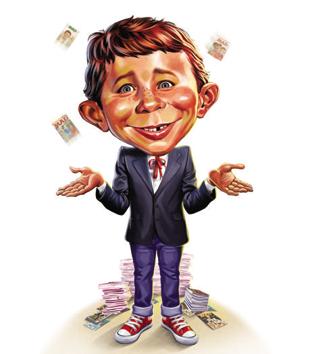
Who is this guy, anyway? Older readers, you’re allowed to raise your ageing hackles. Younger readers, if you don’t know who this is, don’t worry. Even US presidential candidates are struggling to make sense of Alfred E Neuman.
When President Donald Trump, 73, was asked his opinion of Pete Buttigieg, the youngest Democrat in the race, Trump replied: “Alfred E Neuman cannot become President of the United States”. Buttigieg, 37, didn’t get the joke. “I’ll be honest. I had to Google that,” he said.
Trump was referring to the freckled, gap-toothed, big-eared bumpkin who had served as the mascot of Mad magazine since 1952. The magazine’s popularity peaked in 1974, when Trump would have been in his late 20s and Mad hit its highest subscriber tally (2.8 million readers in the US).
Last week, Mad announced that August will be its last issue in print. Special issues will be produced using older material. But there will be no new features.
What on Earth is everyone upset about? Gather ’round millennials; it’s story time, as they say on Snapchat. And we’re not using filters. Mad magazine certainly didn’t have any.
{{/usCountry}}What on Earth is everyone upset about? Gather ’round millennials; it’s story time, as they say on Snapchat. And we’re not using filters. Mad magazine certainly didn’t have any.
{{/usCountry}}Mad was a wicked cool magazine that felt like a comic book, read like a graphic novel and was simultaneously silly, irreverent and sharp. It fearlessly pulled the pants off everyone in politics, pop culture and popular imagination. On every cover, Alfred E Neuman was reinvented, dressed as the target of the month. No one, not the Pope, nor Obama, nor Madonna’s unborn baby, was above a round of heckling.
Where other magazines had a centre page folding out into a poster – a Playboy nude, a Sports Illustrated hero, a National Geographic map – Mad’s back cover could be folded in to turn an innocuous drawing into a snarky new picture. And there was Spy Vs Spy, that iconic wordless comic strip featuring identical black and white Zoo-Zoo-like secret agents locked in a perpetual, futile battle of one-upmanship.
In ’70s and ’80s India, back issues of Mad – battered, dog-eared, back cover vertically creased – were a bonanza at the raddiwala. At a time when gifts of Kraft, Tang and Toblerone were so highly prized, Mad was where that same Western world was freely criticised. Where Doordarshan and All India Radio touched upon what was happening in the great out-there, Mad told you what to think about it.
The magazine was an instant hit. 1952 was the perfect time for parody. Cold War paranoia meant you couldn’t quite believe everything in the news. Patriotism was being wielded into a witch-hunt for Communists. Capitalism was an exciting, job-generating path to bliss. Mad started out as a comic book, with editor Harvey Kurtzman writing practically every story. They offended so many people and sentiments, the magazine issued apologies almost as much as they published stories. They didn’t run ads for 44 years.
“This Magazine is Revolting… Against Conformity” the April 1960 cover screamed. Being spoofed became a badge of honour, and on the honour roll were Bruce Springsteen (featured, obviously, in his sleeveless T-shirt), Keanu Reeves in his Matrix overcoat, and a very normcore Jerry Seinfeld.
Mad also inspired local attempts at the same irreverent humour. Deewana, a Hindi-language monthly, had an Alfred E Neuman lookalike mascot in the 1970s. In the 1990s, JAM, with a dog for a mascot, spoofed a rising India and its mushrooming celebrity culture. By 1998, Mad was reprinting in India, at a more affordable ₹35 an issue. Those 50-odd covers, lined up side-by-side, mark every #90sKid preoccupation: Shrek, The Spice Girls, SpongeBob, The Matrix, Harry Potter, Eminem, Friends.
Then came cable TV and Twitter, SNL, The Simpsons and South Park. Satire went mainstream. YouTube channels like HonestTrailers began to do in 8-minute video-clips what magazines took a month to illustrate. Memes exploded in real time.
And the news itself isn’t what it used to be. Parody is harder when your readers are flat-earthers, anti-vaxxers and Holocaust deniers. When heads of state tweet their stupidity themselves. And when gunmen open fire on newsrooms. We are all now Alfred E Neuman, shaking our heads at a world gone Mad.