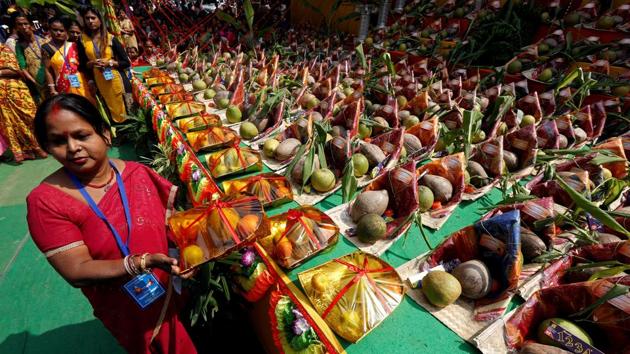
Amid strains of folk songs dedicated to the Sun God and aroma of traditional offerings filling the air, the four-day Chhath festival began on Tuesday, with the ghats in Delhi decked up for devotees.
Celebrated from the sixth day (hence called ‘Chhath’) after Diwali, it is celebrated to pay obeisance to the Sun as cosmic energy. The puja is observed mainly by the people from Bihar and eastern Uttar Pradesh or Poorvanchalis.
The national capital has a sizeable population of people from these two states, who observe it here on the banks of the Yamuna or ponds, lakes and canals. Some of the major ghats include, Qudsia Ghat, and ghats at Wazirabad, Sonia Vihar, Najafgarh and Kalindi Kunj. Various people also observe the festival by converging at parks and gardens, where makeshift arrangements are made for the puja.
Chhath, this year, is being celebrated from October 24- 27. The devotees offer ‘arghya’ to the setting sun and the rising sun in succession on the last two days of the puja. Today marks the ritual of ‘Nahai-Khai’ when devotees prepare traditional food after bathing.
The second day is called ‘Kharna’, during which devotees observe a day-long fast which ends with sunset. They then cook ‘kheer’ (pudding) and roti on earthen chullahs, which is then distributed as ‘prasad’. On the third day, the devotees stand in water and offer ‘Arghya’ to the setting sun. On the final day of the puja, they converge at river banks before sunrise and offer ‘Arghya’ to the rising sun in wicker baskets.
{{/usCountry}}The second day is called ‘Kharna’, during which devotees observe a day-long fast which ends with sunset. They then cook ‘kheer’ (pudding) and roti on earthen chullahs, which is then distributed as ‘prasad’. On the third day, the devotees stand in water and offer ‘Arghya’ to the setting sun. On the final day of the puja, they converge at river banks before sunrise and offer ‘Arghya’ to the rising sun in wicker baskets.
{{/usCountry}}Vegetables, fruits and other natural products are offered to the Sun God on the last two days, and ‘thekua’ — a delicacy made out of fine flour, ghee and sugar — is the main ‘prasad’, which is then distributed after the offerings.
The Delhi administration and municipal corporations are working to spruce up ghats and clean areas around water bodies to ensure the festival goes off smoothly. The government had yesterday said the third day of the festival will be a holiday. Last year too, it had declared a holiday on the occasion.
Various civic leaders today inspected ghats in their respective areas to take stock of the preparations. Delhi Development Minister Gopal Rai yesterday had visited Shyam Ghat at Jagatpur in the Wazirabad area for the same. “This year, Chhath Puja is being observed at 565 ghats while last year it was organised at 268 ghats. The government had earlier constructed 50 permanent ghats for the celebrations,” a senior official said.
Around 40 lakh people from eastern Uttar Pradesh and Bihar have settled in the national capital. All political parties see them as a key electorate, and therefore seek to woo them.
Follow @htlifeandstyle for more