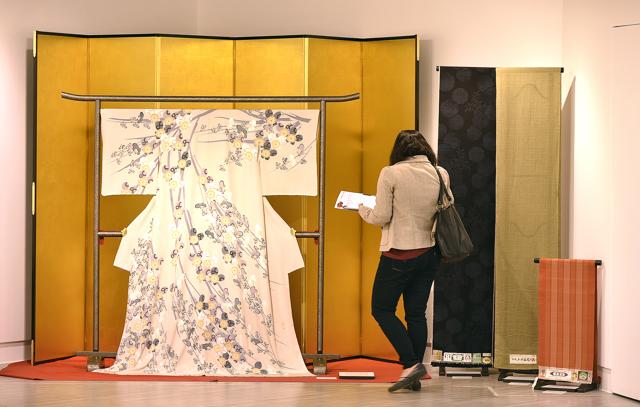
Delicate white porcelain with cobalt underglaze, ceramic bowls in soothing colours and a glossy finish, kimono-length cloth pieces, and even a wooden chest of drawers — the exhibits at the Japan Foundation’s show entitled ‘Handcrafted Form’ seem deceptively ordinary. But as one begins to unravel the history of these everyday objects from Japan, their true ‘value’ becomes more apparent. For instance, the pioneers of Japanese porcelain were actually Korean potters who arrived in Japan in the 1590s, according to Anna Willmann of the Department of Asian Art at the Metropolitan Museum of Art, New York. Consequently, Japanese porcelain was “inspired by Chinese styles”. It is not until the mid-17th century, however, that Japanese porcelain gained prominence in the international market. According to Willmann, with a fall in porcelain production in China, Dutch traders encouraged the export of Japanese porcelain to Europe.
This porcelain is also known as Imari/Arita ware (the former is the name of the port from which the porcelain was shipped to the rest of the country and beyond, and the latter is the name of the district where it was manufactured in kilns), according to Willmann’s essay on the subject on the Museum’s website.
In an interesting insight, Willmann reveals how the technique and designs of one of the finest varieties of Japanese porcelain were “kept secret” by the controller of the Arita kilns, and the “exclusive goods” were used to curry favour with the “feudal lords and nobility” at the time.
Speaking of secrets, there’s also the deceptively simple wooden box — actually a trick box that can only be opened by following a complex sequence of moving its different parts. Close to this is a wooden chest of drawers crafted by a cabinetmaker without using nails, insects carved out of wood that almost appear real, flat ceramic cups and plates with iron glaze trimmings.
{{/usCountry}}Speaking of secrets, there’s also the deceptively simple wooden box — actually a trick box that can only be opened by following a complex sequence of moving its different parts. Close to this is a wooden chest of drawers crafted by a cabinetmaker without using nails, insects carved out of wood that almost appear real, flat ceramic cups and plates with iron glaze trimmings.
{{/usCountry}}All of these provide an insight into Japanese art history and the skills of its artisans. There are objects from different periods in history, and in some of the exhibits, even the raw material — different types of clay that are used in combination to achieve varied results — is on display. Each of these clay types, we learn, is used to achieve different results. A brochure available at the venue familiarises visitors with the complex techniques used. Descriptive signage also accompanies the pieces. Just don’t expect it all to make sense at first glance.
Craft showWhat: ‘Handcrafted Form: Traditions and Techniques’When: 11 am-7pm. Till February 26 Where: Japan Foundation, Near Moolchand metro station, Lajpat Nagar 4, New Delhi
Follow @htlifeandstyle for more.