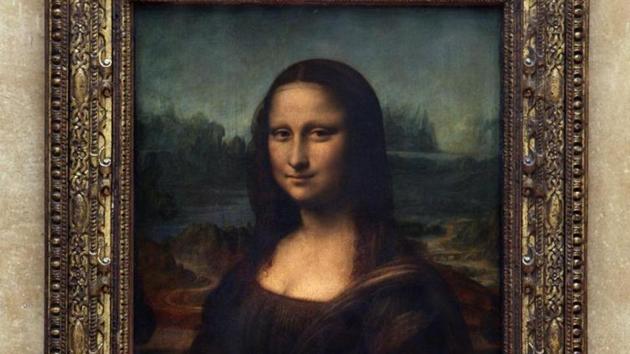
Scientists have created the world’s smallest copy of Italian polymath Leonardo da Vinci’s famous painting ‘Mona Lisa’ using DNA. Researchers from California Institute of Technology in the US developed an inexpensive method by which DNA origami self-assembles into large arrays with entirely customisable patterns, creating a sort of canvas that can display any image.
While DNA is perhaps best known for encoding the genetic information of living things, the molecule is also an excellent chemical building block. A single-stranded DNA molecule is composed of smaller molecules called nucleotides — abbreviated A, T, C and G — arranged in a string, or sequence.
The nucleotides in a single-stranded DNA molecule can bond with those of another single strand to form double- stranded DNA, but the nucleotides bind only in very specific ways: an A nucleotide with a T or a C nucleotide with a G. These strict base-pairing “rules” make it possible to design DNA origami.
A large DNA canvas is assembled out of many smaller square origami tiles, like putting together a puzzle. Molecules can be selectively attached to the staples in order to create a raised pattern that can be seen using atomic force microscopy. Researchers developed software that can take an image such as the Mona Lisa, divide it up into small square sections, and determine the DNA sequences needed to make up those squares.
They then got those sections to self-assemble into a superstructure that recreates the Mona Lisa. “To make our technique readily accessible to other researchers who are interested in exploring applications using micrometre-scale flat DNA nanostructures, we developed an online software tool that converts the user’s desired image to DNA strands and wet-lab protocols,” said Lulu Qian, assistant professor at Caltech.
{{/usCountry}}They then got those sections to self-assemble into a superstructure that recreates the Mona Lisa. “To make our technique readily accessible to other researchers who are interested in exploring applications using micrometre-scale flat DNA nanostructures, we developed an online software tool that converts the user’s desired image to DNA strands and wet-lab protocols,” said Lulu Qian, assistant professor at Caltech.
{{/usCountry}}“The protocol can be directly read by a liquid-handling robot to automatically mix the DNA strands together. The DNA nanostructure can be assembled effortlessly,” Qian said. Using the online software tool and automatic liquid- handling techniques, several other patterns were designed and assembled from DNA strands, including a life-sized portrait of a bacterium and a bacterium-sized portrait of a rooster.
Follow @htlifeandstyle for more