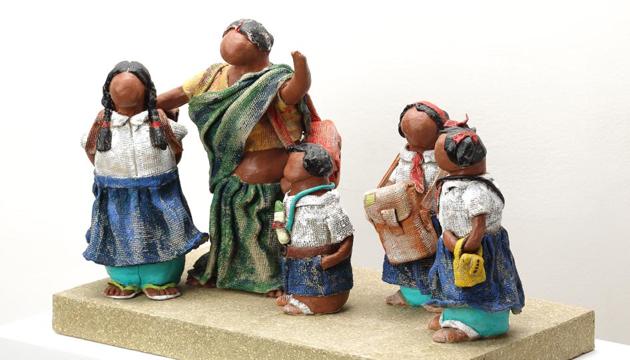
Artist Bharati Pitre’s papier mâché sculptures are based on her observations of day-to-day urban life, be it the obsession with selfies, or the city’s vanishing chawls
A man standing at the balcony of a chawl reading a newspaper. A father telling a bedtime story to his son. A woman on her honeymoon, posing for a solo selfie. These are some of the stories that Pune-based mixed media artist Bharati Pitre’s (54) sculptures narrate.
They are part of Pitre’s latest solo exhibition, Look Once. Look Twice. She is exhibiting 45 papier mâché sculptures made over the last two years. While the series on chawl are compact (1mx1m), some are life-sized.
For inspiration, the artist, who grew up in Mumbai, turns to her memories of interesting people and incidents from everyday life. As the chawls series indicates, Pitre is nostalgic about the tradition of communal living. “I used to visit chawls as a child to meet relatives. The doors would always be open, and there was a common balcony where people would hang out. But, at the same time, a family’s privacy was respected. Once the door was shut, no one would disturb them or come in to strike a conversation,” she recalls.
The funny side
With exaggerated postures, a small head and a huge body, the works are humourous. Some sculptures replace the head of a person with that of an animal. “We use the words donkey, crow or vulture to describe someone. In the sculptures, I have depicted the politician as having a crow’s head to denote his cunningness, and his sidekick with a parrot’s head [he repeats all his lines],” she says.
The faces are mostly left blank, so that the audience focuses on the body language. The works also challenge the norms of proportion. “I want viewers to see the beauty in curves, how it lends to the body language of a person,” Pitre says.
How it began
Pitre was a student of Sophia Polytechnic, and specialised in illustration. Later, she taught at her alma mater. Her initial experiments were with found objects — she picked up broken pots, trunks, chairs — and made an installation using them. “I always liked three-dimensional objects. I never felt excited to paint on canvas,” she says.
Around 15 years ago, Pitre attended a papier mâché workshop by visual merchandiser and freelance artist Sharad Kumar (grandson of Madhubani artist Chandrakala Devi from Bihar — the first rural artist to receive a National Award in 1984). The sturdiness of the sculptures and the flexibility of the medium convinced Pitre to opt for it. While Pitre learnt the traditional technique of papier mâché, she chose to depict urban themes.
As an art form, papier mâché has a long history. While it is believed to have originated in China in 2nd century AD (along with paper making), it is practised across the world. The term itself originated in the mid-17th century in France (the French were the first to innovate and use it commercially). India, too, has a long history of papier mâché products — be it boxes and chest of drawers made in Kashmir, or masks made in West Bengal and Kerala.
Pitre’s work Roots/Routes is also on display at the Kochi Biennale in Kerala. The sculpture depicts an aged sparrow attempting to puff balloons to fly and is on a more sombre note than her recent humorous works.
Look Once. Look Twice is on display till February 6 At Jehangir Art Gallery, Kala Ghoda Call 2284 3989