The naming of former Rashtriya Swayamsevak Sangh (RSS) pracharak Trivendra Singh Rawat as the chief minister of Uttarakhand is being seen as an indication of the right-wing organisation’s rising clout in effecting crucial appointments in the NDA government.
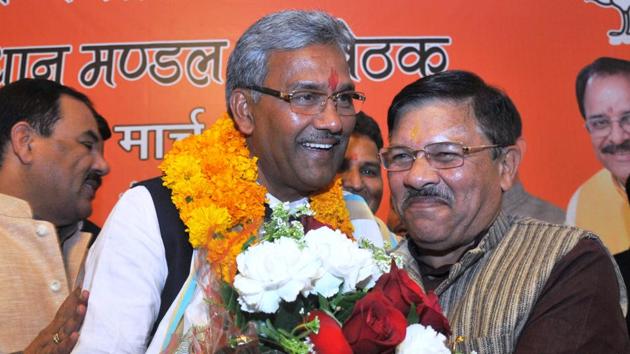
The RSS, however, wants to downplay its influence over the decision-making process. Outfit leaders say it is only “incidental” that two chief ministers and several ministers at the central level are former pracharaks.
Despite admitting that Rawat and two others before him – four-time Gujarat chief minister Narendra Modi (now the Prime Minister) and Haryana chief minister Manoharlal Khattar – were full-time RSS workers, the Sangh leadership claimed all the three were picked on the basis of their BJP credentials.
“There is a clear demarcation between RSS pracharaks and BJP members. Anyone who enters electoral politics ceases to be a pracharak. It is incorrect to say that these chief ministers were picked because the Sangh pushed for them, or they were chosen only because of their RSS background,” a senior functionary said on the condition of anonymity.
When asked if the newer crop of RSS workers was more inclined towards joining politics, the functionary said it has been a standard practice for the outfit to nominate certain members for political activities. “Even in the past, pracharaks were nominated for key roles in the BJP. In 2007, two joint organisation secretaries – V Satish and Saudan Singh – were sent to work with organisational general secretary Ram Lal. Even Modi was assigned to the BJP by the Sangh in 1985,” the functionary said.
{{/usCountry}}When asked if the newer crop of RSS workers was more inclined towards joining politics, the functionary said it has been a standard practice for the outfit to nominate certain members for political activities. “Even in the past, pracharaks were nominated for key roles in the BJP. In 2007, two joint organisation secretaries – V Satish and Saudan Singh – were sent to work with organisational general secretary Ram Lal. Even Modi was assigned to the BJP by the Sangh in 1985,” the functionary said.
{{/usCountry}}The Sangh’s explanation notwithstanding, many important appointments to ministries, academic institutions and government-run establishments have borne an unmistakable RSS imprint since the BJP’s stunning victory in the 2014 Lok Sabha polls. This was noticed in the case of Professor HY Sudershan Rao’s appointment as the head of the Indian Council of Historical Research (he was previously associated with the Sangh’s Akhil Bharatiya Itihas Sankalan Yojana); former ABVP organising secretary Ram Bahadur Rai’s posting as head of the Indira Gandhi National Centre for Arts; and the naming of Baldev Sharma – a former editor of RSS mouthpiece Panchjanya – as chairman of the National Book Trust.
Also, there was little doubt about the Sangh’s role in picking ministers – including Radha Mohan Singh (agriculture) and Mahesh Sharma (culture and tourism) – for the new government after the NDA victory in 2014.
In the second round, several people linked to the Sangh were picked as ministers for the expanded cabinet. These included Faggan Singh Kulaste, Vijay Goel, Anil Madhav Dave, Mahendra Nath Pandey, Mansukh Mandaviya, Parshottam Rupala and PP Chaudhary.
“These appointments are an indication that the Sangh’s ideology and politics – which were earlier rejected despite its growing presence in the society – are now being accepted by the people,” the RSS functionary said.