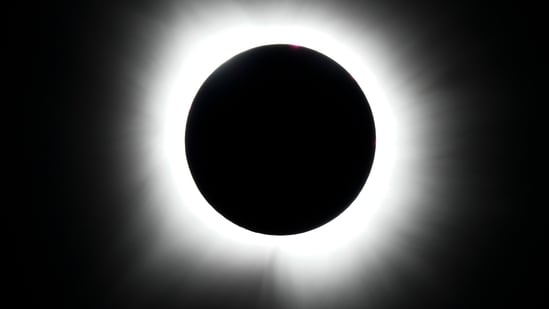
The total solar eclipse occurring today is set to be a major skywatching event, but Indian viewers will miss it. According to NASA the solar eclipse will pass over Greenland, Iceland, northern Russia, the Atlantic Ocean, Spain and a small part of Portugal. Parts of Europe, North America and Africa will see a partial eclipse. India is outside the eclipse's path of visibility.
Will the total solar eclipse be visible in India?
No, the total solar eclipse will not be visible from India. The country lies outside the path along which the Moon's shadow will reach Earth. Indian skywatchers, therefore, will not be able to watch the eclipse directly from any part of the country.
What time will the solar eclipse happen?
The eclipse will take place on Wednesday, August 12, 2026. The exact timing varies by location because different parts of the world will experience different stages of the eclipse. NASA has identified Greenland, Iceland, Spain, Russia and a small area of Portugal as locations where totality can be seen.
{{/usCountry}}The eclipse will take place on Wednesday, August 12, 2026. The exact timing varies by location because different parts of the world will experience different stages of the eclipse. NASA has identified Greenland, Iceland, Spain, Russia and a small area of Portugal as locations where totality can be seen.
{{/usCountry}}For Indians hoping to follow the event, online coverage will be the practical option. NASA's August skywatching guide highlights the solar eclipse alongside the Perseid meteor shower as one of the month's major celestial events.
Also Read A rare convergence is happening in the sky on August 12. An astrologer shares what it could mean
What is the path of totality?
The path of totality is the narrow area on Earth where people can see the Moon completely cover the Sun during a total solar eclipse. According to NASA, the August 12 eclipse's path of totality will cross Greenland, Iceland, northern Russia, the Atlantic Ocean, Spain and a small part of Portugal. Other parts of North America, Europe and northwestern Africa will see a partial eclipse.
According to Drik Panchang, the longest period of totality will last about 2 minutes and 18 seconds, .
Also Read Meteor Shower August 2026: What to manifest under the August 12 sky, according to an expert
Will Sutak be observed in India?
Sutak timings do not apply to Indian observers for this eclipse, as it will not be visible from India. This follows the traditional practice of considering Sutak in relation to an eclipse's visibility at a particular location.
The August 12 eclipse is the second solar eclipse of 2026. While it will create a spectacular view for people within the path of totality, Indian readers will need to rely on live coverage to follow the event.
What is Sutak timing?
Sutak Kaal refers to a period that traditionally begins before a solar or lunar eclipse and continues until the eclipse ends.
According to Drik Panchang, it is a period when certain activities are traditionally avoided. For a solar eclipse, Sutak is generally counted as four Prahar, or roughly 12 hours, before the eclipse begins.
How can Indians watch the solar eclipse?
Although India will not get a direct view, skywatchers can watch NASA's live coverage online. The live coverage will begin at 1:15 p.m. EDT, and at 10:45 p.m. IST on August 12, 2026.
What does the solar eclipse mean in astrology?
The eclipse will fall in Leo, a zodiac sign linked with confidence, creativity, self-expression and recognition. However, today's rare celestial event may be a time of reflection and personal change for people who follow astrology.
Astrologers have linked the Leo eclipse with questions around identity, visibility and letting go of old patterns. Many astrologers have described it as an opportunity to reconsider identities and roles that may no longer feel authentic.