
 E-Paper



Bengaluru’s taxi wastelands: Loan defaults put a brake on the cab dream
Many cabs attached with Ola and Uber are lying unused in parking lots and garages, seized by financial institutions and private moneylenders from those who could not repay vehicle loans.


Rows and rows of cars stand idle in a parking lot in south-western Bengaluru. Grass has begun growing around some of them, a testament to the monsoon rains the Karnataka’s capital city witnessed over the past three months.
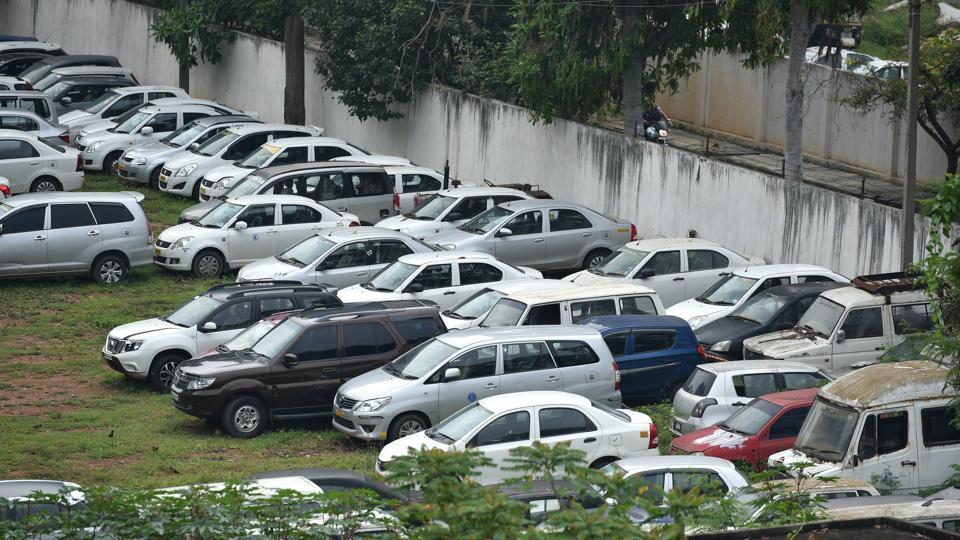
This, however, is no ordinary garage. It is the dumpyard for cars seized by financial institutions and private moneylenders from customers, who could not repay the vehicle loans.
While the garages themselves have been around for some time, a new trend of an increasing number of cars used as taxis making their way to such places is emerging.
Kishore BM, the owner of two such garages, says most of the new taxis coming to his parking lots are those that were once attached to app-based cab aggregators Ola and Uber.
“We have all manners of cars and trucks and any vehicles bought using loans,” Kishore said. “At present, there are at least 500-600 taxis in the godowns, most of them were attached to Ola and Uber,” he added.
However, non-bank financial institutions and banks refused to provide data on the total number of seizures of vehicles or on the number of defaults. They also did not provide the total number of loans disbursed to such drivers.
The debt burden
Drivers know of these locations, always spoken of with a hint of fear, as the graveyards for their dreams of a high-paying job in Karnataka’s capital because they bear testament to a life that now seems unattainable.
Muniswamy is one such driver who moved back to his hometown Bhadravati five years after he shifted to Bengaluru, enticed by the prospects of enormous earnings as a driver for the cab aggregators.
“Before I moved to Bengaluru in 2013, I was earning a pittance working as a taxi driver in Bhadravati. So, I jumped at the chance after a few friends told me stories of the enormous earnings they were making,” said Muniswamy.
And life in those initial days was good, he said, as he was taking home about Rs 50,000 a month. That situation changed a couple of years later. Muniswamy said, by 2016, incentives began reducing. The 36-year-old’s car was seized in February after he defaulted on instalment payments on loans he had taken from private moneylenders.
“The private moneylender I had borrowed from began resorting to threats and even sent some thugs after me before they seized my vehicle,” he said.
Other drivers echo Muniswamy’s story. Prem Surinje, who still drives his cab, says paying loan instalments has become very difficult because of a dip in his earnings.
A trend that research firm Redseer Consulting has captured. It has estimated that a driver takes home about Rs 18,000-20,000 now, out of average earnings of Rs 50,000. According to Redseer, at least 45% of the earnings are spent on fixed costs like loans repayments and another 25% towards variable costs like fuel. Surinje estimates that the burden of fuel costs has only increased with the continuously rising prices.
A major reason for the dip in earnings, drivers say, is because of the reduction of incentives that are paid to them. In January, Redseer had estimated that the incentives paid out to drivers had reduced to 25% of gross book value by May 2017, down from 52% in January of the same year.
Platform problems
At the heart of the troubles, drivers face in India, unlike in countries like the United States of America, is a major difference in how the platform model that companies like Uber and Ola utilise developed, says Aditi Surie, a researcher at the Indian Institute of Human Settlements.
“Uber and Airbnb started in the US at a time, when unemployment was high. There were legal structures that kept employment low like for example there were jobs that had zero-hour contracts, where people weren’t allowed to move into full-time employment,” Surie said.
When it was launched in San Francisco and New York, said Surie, there was an assumption that people could choose when they would use their cars for private purposes and for earning money. “So, people weren’t expected to buy cars to get on the platform, although that did happen as the company grew,” she said.
Contrasting that with the Indian scenario, Surie said, here those who now drive the cabs were not car owners. “But the sheer size the platform took made people buy cars,” she said.
According to Surie, as is the way with technical disruptions, the companies changed people’s economic behaviour by creating a need. “They built a market and used different kinds of pricing to create a need,” she said. And with the surge in cabs debt rose, Surie said. “There is a heavy debt burden that drivers face,” she said.
Adding to the problem of the model, Surie said, was the fact that it scaled very fast with many people joining the platform.
In Bengaluru alone, the number of taxis registered between March 2013 and July 2018 increased by 209% from 40,185 to 124,270 or about 209%, according to the state’s transport department.
Even this, transport department officials said, was not an accurate number because taxis registered elsewhere in the state that had state permits were also plying on Bengaluru’s roads. As of July, there were 228,449 taxis plying in Karnataka. This increase, drivers acknowledge, was also a big reason for the reduction in earnings.
Both Ola and Uber said no driver had yet brought to the companies’ notice the problems they were facing with debt.
A spokesperson for Ola said: “Driver-partners are the pride of Ola and their welfare is a key priority for us. We have not received any reports of issues regarding vehicle loans. Having said this, Ola stands fully committed towards bettering the livelihoods of its driver partners through a range of initiatives which includes ‘Chalo Befikar’, a comprehensive and free insurance program, that provides medical and life cover up to 5 lakhs and ‘Heroes of Ola’, a multi-city drive, that rewards drivers for exemplary customer service.”
A spokesperson for Uber said incentive payouts were based on a dynamic model and it was sought constantly to improve both earnings and fares, and the idea was to ensure that it helped drivers improve their organic earnings.
“With sustained high demand from both riders and drivers we can shift from startup mode to a more sustainable business model and begin reducing higher levels of incentives, and invest more in drivers and our products for the long term,” the spokesperson said.
The still-born Tygr
On November 29, 2017, about 200 drivers gathered at the Town Hall. Nothing, it seemed, could dampen their spirits, not even the three-hour delay in the arrival of the chief guest, former prime minister HD Deve Gowda.
The drivers had gathered for the launch of Namma Tygr, a driver-led app-based cab aggregator, the culmination of months of protests by drivers against dwindling earnings. But it took just two months for the promise to come crashing down when in January the state transport department rejected the company’s application for a licence to operate as an online cab aggregator.
Initially, the drivers had been buoyed by the support offered by Janata Dal (Secular) leader HD Kumaraswamy. It was under his guidance that the idea to set up a separate app-based cab aggregator took shape.
Sumit Kumar, a director of Namma Tygr, which now operates as an ordinary taxi fleet, said two things put the brakes on the company: the rejection of the licence application and investors’ apathy. “We raised about Rs 3 crore worth of investments,” Kumar said.
A driver, who was part of the launch team of the company, said he was disheartened by the turn of events. “Of course, there is still hope that something will save us from this situation,” the driver, who did not want to be named, said.
“The first reality check was the almost near boycott by investors. Then came the rejection of the licence, and everything seemed to be falling apart,” the driver said.
However, subsequent events did not let drivers lose hope. By May, Kumaraswamy had been sworn in as the chief minister and the hope of restarting Namma Tygr, this time with the government’s help, surfaced again.
“It has been four months now and there has been little movement, except for meetings that don’t seem to be moving far,” the driver said.
There have even been rumours of the government launching its own app-based cab aggregator, but transport commissioner VP Ikkeri denied this was the case. “There are no such proposals before us at present,” he said.
The state government, though, continues to see the space as an important self-employment option. Recently, the social welfare department of the state launched the Airavata scheme, under which 4,500 people belonging to the Scheduled Caste and Scheduled Tribe communities will be given training and funds to set themselves up as self-employed persons.
State social welfare minister Priyank Kharge said the department was aware that loans defaults were a phenomenon.
“It is for this reason that we will provide Rs 5 lakh seed money to the beneficiaries, which would mean that they would be able to afford most of the cars available,” Kharge said. “This will ensure that drivers will not have other costs and the Rs 35,000-45,000 average earnings would be take home,” he said.


