The best stories are the ones whose beginnings elude you. And so it was with my pilgrimage to the four-day Ziro Festival of Music in Arunachal Pradesh. Did my adventure begin when I decided to take a solo trip because none of my Mumbai buddies could bear the thought of travelling 3000 km across the nation? Or did it begin in hot and humid Guwahati, my entry point to the Northeast, where a friend cooked me a full-course Assamese meal?
The best stories are the ones whose beginnings elude you. And so it was with my pilgrimage to the four-day Ziro Festival of Music in Arunachal Pradesh. Did my adventure begin when I decided to take a solo trip because none of my Mumbai buddies could bear the thought of travelling 3000 km across the nation? Or did it begin in hot and humid Guwahati, my entry point to the Northeast, where a friend cooked me a full-course Assamese meal? Did it begin when I hurt myself and a stranger wrapped a bandage around my big toe? Or did it begin with that wide-ranging conversation I had about everything from poetry translation to Jacob Collier? Do I begin in Assam or Arunachal? Do I begin with food, music or people?
I’d been thinking of taking this trip for about a decade. Getting to this mysterious place in the farther reaches of eastern India that’s almost impossible to spot on a traditional map, fabled among musicians and music lovers, was going to be as much a celebration of music as an adventure. I finally decided to get out of the cocoon of metropolitan life and head to Ziro last week.
There is no easy way to get to the place. Since there are no direct flights to Itanagar, the capital of Arunachal Pradesh, from Mumbai, I decided to hang out with some old friends in Guwahati before making my way to the 10th edition of the festival that’s touted as the Woodstock of India. It was my first time in the Northeast. From Guwahati, the intrepid traveller can either take the Donyi Polo Express and get down at Naharlagun from where they can make a three-hour journey by cab or bus to Ziro, or travel to Ziro by road. Since I was in experimentation mode, I signed up with Encamp Adventures to get on a bus and camp at Ziro.
The 450 kilometer ride on an overcrowded Traveller that lurched around on pitted roads was excruciating. But nothing unites people like suffering and soon conversation flowed as did beautiful human connections. My co-travellers included people from Bengaluru, Pune, Thane, Siliguri, Durgapur and many other parts of the country. After a 14 exhausting hours, we reached Ziro with its narrow roads and muddy campsite about two kilometres from the festival venue. It is on the walk to the venue that travellers first encounter Ziro life. The locals are warm and welcoming and momos and chicken fried rice are available everywhere. For a Mumbaikar, the prices were a delicious surprise – a 12-piece plate of pork momos cost ₹200 at the Khao Piyo Café while a local Arunachali brew in Bisleri bottles labelled “Homemade Wine” costs about ₹300. It was the strongest alcohol I’ve ever had with that 500ml packing more punch than five cans of beer.
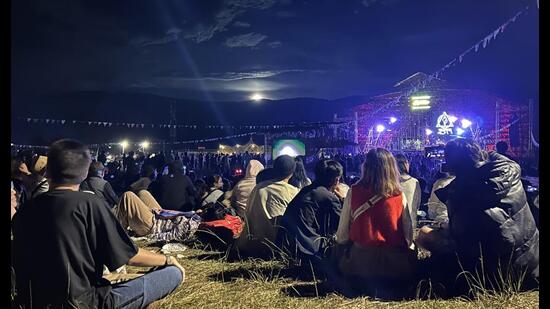
And now for the festival venue. It is simply like no other in India. The vast expanse of greenery under a resplendent sky with mountains in the distance took my breath away. The cold breeze and the sound of music wafting over people lost in the selves they seemed to have found after ages – I was entranced. Two stages, Danyi and Pwlo (local Apatani tribal terms for Donyi Polo or Sun and Moon in the other Tibeto-Burman languages of Arunachal) hosted performances by bands from India and abroad. Benry Moses, an indie-alternative singer-songwriter from Nagaland played against a gorgeous sunset at the Danyi Stage. I’d been humming the lines from one of his songs, Midnight Stories just before I hopped on the bus: “I am constantly reminded, with every little glimmer in the sky, how I used to see them shimmer in your eyes”.
As the festival lights took over the night, there was colour all around. This is probably the only place where sunglasses at night look rather cool. Maylula, a band from Arunachal Pradesh, got on the Pwlo Stage. A blend of folk and Western, the band’s music draws inspiration from local folklore and poems as well as The Beatles, Queen and Bob Dylan. Next up was Flying Kik, a five-member band from Bhutan that hovered between punk rock, reggae and hip-hop.
The next two acts turned out to be the best ones of the festival. Chennai band Jatayu, that fuses traditional Carnatic sounds with funk, absolutely rocked the stage. They transported me back to my college years when I attended every gig I could and headbanged at the front barricades all through the night. I attempted to recapture that lost time but found my neck isn’t quite as resilient as it once was. Still, for that one hour, Jatayu made me jump, clap and happily grow down! Next up was Taba Chake, a musician originally from Arunachal, who now lives in Mumbai. With a gifted voice and deceptively simple lyrics, his was, without a doubt, the best act of the entire festival. Everyone danced to his great songs like Udd Chala and Aao Chalein.
The Ziro Music festival is as much about what happens after the performances as it is about the performances themselves. At the camp, everyone gathers around with their own instruments, music and conversations. I met some wonderful people including Prakash, who rode for 450km to get to Ziro in time for the festival, and still played guitar at 3am the following morning. It was wonderful to be sitting around a bonfire under a clear sky surrounded by starlit faces, everyone enjoying the moment.
The second day began with no breakfast at the campsite and no water in the washrooms. Still, we dragged ourselves to the festival grounds. Incidentally, the place is huge with a food court that served unique tribal North Eastern fare. The Apatani stall – the tribe is native to Ziro – served excellent local delicacies. That washed down with a couple of interesting cocktails set me up for the day’s performances beginning with Delhi-based electronic artist Tarana Marwah aka Komorebi, who created unique soundscapes at the Pwlo Stage. One of the most interesting things about the festival was the number of genres hosted. Everything from rock, punk and reggae to electronica, folk and very mainstream music was presented.
The Boo Boo Bama Orchestra, a Swedish band were great fun. As the bare-chested vocalist danced around and one of the band members climbed up the pillar next to the stage, women swooned. Their infectious energy turned the second day into a party. Everyone was excited to learn that the night would end with DJ Smokey on the Takvr Stage. The excitement turned to alarm when we realized this, the festival’s third stage, was four kilometres away from the main venue. It would have been a bad idea anywhere to make people travel to a different venue for a performance but at Ziro, it was the worst possible idea. This is a village with almost zero transport options. How were we expected to get there and back? The organizers announced that a shuttle service would take us there. Everyone happily booked tickets and then waited for nearly an hour for the bus that never came. Eventually, we paid a stiff amount to some local cab drivers and got to the venue to behold DJ Smokey, the only person in a saree in Ziro. Dressed in scintillating blue, Smokey re-energized all the exhausted souls who had managed to make there with some high-octane EDM. We went absolutely berserk dancing. Returning to camp afterwards naturally involved being crammed into a van that charged an exorbitant sum for the six-kilometer drive. It was a looting but there was nothing to be done but grin and bear it.
Some big acts were scheduled for the last two days of the festival that fell on the weekend. The camp got overcrowded and so did Ziro. The price of food and everything else at the local shops shot up. The ₹200 wine was now dearer by another 200 rupees. The villagers said it was the only time of the year that they could make money. Fair enough, I suppose. But by this point paradise had definitely started to look more worldly, more familiar, perhaps a bit too familiar. Cramped roads, surge pricing, cafes and local transport charging unhinged amounts; it all felt like home, baby!
Farhan Akhtar was headlining on the third day and that definitely indicated a shift at ground Ziro from a laid back indie vibe to a manic Bollywood zing. Akhtar is an excellent writer and director and a shrewd producer. He is sharp, witty and good-looking too. He is, however, a very ordinary musician. His performance was flooded with fans who had come to have a glimpse of the star, not so much to listen to his music. He sang some of his English songs, which bored the audience. They perked up again when he moved on to songs from Rock On. Most of the hardcore music crowd walked back disappointed. Well, what did they expect? Having Farhan Akhtar headline a music show is like having Vivian Richards play a golf tournament – he likes playing golf but that’s not what the crowd loves him for.
Saturday came around and the village was so crowded that Ziro started feeling like Andheri. Back at the camp, washrooms stayed filthy and there was an abject lack of water. Everyone blocked it all out and focussed on conversations that continued to grow in beauty, emotion and intellect. Nicolas, a solo traveller from Argentina talked about his last three months touring remote parts of India. As you may have guessed, our conversation started with me asking him, “Messi or Maradona?” but then it went all the way into languages of the world, the history of Latin America and Europe and life as a traveller. Several people were part of the conversation including a girl who was doing a project about tribal people in India and the origins of the Sindhi community for which she was planning to travel to Pakistan. And then there was Chow, who rode his motorbike through tough terrain as a habit.
The next day, a sprained big toe rendered me immobile and confined to the camp where I got talking with Danny, possibly one of the most interesting people I’ve met. A hairstylist from Bengaluru whose day job involves cutting Virat Kohli and Hardik Pandya’s hair, he is also a KTM-sponsored biker who gets his kicks going on wild camping adventures. His stories made me feel like the camp at Ziro, that I’d initially found too remote, was a First World facility. I hobbled to his bike and we rode off to have more scintillating conversations over dinner.
The next morning, all of us left for Guwahati on the same bus that brought us to Ziro. This time everyone knew everyone else and the torture on the road was expected so things weren’t as dire. I had made some great friends including Insiya, a dentist from Bengaluru, and Amir, an IITian with whom I discussed politics. Then, there was Seema who is doing a PhD in elephant communication. Soon we were all part of a conversation that kept us involved until we reached Guwahati at 1am.
Saying goodbye was a wrench but real life beckoned. I was already looking forward to the two-hour-long hot water bath I would take when I got home to Mumbai. As I waited for the plane to take off, my mind was still an underground rock show. “Main Udd Chala,” Taba Chake sang into my headphones.
Mihir Chitre is the author of two books of poetry, ‘School of Age’ and ‘Hyphenated’. He is the brain behind the advertising campaigns ‘#LaughAtDeath’ and ‘#HarBhashaEqual’ and has made the short film ‘Hello Brick Road’
One Subscription.
Get 360° coverage—from daily headlines
to 100 year archives.
Archives
HT App & Website