How did the idea of the Future Library project originate?
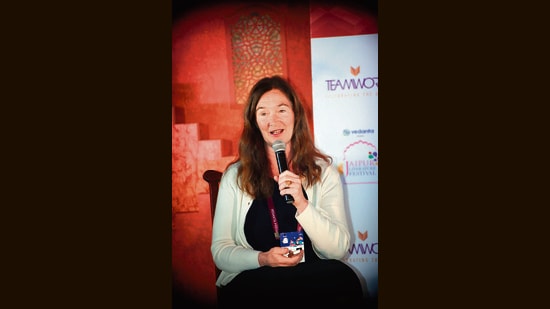
I commissioned Katie Paterson to do an art project to transform a harbour in Oslo on behalf of property developers. She came to Oslo, did a lot of research and went back to Berlin where she was living at the time. Three days later she called me and said, ‘I have the perfect idea for the public spaces project, but I need to stay in a cabin in the forest first.’
I offered her one where she stayed for about a week in the deep forest. Afterwards, she came out and said this is the work: ‘It’s going to last for 100 years. We’re going to grow a forest, design a special room, and commission an author every year until 2114 to write an unpublished and unread manuscript.’
We will place them in the room where they will remain until 2114. The authors must come to Oslo and walk to the forest together. The ritual, which is part of the artwork, is handing over the manuscript among the trees. A hundred years from now the trees will be turned into paper and all the books printed at the same time.
First was Margaret Atwood, and now it is Amitav Ghosh. What fascinates me is that none of us will be around 100 years from now. In a way, the project is about the connection between humans and nature.
What compelled you to choose Amitav Ghosh as your 12th writer in the project?
{{/usCountry}}What compelled you to choose Amitav Ghosh as your 12th writer in the project?
{{/usCountry}}Amitav is someone we’ve been following for a long time. What’s really nice about him is that he writes both fiction and non-fiction. I also think what he brings to the table is a new kind of world view, as he does in his latest book, Ghost-Eye, where he talks about reincarnation. Linearity has obviously not been able to fix the problem.
I have a daughter who is a doctor. I grew up on a farm and it’s not more than two generations ago when my grandmother could read hands and coffee cups and all that. I too was trained by my grandfather to find water in the valley for people with a stick. And I was regarded as a skilled and gifted water dowser. This story just came back to me because, through his storytelling, Amitav opened up the non-scientific, the non-linear, and the mysteries that surround us.
What kind of brief are the writers given?
They can write whatever they want as long as there are only words. It could even be a grocery list as Margaret Atwood said in an interview. We cannot and shall not know. That’s a little bit annoying because these authors are having fun leaving something behind.
Although when Han Kang was in Oslo five years ago, she hadn’t yet printed her manuscript, so I took her home to print it in my basement. While she was taking a shower, I saw the pages as they came out of the printer, but they were all in Korean, so I couldn’t read them.
The project is about imagining our future in a certain way. How do you foresee it and in what way did that impact the design of the space?
This is the core of our work. We are having problems imagining that future because so many things are at stake now from climate change to war. Logistically, the project is kept as simple as possible. We only have mechanical boxes and glass. The forest is being maintained, and I managed to get a 100-year contract with the municipality. They have lent us the forest and the room in that new public library.
I have a Trust whose only purpose is to look after the work. Personally, when I’m thinking about the future, I’m not curious because I know I’ll be dead. But I appreciate being part of the process, every year of my life.
The work resonates with people across the world because, deep down, we are more alike than we realise. We share similar needs — especially in this moment. We are also getting proposals from around the globe from countries that want to be represented. In that way it is becoming global.
Personally, it’s about hoping for a future, doing the rituals, meeting other people, connecting around the globe. It’s about trust and trusting the coming generations and they have to trust us that we actually care and start this kind of project now.
Also, our relation to time has become so short term and instant. We have lost track of long-term thinking, which earlier people were in tune with. Contemplating slowness is also hoping. The beauty of art is it opens up new ways of thinking, and you can interpret it because it doesn’t necessarily give answers. Since I came to India, it’s interesting how it’s been interpreted as a slow peace march, given your rich history of taking out marches.
What difference do you hope this will make?
The difference is in the process. I don’t think we’re doing this now and then something extraordinary will happen. Creating the future is by doing every day. I believe in the process. I believe in meeting you, people here in India and to discuss these things across ethnicities, religions, borders, that we could have a lot in common and that we can speak about this work in all kinds of ways. That’s why we need it now. It’s not that we need this work in 100 years.
Given that we now live in echo chambers, how do you hope a project like this will help break down these communication barriers?
Margaret Atwood said that we need new stronger narratives for a changing world. That’s what art and culture do: they build bridges through narratives. Imagination is fundamentally human. If we stop imagining futures, we cannot create them — and that eventually means losing hope. She also said visions are too far away and what we need are practical utopias. I’ve learned to think of each day as a practical utopia, which drives me to meet you and create moments with you and everyone else. There’s so many levels, so many layers and levels of this work.
The project is almost like child’s play. Like you put a box in where you put secrets…
An MIT professor wanted to research the project for her new book on intergenerational justice. As she sat in Future Library’s Silent Room, where the manuscripts are stored, and interviewed everyone entering, she concluded that this is about innocence and hope. It is as close as you can get to holding a baby and what it takes to raise it.
Why are you putting a copy in the bunker? Is it to make the project disaster-proof?
The archive is underground since the library and forest can burn. Even climate change has started affecting the forest. Last spring, we had a session where we planted more trees, but of a different kind because diversity is resilient. Of course, a lot of things can happen to the forest and to the room, but if you think you’re in control of everything, nothing will happen. I have to trust that the people who come after me will actually fulfill this project. This is really an exercise in bringing back trust on the table again.
Kanika Sharma is an independent journalist.