Your stories are like dream sequences capturing a spectrum of love and desire. They feature women in many kinds of relationships. A woman leaves her husband as well as her lover and runs off to join the circus because she’s in love with a hijra lion tamer she hasn’t yet met. An unhappily married woman harbours a growing desire for her sixty-something art tutor. There’s a woman who takes regular appointments with her ex’s new girlfriend who is a hairdresser.
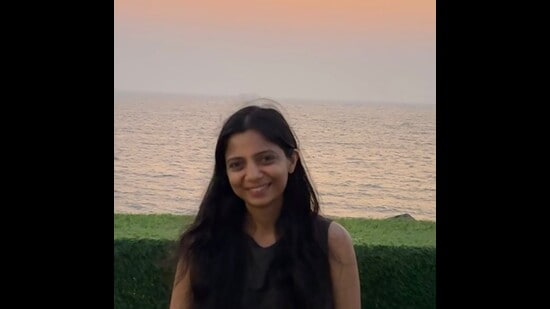
Your stories are like dream sequences capturing a spectrum of love and desire. They feature women in many kinds of relationships. A woman leaves her husband as well as her lover and runs off to join the circus because she’s in love with a hijra lion tamer she hasn’t yet met. An unhappily married woman harbours a growing desire for her sixty-something art tutor. There’s a woman who takes regular appointments with her ex’s new girlfriend who is a hairdresser. You write about queerness, non-monogamy, situationships in strange and outlandish settings in a way that captures even more precisely the realities of millennial relationships. Principles of Prediction was first published in 2020, and the stories were written over a decade. How did they come to you and how did they come together?
Sometimes I feel like I don’t know if I’ll be able to write the same way anymore. I once called it the manic fiction of my twenties. It came out of the person I was back then.
And those concerns of relationships came from experiences that don’t get labelled or acknowledged. I think people still have — maybe at any age — those kinds of experiences in relationships, or are in relationality with someone else where it’s like something happens and it’s not really spoken about or definable. Situationships as a concept emerged later, so then it got a category. But there’s still stuff that’s not a situationship and that you kind of feel… I mean, now looking back at it, I would say it was part of my desire for some of those things to have a home or label so that it is acknowledged as a loss even when it’s left behind.
Drawing Lessons has that. I wouldn’t say it’s necessarily something romantic — you don’t know what happens after the story. It might not even have a sensual element to the desire between the two people who connect in that story. But it is something. And maybe even the one you mentioned, about someone fascinated by their ex’s, yeah, I’ve experienced that kind of fascination, that connection where you’re like, oh, who is this?
In Drawing Lessons, your protagonist Moira has a sex dream about her art teacher whom she’s increasingly attracted to. Tell us about constructing that particular story.
It was also some of the things I was engaging with back then — people in particular age brackets, and particular bodily experiences, how they get desexualized.
At the time I was in a gender studies program. And some of the theorists on my mind were Susan Sontag and Audre Lorde, her Cancer Journals. Back then, I’d be reading and absorbing so many new ideas and theories, the stories became a way to process and condense things for myself. I wasn’t a very good academic writer, so this became the form I could work with ideas in. I’m a little embarrassed now, in retrospect, at how much some of the stories engage with theory.
It was a time period you might remember — I’m not saying these stories are autofiction, but there was this theory-fiction and autofiction moment. I was in university alongside that.
Your book is in some ways a 2010s liberal arts time capsule. But in two of the stories you move away from the millennial and the abstract. Radio Story and Westward are rooted in history — how did you write them?
Radio Story is separate and unique. It was one of the first stories I really revised, edited, completed, and sent out into the world. It came from my great-grandfather, my grandmother’s father, who was a ham radio operator during independence-era India.
It came out of stories I knew from her. Ham radio operation was banned in India, and there were groups running an underground operation. My great-grandfather’s involvement was mostly technical. He had that knowledge, and I think he was approached to help set things up. My grandmother would tell me what she remembered from childhood — hiding the apparatus, people coming home to check, what happened around it. So, I had a glimpse of those stories, then did my own research to bring it into a larger context, and it was completely fictionalized from there. My grandmother has been sweet about the fictionalizing — she read it and said there were emotional resonances, that it’s interesting how that intuitively comes through. She told me recently that there’s a chartered accountant character in the story, and asked how did you know that — my mother had that same trait.
Some of these stories were written once I had the contract for the book. It’s a nice feeling, being able to write with that behind you. For Westward, I found one anecdote and turned it into a story. The first Indian psychoanalyst, Girindrasekhar Bose — his daughter, Durgabati Ghose, wrote a memoir, The Westward Traveller, about being in Vienna and her one encounter with Freud. She is completely erased even now in psychoanalytic history. In her memoir, there’s a moment where she’s dog-phobic and Freud dismissively tells her to go ask her father what her dog phobia means. She writes what she wishes she had said — I think it’s Ashis Nandy who has written about that moment of speaking back to the big father of psychoanalysis. I found that very precious. So, I did more research into how psychoanalysis was being practised and developing in India at the time — some details accurate, some maybe not.
I remember thinking, even when I had first read these stories six years ago, that they are very psychoanalytic. You write, for instance, about “the impossibility of articulating what is the emptiness inside me, which is also a kind of nourishment.” You’re now pursuing a doctorate in psychoanalysis. How did that happen?
I moved back to India in 2018. I’d done my MFA, done gender studies, came home, and thought: what job can I find with my only skill being writing fiction? I did some writing-tutoring work, mostly with adolescents and younger children. During Covid, I had eight to 10-year-olds in a creative writing online workshop, and what was life-giving was just hearing their stories, how happy they were to talk. They were just sharing something — it wasn’t about their skills in story writing, there was something else happening, playing with fantasy worlds, projections of themselves in characters. Children just want to tell you things. Psychoanalysis isn’t like that — my initial fantasy was that people would just come and tell me stories. But without a psychology background, what could I do? So, I started a training.
Bombay has a school that’s very Kleinian, and I did that for a few years. Melanie Klein took off from some of Freud’s ideas, and her work was very much about the mother-baby relationship. I was fully ready to work as a clinician. Then something in me shifted — first you learn from authority, assuming everything they say is the word of God. Once you start forming your own ideas about what you’ve learned, you might move on. That happened for me. I went into analysis with a Lacanian, and knew: this is what I want to do.
The mother-baby thing shows up in one of the two new stories in the collection. In Virtual Baby, you write about a woman and her relationship with her premature newborn baby and the virtual baby in the immersive game café she grew accustomed to caring for during her pregnancy. In the other new story, Hair, your protagonist is always talking to AI about her marriage, a pretty recent development in our lives. When did you write it? I also found that you’ve removed my favourite story — Feline — from the original collection. How different is this new paperback edition?
I wish we’d spoken before I removed Feline — my process was just removing stories I felt didn’t fit anymore, or wasn’t connecting with. With Feline, it was about the geographic location of the story. When I wrote it, I wanted one story in the book from Texas, since I’d spent five years there. This time, I felt like all the other stories were so different. Notes from the Ruins, too — I wasn’t connecting with it anymore, so I removed it. I removed two and added two. I write at the pace of about one story a year, so that’s what happened. I haven’t written short stories in a while. Hair was written about a year and a half ago.
It was speculation — what happens when AI intrudes into our relationships. Virtual Baby, you can see how the themes were just what was surrounding me.
Now, maybe it’s an age thing, but I’m not fully able to engage with fiction the same way. I find myself more excited by non-fiction, or more experimental work. That was actually true in the past too. While writing the short stories, my gender studies thesis was very much a lyric-essay type, the kind of thing you get to do when you’re just studying. That’s where my heart is right now, too.
Saudamini Jain is an independent journalist. She lives in New Delhi.
One Subscription.
Get 360° coverage—from daily headlines
to 100 year archives.
Archives
HT App & Website