Why do conversations about colonial history feel especially urgent right now?
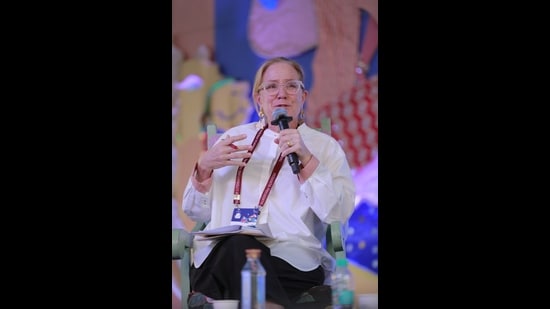
In many ways, I think of the past as a setting, as a prologue. The past sets the stage for the beginning of our story. But it doesn’t necessarily set the stage for the end of it. And so when we think about the urgency of the colonial experience in the present-day circumstances, we need to focus on both the ideas and practices and legal systems that were bequeathed to formerly colonized populations. Even though it’s been 50, in some cases over 75 years, many of those practices and legal systems still remain in place.
For me, much of my work looks at states of exception and emergency regulations, and the ways authoritarianism is really part and parcel of the colonial legacy. We see it play out over and over again. We certainly see it here in India, we’re seeing it right now in Palestine, and we can also see it even in the United States today.
Do you feel historians today are being asked to do something different than in earlier decades? Perhaps to intervene more directly in public discourse?
That’s a terrific question! The short answer is yes. Historians by nature are not what I like to call presentists. They’ll tell you long, wonderful, important stories about the past, but they always hesitate to speak about the present.
If historians don’t step up, people who frankly have no knowledge of history are going to do that — they’ll talk about it in the media, on television, social media. So, I feel it’s incumbent upon historians to help explain, in simple terms and understandable language, the ways the past does and does not influence how we think about the present.
{{/usCountry}}If historians don’t step up, people who frankly have no knowledge of history are going to do that — they’ll talk about it in the media, on television, social media. So, I feel it’s incumbent upon historians to help explain, in simple terms and understandable language, the ways the past does and does not influence how we think about the present.
{{/usCountry}}Honestly, I sometimes wonder why historians who know so much don’t want to dip their toes into any present-day issues. I myself have a different approach to that — not necessarily better or worse — but it comes from a sense of responsibility to help smart people in the public today understand how we got to where we are today.
You’ve spoken before about the difficulty of working with incomplete or deliberately destroyed archives before. How does a historian ethically construct a past that power has tried to erase?
Another really important question. The ethics of reconstructing the past are multiple. When I work through archives trying to piece history back together, I’m always thinking about honouring the lived experiences of people who survived the violence I work, or more so study, with.
In that sense, the work cannot be apologetic to the state, but it also can’t always condemn the state because there’s a lot of nuance. Colonial actors are complicated people wrestling with questions about complicity, guilt, and responsibility. There’s complexity on both sides of the divide.
So, a historian has a responsibility to present a fullness — a complete picture of individuals and how that period shaped who they were, how they felt, and how they lived.
Oral testimony plays a crucial role in your work. How do you weigh memory, trauma, and subjectivity against official records that claim authority?
There’s this notion that developed in the nineteenth century, that written records are more reliable than oral sources. And hence, the British government was banking and promoting that assumption when it curated archives to present a very particular story embedded in their records.
So, if you want to challenge that narrative, you have to turn to alternative sources — missionary archives, diaries, journals, and especially oral testimonies, particularly for populations that were illiterate or were denied the means to record their own histories.
When my first book Britain’s Gulag: The Brutal End of Empire in Kenya (2005) came out, many critics questioned oral testimony, saying people misremember or invent things to serve a narrative. That concern isn’t entirely wrong. But here, historians can use additional tools.
I turned to scholars like Daniel Schachter, a cognitive psychologist who specializes in trauma and memory. And what I learned was that most people don’t remember what they ate for breakfast last week. But individuals who experienced trauma often remember events with extraordinary clarity. They may forget exact dates, but the events themselves remain vivid. In my experience of collecting oral testimonies — from both victims and perpetrators of violence — the level of detail people retain about traumatic events is remarkable.
When your books later contributed to legal accountability and reparations, did that change how you thought about the power and responsibility of historical writing?
It didn’t so much change my thinking as affirm why historians must be extraordinarily careful. I made significant claims in [Britain’s Gulag] against powerful institutions, and there were strong efforts to discredit my work — to say it was fabricated, unreliable even.
Eventually, the work went under legal scrutiny, where evidence must stand objectively. It’s like my revisionist history was put on trial. The only thing I was sure of was that my research was careful — I’d spent 10 years on it.
That experience reaffirmed the importance of rigorous historical research. You cannot cut corners. It’s an extremely time-consuming process, but that is our craft as historians.
One of the central arguments in Legacy of Violence is that violence wasn’t a deviation from empire but a governing tool. Why has that idea been so difficult to accept, especially in Britain?
Britain maintained a strong belief in imperial exceptionalism — the idea that Britain somehow got empire right. And to preserve that narrative, these episodes of violence had to be explained away as isolated incidents caused by bad actors.
My argument asks: how many “bad apples” must exist before we recognize a systemic pattern? When you examine the legal structures enabling violence, it becomes clear that these were systemic features, not exceptions.
What was described as a “state of exception” was actually the system itself developing over time.
You write for both academic and general audiences. How do you approach accessibility without oversimplifying complex histories?
I usually begin within a narrow academic framework — producing work that is rigorously researched, thoroughly documented, and heavily footnoted.
Once the academic text is done, I focus on storytelling. I genuinely love the craft of writing — how a narrative begins, ends, and unfolds through characters. With Legacy of Violence, I insisted on nearly one hundred pages of footnotes. So, readers can get a wonderful story, while also seeing the depth of documentation behind it.
You can absolutely do both at the same time.
In recent years, historians have often found themselves at the center of culture wars. How should historians respond when their work is attacked as political rather than scholarly?
You can never control how people receive your work. My responsibility, as both a writer and a scholar, is to stick to the facts and tell a narrative grounded in evidence.
If someone wants to dismiss that as political or label me a “left-wing historian”, that’s their choice. My work is objective and rigorously documented. I’ve been called many things over the course of my career, but those criticisms don’t deter me.
Much of your research involves torture, brutality, and suffering. How do you emotionally protect yourself while working with such material for years?
It does take a toll. Over time, I’ve learned to pace myself and to step away when needed, even though the work never fully leaves you.
At the same time, it gives me a perspective on life — what truly matters and what doesn’t. I’m deeply aware of the privilege I’ve had working at well-funded institutions. I don’t take that lightly.
One way I process the trauma embedded in my research is by ensuring these histories are widely known. Opportunities like speaking here at the Jaipur Literature Festival, engaging with thoughtful audiences, give meaning to the work and honour the sacrifices and lived experiences of people from the past.
As a professor, how do you encourage students to sit with discomfort rather than shutting down or becoming defensive?
It worries me that today’s students don’t like discomfort. And the material they study with me is very discomforting.
I try to encourage them by telling them that to really learn and grow as an intellectual — and a human being — you’re going to have to be uncomfortable. You have to walk this journey I’m going to take you on and that way we can honour the sacrifices of the people from the past.
Rutvik Bhandari is an independent writer. He lives in Pune. You can find him talking about books on Instagram and YouTube (@themindlessmess).