In 1912, at a time when the global medical establishment was almost exclusively a male domain, an Indian woman achieved something remarkable. Jamini Sen became the first woman Fellow of the Royal College of Physicians and Surgeons of Glasgow. It was a milestone that should have been celebrated as a national triumph. Yet, despite a path breaking career that spanned continents, her name and legacy gradually faded from India’s public memory.
This new biography that traces her journey from the
In 1912, at a time when the global medical establishment was almost exclusively a male domain, an Indian woman achieved something remarkable. Jamini Sen became the first woman Fellow of the Royal College of Physicians and Surgeons of Glasgow. It was a milestone that should have been celebrated as a national triumph. Yet, despite a path breaking career that spanned continents, her name and legacy gradually faded from India’s public memory.
This new biography that traces her journey from the medical wards of colonial Britain to a decade-long tenure as the personal physician to the Nepal royal family under King Prithvi Bir Bikram Shah, seeks to revive Sen’s story and restore her to her rightful place in social and medical history.
Beyond her professional achievements, Sen lived a life of striking autonomy. She remained unmarried, crossed international borders to pursue her vocation, and raised a child alone — all while navigating the rigid social structures of the early 20th century. Her life was lived entirely on her own terms, redefining what was possible for an Indian woman over a hundred years ago.
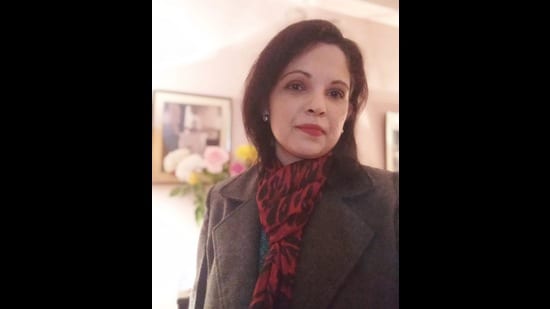
As a direct descendent, Deepta Roy Chakraverti was uniquely positioned to tell this story. Here, she talks about using private family archives and oral histories preserved across generations to piece together the story of a remarkable life.
You write that India has forgotten a jewel in her crown. What prompted you to dig deeper into Jamini Sen’s life and her role and contribution as a single woman and doctor?
I felt great anger at an injustice. Here was a woman who had done so much for her country, who had worked tirelessly to bring healing to the sick and ailing; a woman who had won the highest honour and brought such recognition for her country. At a time when women were kept behind doors, Jamini defied orthodox barriers and conquered at home and abroad. And she had done all this as a single woman – without the backing of a husband, or godfather. And yet, no one remembered. At best she was a footnote, or an article in a journal. It made me angry and determined to have her story out.
What kind of archival material were you able to access to piece together this story? What were the most surprising things that came to light?
For some details, I relied on Bengali and English writings by writers from long ago, who also happened to be my ancestors – Kamini Roy (Jamini’s sister) and Saradasundari Devi (Keshub Chandra Sen’s mother). There were also parts from Jamini’s diary. For professional details of Jamini’s accomplishments, there were records from the Royal College of Physicians and Surgeons of Glasgow, there were past records too from Cambridge and from the London School of Hygiene and Tropical Medicine. Most importantly, for Jamini’s personal details, there was oral lore from my maternal side – through my grandmother Roma Sen Chakraverti (Jamini’s niece) and my mother Ipsita Roy Chakraverti. I have inherited some of Jamini’s belongings, which are very precious to me. Chief among them is the Tsog spoon, the King’s watch, (both spoon and watch were given to her by King Prithvi Bir Bikram Shah of Nepal) and the brilliant blue pin, which I have written about in the book.
They say objects have memory, and every time I hold these in my hands, they seem to take me back to another time. While writing the book, I often handled these objects and sometimes as I would look at the watch or the spoon in my palm, for a flash, it was as if another hand held them. Older, careworn hands, laid on mine. Perhaps it was a writer’s imagination. Or perhaps it was not.
A hundred years ago, families were large and extended. Jamini herself never married but she had many siblings. From the line of her niece Roma, I am Jamini’s last descendant. (I am an only child and I never married). It was very important to me to have Jamini’s story known to the world. It must not be lost.
What was the most surprising thing that came to light? It was her attitude. As a woman, she defied convention and took the social backlash that came with it. She suffered many bereavements and yet, through it all, she maintained a certain stoic attitude. Every time life dealt her a blow, she suffered but she rose again. There was no complaining. She had a great sense of purpose, and a dedication to those who sought her help. A woman of science and great scholarship, she also had a deep and abiding faith in a higher power. It was a balance, of science and mysticism which contributed to her excelling in her work, her studies, and also giving her great strength and comfort when times were difficult.
You write that Jamini didn’t adopt the Western attire expected of Indian professionals during colonial rule and instead wore a saree. How did she balance her rigorous Western medical training while staying true to her Indian identity?
Jamini was a woman who took pride in her Indian identity even when she was celebrated in the West. That stayed with her throughout her life.
What were some of the primary hurdles she faced in the male-dominated medical field?
Jamini’s problems were threefold. Not only did she have to battle the prejudice against women entering medicine, she had to fight against a society that was hostile to women stepping out at all. After starting practice, she then had to fight an unexpected problem – women patients had more confidence in a male doctor than another woman, even when she was fully qualified and competent. Society taught them that men were supposed to be better at everything they did!
A few years into her career, once her successes across the globe became known, and especially after she became the first woman Fellow of the RCPSG, her problems were of a slightly different nature. Jealousy. Perhaps her professional contemporaries felt it more, and they passed it on to their womenfolk.
A century has passed but sadly, many of the hurdles faced by women then still remain.
Your book delves into Jamini’s decade in Nepal (1899–1909), where she worked under King Prithvi Bir Bikram Shah. How did she navigate the complex hierarchies of the royal palace to successfully introduce modern sanitation and maternal care to the Kathmandu Zenana Hospital?
Jamini’s story is not only of a woman in medicine or of feminism; it is equally of a professional woman and her use of diplomacy and tact in taking her work forward. One of the problems, in a place like Nepal, was overdependence on traditional medicine. Forcible conversion to more modern ways might have been effective temporarily but would not have had a lasting effect. So, Jamini tried to blend the two -- to let them keep their traditions, and just add to that the newer ways. As long as the patient was healed, it did not matter which method got the credit.
The book also touches on her personal life and on the death of her adopted daughter, Bhutu.
The death of the child destroyed a part of Jamini. Everything that she had planned for Bhutu, gone in an instant. The child, the one person she could hold as truly closest to her, taken away. She was devastated, but her abiding faith in a higher power and her devotion to her work, restored her. She was not a woman to give in to self-pity or let grief cripple her. She was strong willed and she gave her all to those who came to her for help.
Her iron will brought her back from that shadow of grief and made her the saree wali daktarin sahib of British India.
As a descendant of Jamini Sen, what has writing this book meant to you and what lesson from her life do you hope readers will take away?
Jamini Sen’s life is testament to the fact that strong willed women can achieve anything. They need three things: ability and skill in what they wish to do; a certain stubbornness, an unwillingness to admit defeat; and finally, they need God’s own will. And then, nothing can stop them.
Majid Maqbool is an independent journalist based in Kashmir.
One Subscription.
Get 360° coverage—from daily headlines
to 100 year archives.
Archives
HT App & Website