Set to rekindle the joy of reading in the lives of Dilliwallahs in transit, volunteers at Books on Delhi Metro (BODM) are back on track after a pandemic-induced hiatus of two years. Resuming in the last leg of February, BODM is once again dropping books at a metro station near you.
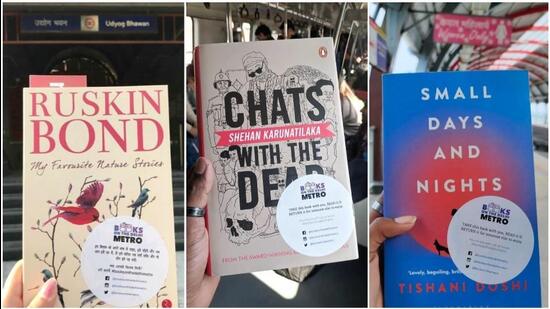
A nifty volunteer-led book sharing initiative, BODM was started in 2017 by a bibliophile, Shruti Sharma. There was a time in the early aughts when bogeys would be packed with students and office-goers head deep in newspapers and books. But as the twenty-tens dawned, mobile phones took over, pushing books into oblivion. BODM addressed this shift, too, while aiming to reintroduce reading when on the go. Its ‘Take it, read it and pass it’ model helped build a network of eager readers across Delhi-NCR.
Sharma’s aim was simple: To serve everyone who takes the Delhi Metro — from the daily wage labourers who might not know how to read but might want books for their children to the elderly who might like to read a book in a regional language. Her network comprises 30 to 40 book fairies (volunteers), most of who are Delhi University students. The books they mostly receive are via donations whereas some others are from personal collections; information on books and stations is usually posted on their social media pages.
In a span of three years from the time of its inception, BODM had given away around 4,000 books, but that was till the Covid-19 pandemic hit in 2020; their last book drop was on March 15. Sharma shares how her team had to halt operations as the city went under several lockdowns and a cloud of uncertainty gripped public life. “We were heartbroken. Before the pandemic, we would meet our book fairies every month to give them books to distribute. Here we had a network that connected people physically with a treasure hunt at its heart and then we had nowhere to go,” says the 31-year-old marketing professional, adding that soon they devised a way to home deliver books across the country. “We fired our social media engines and posted all available books for free. People would comment on what books they wanted and we would ship those. They only had to pay the shipping charges,” she says. Tackling initial apprehensions that the virus could also transfer through materials, Sharma says that they would sanitise the books and caution buyers to open the packaging only after a week of delivery.
{{/usCountry}}In a span of three years from the time of its inception, BODM had given away around 4,000 books, but that was till the Covid-19 pandemic hit in 2020; their last book drop was on March 15. Sharma shares how her team had to halt operations as the city went under several lockdowns and a cloud of uncertainty gripped public life. “We were heartbroken. Before the pandemic, we would meet our book fairies every month to give them books to distribute. Here we had a network that connected people physically with a treasure hunt at its heart and then we had nowhere to go,” says the 31-year-old marketing professional, adding that soon they devised a way to home deliver books across the country. “We fired our social media engines and posted all available books for free. People would comment on what books they wanted and we would ship those. They only had to pay the shipping charges,” she says. Tackling initial apprehensions that the virus could also transfer through materials, Sharma says that they would sanitise the books and caution buyers to open the packaging only after a week of delivery.
{{/usCountry}}Sharma’s story is not too different from many Delhiites who grew up in the ’90s. As a child, she would geek out at any mention of books, but due to financial strains she could not read as much as she would have liked to. “Mine was a typical middle-class upbringing. Education was a priority, but spending on novels was not even considered. So, I would borrow books from my friends,” she says. After getting married in 2017, she found a piece of news on book-sharing networks that intrigued her. “I read that Emma Watson was dropping books on the London Underground. I researched more and found out about similar book-sharing programs in various cities like London, New York and Melbourne,” says Sharma, who had then contacted Hollie Fraser — the force behind Books on the Underground (established in 2012 in London) — to understand the concept and logistics.
Armed with permissions, Sharma sorted through her collection, pasted the BODM logo and stickers on the books and in May 2017, set out to change the way Delhi commuted! Remembering like it happened just yesterday, she says, “I dropped The Namesake at Janakpuri West Metro Station at 9.30am. I was going to office and my husband took a picture of me... Having a partner who understands your passions helps a lot. When I had discussed this idea with my family and friends, they called me crazy. They were cynical and thought this concept would never work in a place like Delhi. But I am a believer in the inherent goodness of people,” says Sharma.
Recalling funny incidents when people would look at an unclaimed book on the transit system with suspicion, Sharma shares, “There were times when security personnel ran up to us to say, ‘You left something’ and then we would explain the concept to them”.
The network is growing and the lifting of curbs alongside reopening of offices and educational institutes in the city has stirred renewed hope among the team. With each of the 285 stations on the Delhi Metro network criss-crossing through the heart of Delhi-NCR, there is a great probability of you having a serendipitous encounter with a book, too. Happy hunting and reading!
Author tweets at @TheBalinian
Follow @htcity for more