An intellectual biography of BR Ambedkar
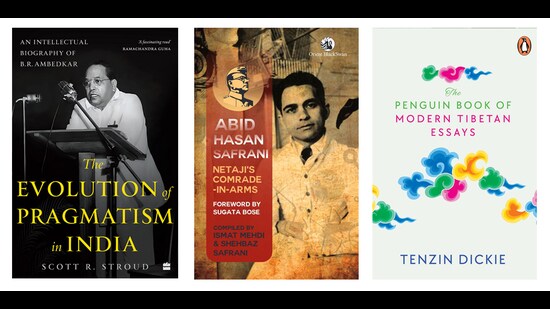
In The Evolution of Pragmatism in India, Scott R Stroud delivers a comprehensive exploration of the influence of John Dewey’s pragmatism on BR Ambedkar, architect of the Republic of India’s constitution. Stroud traces Ambedkar’s development in Dewey’s Columbia University classes in 1913-1916 through his final years in 1950s India when he rewrote the story of Buddhism.
The author examines pragmatism’s influence not only on the philosophical ideas underpinning Ambedkar’s fight against caste oppression but also how his persuasive techniques drew on pragmatism’s commitment to reconstruction and meliorism. At the same time, Stroud is careful to point out the ways that Ambedkar pushed back against Dewey’s paradigm and developed his own approach to challenges in India. The result is a nuanced study of one of the most important figures in Indian history.*
The story of an unsung national hero
In the words of historian Sugata Bose, “Netaji’s comrade-in-arms Abid Hasan Safrani was a quiet revolutionary who kept himself out of the limelight even while being present at every vital scene and moment of the final phase of our freedom struggle across Europe and Asia.” A member of Netaji’s Azad Hind Fauj, Safrani is famous as the man who coined the slogan “Jai Hind”, which became the national salutation for Indian soldiers, statesmen and civilians alike. Safrani grew up in old aristocratic Hyderabad of the 1920s in a richly syncretic, secular culture and a vibrant social and intellectual environment that influenced him deeply, leading him later to plunge into politics under Subhas Bose’s leadership. He went on to become one of Netaji’s closest associates, and was the only one to accompany him on his historic submarine voyage from Kiel in Germany to Japanese territory in Sumatra, Malaysia, during World War II. A polyglot and connoisseur of art and history, Safrani also served independent India as a diplomat of distinction in China, West Asia, Africa and Europe. Compiled by his niece Ismat Mehdi, who accompanied him on his foreign postings to Bern and Baghdad, and his nephew Shehbaz Safrani, who was with him in Baghdad and Damascus, Abid Hasan’s accounts of his time and journeys with Netaji — collected from his notebooks — bring alive key historical events and fill in crucial gaps in the narration of India’s freedom struggle. Anecdotal memories of Safrani recounted by family and friends also reveal a self-effacing, fiercely loyal, brave and generous man with an endearing persona. The story of an unsung national hero, this book preserves and disseminates some of the finest and forgotten lessons of our freedom struggle, to better understand the evolution of independent India.*
The romance, comedy and tragedy of modern Tibetan life
{{/usCountry}}The romance, comedy and tragedy of modern Tibetan life
{{/usCountry}}The Penguin Book of Modern Tibetan Essays is a groundbreaking anthology of modern Tibetan non-fiction. This unprecedented collection celebrates the art of the modern Tibetan essay and comprises some of the best Tibetan writers working today in Tibetan, English and Chinese. There are essays on lost friends, stolen inheritances, prison notes and secret journeys from-and to-Tibet, but there are also essays on food, the Dalai Lama’s Gar dancer, love letters, lotteries and the Prince of Tibet. The collection offers a profound commentary not just on the Tibetan nation and Tibetan exile, but also on the romance, comedy and tragedy of modern Tibetan life. For this anthology, editor and translator Tenzin Dickie has commissioned and collected 28 essays from 22 Tibetan writers, including Woeser, Jamyang Norbu, Tsering Wangmo Dhompa, Pema Bhum and Lhashamgyal. This book of personal essays by Tibetan writers is a landmark addition to contemporary Tibetan letters as well as a significant contribution to global literature.*
*All copy from book flap.