
 E-Paper



HT Picks; New Reads
This week’s pick of interesting reads includes some of Punjabi literature’s most powerful short stories on Dalit themes, a neurosurgeon’s unexpectedly funny view of life seen through his work, and a speculative history of Kerala that’s also a sly metafiction

 Prefer HTon Google


A window into Punjabi society
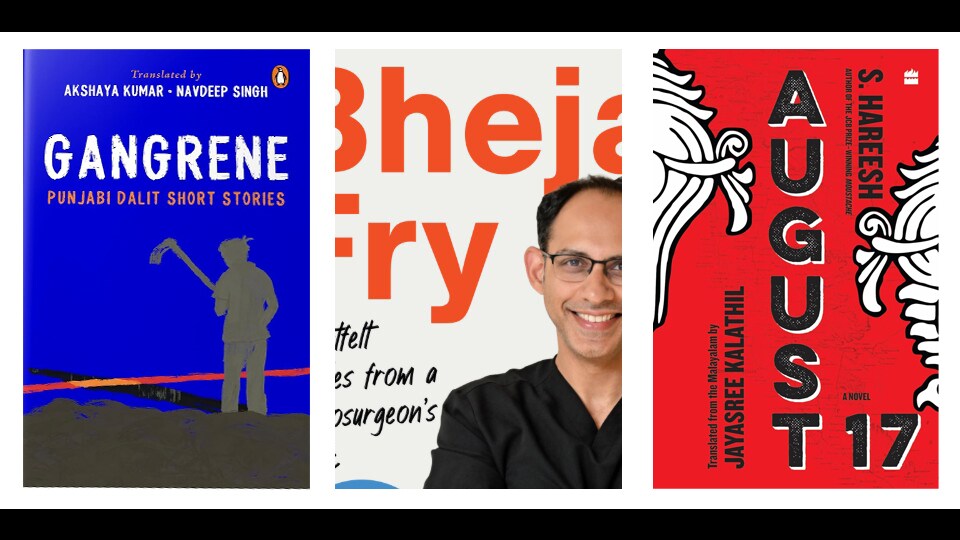

In percentage terms, Punjab has the highest Dalit population in India (around 30 per cent of its population). Despite that, Punjabi Dalit writing has struggled to find recognition.
Initial writings about Dalit issues were largely by the stalwarts of Punjabi literature like Nanak Singh, Gurbaksh Singh Preetlari, Kulwant Singh Virk and Gurdial Singh. Since the 1970s though, Punjabi Dalit writing has undergone a shift in consciousness with the emergence of Attarjit, among the earliest Dalit writers to make a mark. Soon, others like Prem Gorkhi, Mohan Lal Phillauria, and Bhagwant Rasulpuri emerged.
Gangrene is an attempt to compile some of Punjabi literature’s most powerful short stories on Dalit themes and issues. Carefully curated by Akshaya Kumar and Navdeep Singh, this volume features stories on a variety of issues ranging from caste identities and rural exploitation to urban life and housing. Searing in its indictment of casteism, this volume is a window to a better understanding of Punjabi society.*
Illness as a test of the human spirit

Neurosurgeon Dr Mazda Turel has spent decades encountering the strange, moving and often unexpectedly funny edges of human life through his work.
In these pages you will find a wheelchair-bound woman whose devoted caregiver husband suddenly became a patient himself, a woman whose dog discovered her breast cancer before she did, and a brilliant teen with a brain tumour who got his doctor to teach him to red MRI scans. Through these unusual cases, Dr Turel comes to understand illness not just as a medical condition, but as a test of resilience, identity and the human spirit. Told with warmth, insight and quiet humour, these stories are as colourful and intriguing as they are deeply humane.*
Reimagining Kerala’s history as an alternate world

On 17 August 1947, the kingdom of Thiruvithamkoor declares itself a free nation, refusing to join India. In the years that follow, it becomes a republic of coups, betrayals and revolutions - chronicled by a shadowy informant known as the CID.
Through his eyes, S Hareesh reimagines Kerala’s history as an alternate world where the lines between fact and fiction, faith and power, sanity and madness blur beyond recognition. At once speculative history and sly metafiction, August 17 explores how nations are built – and undone – by the stories they choose to believe.
Brilliant, subversive and darkly funny, this is a novel of astonishing scope and imagination. Rendered in Jayasree Kalathil’s masterful translation, August 17 confirms Hareesh winner of the JCB Prize for Moustache – as one of the most daring and original voices in contemporary Indian fiction.*
*All copy from book flap.


