The book reverses the colonial gaze. What interested you in making the colonizer appear alien and grotesque?
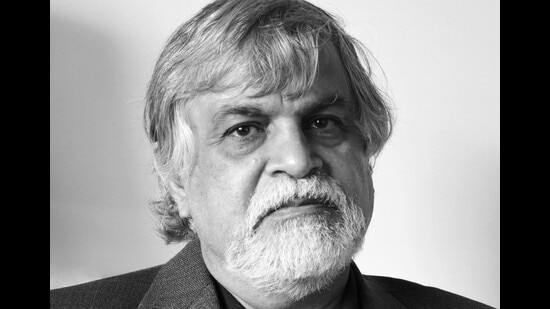
I just wanted to introduce an alien. When the colonizers arrived, they were aliens. And then, of course, once an alien comes, all kinds of things are set loose. There is insecurity, there is order also. There is anxiety about the loss of culture or faith, identity and so on.
It could be an alien race, or it could be you opening up to the world. But that is another way of looking at it: you live in a narrow, self-defined world and suddenly something happens and the world becomes larger. When it becomes larger, then all kinds of anxieties set in, whether one likes it or not. It happens. It will be both. Some people, of course, resist. Some people accept. But then there are people who are, let’s say, elite intellectually, who actually question what will happen to who we are. And that is the question that Amir Hassan asks.
His master, the Sufi, says the world just got bigger and you find out that there is more to the world than you thought. You have to accept that. It was always there. It won’t go away.
The Avians in the book exploit existing caste divisions, much as colonial powers have historically exploited local hierarchies. Was that parallel deliberate?
{{/usCountry}}The Avians in the book exploit existing caste divisions, much as colonial powers have historically exploited local hierarchies. Was that parallel deliberate?
{{/usCountry}}They used it, which is what the British did, for example, in Kenya. They would set up certain tribes against each other. Or, I think even here. People at the lower end of society start coming up and exert pressure, which the former elite, who still remain the elite, resent. In this book, the upper caste don’t have people to work for them because those who once did have now become policemen and so on. You see this in a place like Kenya where you have the black, white, Asian and different tribes situation. That gives you things to play with. You can use that to move the novel forward, to some conclusion, some direction.
Why did you centre Amir Hassan, a historian and poet, in a novel so concerned with who controls its narrative?
I pictured Amir Hassan writing it at a time when Delhi was in turmoil. There were a lot of intrigues and a lot of murders. The Sultan himself was ailing, probably being poisoned, and he thought he would imagine another, better world. An ordinary person cannot do it; it has to be a writer or a poet or a historian, which is what he is. Everything is then seen through his eyes.
But that does a lot of things. He is inspired by the figure of Amir Khusro. Very influential, very central. In the 15th century, this was a big subject in society: politics and conquest and poetry, religion and so on.
Amir Hassan repeatedly confronts knowledge that challenges his assumptions. What did you want his questioning to reveal?
He questions and then he finds an answer, or says, okay. When he sees the human figures who are very low in status and learns of the fact that male babies are thrown away, that creates a tremendous shock in him. How is that possible? This is not the Muslim tradition. The story is that when the Prophet came, the first thing he got rid of was infanticide. And now here you see a society which, in fact, uses infanticide to stay stable.
So, then he explains it himself that there are other societies which also use infanticide to survive. He is continuously making sense of these things.
The novel is fascinated by how knowledge is written, preserved and manipulated. Why is the written word so important to Amir Hassan?
He is a historian, he is a poet, and he is hyper-aware of the fact that knowledge can be manipulated. He writes a true history according to his observations, whereas the Avians are trying to change it.
His resistance and that of the Sufi is to keep writing. Writing is a form of resistance so that is what he has to do. He writes and he makes sure that a good copy survives.
That is the kind of resistance that remains possible when you cannot overturn certain forms of rule. Things happen and we live with them -- colonialism, imperialism. Resistance works when there is a target. The Vietnamese, for example, fought for 20, 30 years and they reached some kind of solution.
In this book, there is a sense that it is pointless except to try to maintain some kind of integrity.
The book mythologizes history. Do mythology and empire function together by turning a narrative into unquestionable truth?
There is no absolute truth, unless in mystical terms. But I think a novel like this stands in some way against the society we live in. Nowadays, who reads? But for a novelist, you know, this is what you can do.
In my previous novels, the subject is more explicit. A real community, a real country, and direct talk of colonialism and empire. Here, it is in terms of speculative fiction or even fantasy. We know what it says about colonialism and empire and domination, but it is also kind of fun because what else can you do? You can’t change the world as it is.
The novel becomes another way of asking questions. You can create a world where the things you are thinking about are made strange enough for you to look at them again.
You also bring humour into a novel dealing with violence, domination and political hypocrisy. Can humour cure us?
Humour can cure you because of so much anger in people like me. You see what’s happening in the world -- the lies, hypocrisy. It is just shocking that even as we talk, people are being murdered. But most of the world doesn’t care. That’s what we’ve become.
Then, all you’re left with is humour and fantasy.
Maybe at some point in time, a story like this will have more relevance. When you look at HG Wells, Aldous Huxley, and even Orwell, their work comes back because the questions remain.
I’m very pessimistic. But this was a fun novel to write.
What drew you to the scientific and philosophical world behind the novel?
I discovered a lot in my research. I had heard about the stories about the angels and the birds and the status of science in what you might call the Islamic world at that time. And I was fascinated. It just stayed with me.
When I wrote, it all came together – al-Biruni and even Tusi, and the speculation that the philosophers had about the nature of creation and the nature of God and so on. It opened my mind.
In a certain part of the world, people were asking these questions and some of them were persecuted for asking those questions. I asked the same question in the book.
You know, there are books about when the animals appeal to the Creator about their status below the human being, a child grows up without parents on an island and discovers how the world is put together. This is from a novel written in the ninth or 10th century. I was fascinated by this.
The Avians have definitive answers, while the humans keep questioning. Is uncertainty ultimately more humane than certainty?
This was a society which existed always under the threat of extinction. So, they developed means to survive. Their means to survive were these rigid rules, which by and large were humane; certain rules were cruel, inhuman. But they did what they did to be able to survive. Otherwise, they would have been just finished off by the Mongols or by someone else.
The humans, meanwhile, are constantly asking questions. I think that is what makes them human. You don’t know everything. You speculate. You question. You try to make sense of what you see.
The novel is suspicious of both the old order and the new one. Where, then, does ethical resistance lie?
Well, in this world, it is with this group called the Terrorists. Resistance is called terrorist until they succeed. In Kenya, it was the Mau Mau, and then there was the ANC in South Africa. They were called terrorists.
I don’t know, to be honest. That question is not answered because sometimes you fight where there is no autonomy. With the freedom movements, there was a target.
Whereas here, the aliens were not going to go away. The world had opened up. You can resist, but for how long? This is what the Sultana tells Amir Hassan: these people, they will die and that is it. Resistance will not stay forever.
But there is resistance, and some of it is just crazy, by fanatics. Some of it is real, like Amir Hassan himself. But his resistance and that of the Sufi is to keep writing.
You also sound pessimistic about whether resistance can change history. Is that contradiction important to you?
There is some sense to that, but you cannot overturn certain forms of rule. I don’t think this kind of thing is possible today or ever. If you think of the Iranian situation, I think it has sort of changed them. I think American dominance has suffered. You could say that that kind of resistance works, at a great cost.
But in this book, I cannot picture it. It can work in the sense if the Avians say “enough, we don’t want to stay here, these people are crazy,” and then leave. That can happen. But I’ve left it open.
Women in the novel resist systems that claim to offer order and liberation. Did you see gender as a test of those universal claims?
That came as an accident. But even if it was accidental, it almost tells the reader that not much has changed for women. When these aliens did not come, they were at the hands of men, and sometimes upper-caste men, and sometimes men who were from their own family.
The women who Amir Hassan finds in Birdland are basically slaves. They live outside the main society and they can only do certain things. But then Hibba finds a way to resist and send her daughter away. Amir Hassan thought it was not possible, but she found a way to do it.
Why does the Sultana help Amir Hassan, particularly when she represents the power he questions?
I think she had a soft spot for him. She respected, intellectually, what he was doing.
In fact, all the people on board, all the Avians, they also respected that aspect of Delhi society: history and culture and politics, poetry and so on. Which is why the two old men were studying Persian and so on.
There is that element of curiosity and respect even within a colonial relationship. They have come as rulers, but they are also fascinated by the society they have entered. That is part of the complication.
In fact, I got that idea from the fact that when I was writing my novels that sat in Tanzania, I discovered that there was Swahili poetry of resistance. It was collected by the German colonizers and translated. So, you know, there are some good elements to the colonial enterprise.
So, do you feel colonialism is beneficial?
The good element of colonial rule was that it brought some kind of order and equality. Like the lower castes were free. Religious bigotry was reduced.
It was more benign compared to the Sultanate where the punishments were brutal. Amir Hassan appreciates it. Although in critical times the punishments that the Avians inflicted became as brutal.
But then, of course, there was exploitation of resources.
If I think about it, the Avians were better colonizers than the British.
What makes the Avians better colonizers?
I think British rule was very insidious. It took away a lot. But it gave a lot too. I mean all the dictionaries they produced and all the linguistics, the research they did and so on. But the inequality between the British and the people they ruled was much more intense, as described in the books. Very short-sighted.
The Avians, by comparison, impose order and equality more directly. They are not necessarily good, but in the world of the novel they are better than what we have seen historically. They have their own brutality, their own exploitation, but the relationship is different.
Is colonialism then, inevitable, given how repeatedly domination has appeared in history?
For humans, I think so. From what we’ve seen, it has always happened.
But sometimes colonizers themselves change. For example, the Mongols, they were really destructive when they came from Ulaanbaatar, Karakorum. But they suddenly, at some point, just became Persians. Today’s Persians are a bit of them, descended from the Mongols.
That is the strange thing about history. People come, they conquer, they destroy, and then they become part of the society they conquered. The conqueror does not always remain separate forever. Things change, cultures mix, languages change, people go on.
You described yourself as pessimistic. Can we live without hope?
You have to be young to be hopeful.
And I think young people should keep on fighting. I demonstrated against the Vietnam War when I was young. At this age, I just tell myself, let the young people do it.
But I think that is also why writing remains important. You cannot necessarily overturn the world. You can question it. You can keep a record. You can maintain some kind of integrity.
Pranavi Sharma writes on books and culture. She lives in New Delhi.