Let’s talk about Blaft! Having launched in 2008, it is in its 17th year now. How has it changed in the context of who and what you publish?
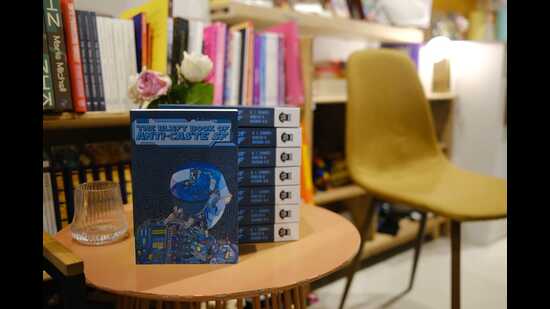
Rashmi: We brought out the first anthology of Tamil pulp fiction because we strongly believed this book needed to exist. We hoped there would be more than a fair number of folks like us who would want to read it too. Since then, the titles we’ve been bringing out are books we
Let’s talk about Blaft! Having launched in 2008, it is in its 17th year now. How has it changed in the context of who and what you publish?
Rashmi: We brought out the first anthology of Tamil pulp fiction because we strongly believed this book needed to exist. We hoped there would be more than a fair number of folks like us who would want to read it too. Since then, the titles we’ve been bringing out are books we really want to read ourselves — that has been the driving catalyst that makes things bloom in Blaft’s petri dish.
Rakesh: When we started out, Rashmi and I were frustrated with what felt like a suffocating sameness about most of the Indian writing available in English bookstores. It seemed like everything was about delicate sad women, with mangoes and sari borders on the covers. While those books still exist, things have opened up a lot — there’s more writing in different genres, more translations, more experiments. But I don’t think our ethos has changed much really; we still like to publish books that feel different and surprising.
As a small independent press, how has a platform like Kickstarter helped you? Since this campaign made more than three times the goal amount, did you expect such an enthusiastic response?
Rakesh: Kickstarter has been great, especially for getting our books into the hands of international readers; people from all over the world find it easy to support us there.
We kept our goal as the amount that would allow us to meet minimum production costs. I did expect that we’d meet it easily — there was a lot of interest early on; besides, there were more than 40 contributors, all of whom had networks of friends and family and fans. But I didn’t expect it to exceed the target by quite so much!
Rashmi: We are really thankful to everyone who supported this campaign. We were completely blown away at the support this book project received. Indie publishing is a hard knock business, you don’t have the infrastructure or fiscal bandwidth that legacy publishing houses have to keep multiple manuscripts in development. This book could only have been conceived through a crowdfunded model. We also want to make books that have stellar production quality in terms of printing and design. We could realise those aspects as well thanks to the ACSF backers.
Why ‘anti-caste’ speculative fiction? How did you envision the collection in the planning stages?
Rakesh: For me, it was just this: if you do a caste census of Indian writers published in English, you’ll find that it’s something like 70% Brahmins and 20% other “upper-caste” writers. And in genres like science fiction, it’s more like 99%. Many of those writers do excellent work, but it’s just totally non-representative of the population, which is only 20% or 30% upper caste. That seems super unhealthy, you know? Like the imagination of most of the country is being throttled.
What possibilities does speculative fiction as a genre offer that perhaps is not the case for realism? Could you please expand on the line about how “it’s a powerful way to think critically and ask important questions about our world”?
Rashmi: I am no expert in speculative fiction. But if I was attempting to articulate what the genre means to me at this point in time, it’s that it lets you reframe the absurdity of the unfairness and imbalance of our day-to-day existence. Realism is also not an umbrella term that covers everyone’s lived experience, right? I think spec fic gives a writer trying to make sense of these absurdities the possibility to build a layered story — fantasy on horror with science fiction at the base, double sandwiched maybe, with a slice of camp.
How did you decide on the contributors and how to source contributions? Were there any specific challenges in getting submissions?
Rakesh: We had a rough target page count. RT Samuel had a network of author friends — many of whom have been active in anti-caste academic or artistic spaces — and solicited contributions from that group. I did a bunch of research hunting for writers in other languages and hooking them up with translators. Those pieces together accounted for about ¾ of the page target; after that we put out our open call with a plan to fill the rest of the pages with submissions.
As for challenges: all the submissions we got from the open call were written in English. Which was fine, but I would have loved to include more translations. In particular, the book doesn’t have anything from Hindi. I can’t believe that among 400 million Dalit/Bahujan/Adivasi Hindi speakers there’s nobody writing cool speculative fiction. They must be out there; we just haven’t found them.
What was the editorial process like? How did you divide the work and labour between the three of you? Were there specialised tasks for each one of you?
Rakesh: RT Samuel did a lot of the commissioning and had the final say on what went in and what didn’t. I did a lot of the working-with-translators. Rashmi was keen on including comics.
It is commendable that the anthology contains contributions translated from other languages as well as multimedia pieces. What was the thought process behind that decision and did it affect how you viewed “speculative fiction”?
Rakesh: We’ve always been interested in genre fiction in Indian languages—after all, we launched our company with an anthology of Tamil pulp stories. Genre boundaries are different in different languages, the tropes are different, the whole idea of what imaginative fiction can be is different.
In many ways, the manner in which these stories are written and presented also pushes the horizon of possibility along with their content. Could you please comment on this aspect?
RT Samuel: Blaft has always had a very strong visual language and has also prioritized storytelling across mediums so this project wasn’t any different. And genre-wise SF has also always had a tradition of breaking new ground in terms of art, graphic novels, film (both animated and live-action). It’s just part of the canon, so to speak.
How have contributors and readers responded to the anthology so far? And what next? Have you begun thinking about a follow-up or a similar anthology?
Rakesh: As stretch goals for the Kickstarter, we decided to bring out two collections — a book of short stories by PA Uthaman, translated from Malayalam by Mridula Makkuni, and the full book Parivrajak by Gautamiputra Kamble, translated from Marathi by Sirus J Libero. No plans for a sequel yet, but hopefully soon!
Areeb Ahmad is a Delhi-based freelance writer and literary critic. He is @Bankrupt_Bookworm on Instagram.
One Subscription.
Get 360° coverage—from daily headlines
to 100 year archives.
Archives
HT App & Website