A sense of nostalgia engulfs many cities that have seen a period of literary brilliance. One of them is Allahabad, now known as Prayagraj, which has seen the emergence of such formidable writers as Firaq Gorakhpuri, Suryakant Tripathi Nirala, and Harivansh Rai Bachhan, among others. The second edition of Bazm-e-Virasat, held from 19 to 21 December, 2025, at the Bishop Johnson School celebrated the city’s rich literary and cultural heritage.
The first day of the festival, 19 December, was the
A sense of nostalgia engulfs many cities that have seen a period of literary brilliance. One of them is Allahabad, now known as Prayagraj, which has seen the emergence of such formidable writers as Firaq Gorakhpuri, Suryakant Tripathi Nirala, and Harivansh Rai Bachhan, among others. The second edition of Bazm-e-Virasat, held from 19 to 21 December, 2025, at the Bishop Johnson School celebrated the city’s rich literary and cultural heritage.
The first day of the festival, 19 December, was the 98th anniversary of the execution of four freedom fighters involved in the Kakori conspiracy case. In their honour, Dastango Himanshu Bajpai performed the tale of their bravery. He traced the lives of Ashfaqulla Khan and Ram Prasad Bismil and spoke of how they inspired an entire generation of freedom fighters. A session on Lantarani or the exaggerated narration of certain incidents followed. As an introduction, poet and activist Anshu Malviya explained that the city belongs to its madmen. Abhay Awasthi spoke about the historicity of Zero Road and how it has been a hub of Bharat Ratnas, and those on the “waiting list”. Dhananjay Chopra recounted covering the rally of Amitabh Bachhan, during his brief spell as a politician. While reciting one of his father’s poems, the superstar had shown his thumb to the audience. “Amitabh Bachhan shows his thumb to the people of Allahabad once again,” Chopra’s report stated.Party supporters protested but Bachhan himself came to his rescue. “He’s an Allahabadi, let it be,” he said.
Poet Yash Malviya talked about Maharajin Bua, one of the few women who sold wood for pyres, and how she used her wit to survive in the business. Asif Usmani added to the conversation by remembering an incident where a boy actually named “Prime Minister” was arrested for gambling. The local Urdu newspapers couldn’t resist and the headline read: “Prime Minister arrested for gambling”, Apparently, the police landed up at Prime Minister’s home and compelled his parents to officially change his name.
The next session on the saints of Allahabad had the former Vice-Chancellor of Allahabad University, NR Farooqui speaking about the rich heritage of Sufi culture in the region, “Sufism is a made-up word by orientalists while the original terminology is something else. Sufis lived a life of wilful poverty,” he said. “Allahabad is a place where theory and praxis meet and has been connected to Brahma. It is a city of knowledge and not of kings, and has been a counter culture to monarchy,” said professor Badri Narayan,
Siraj Ajmali spoke about the city’s geography and its spiritualism. The day ended with a soulful performance by Prahlad Tipanya and his group followed by a mushaira.
The second day began with a session on the city with Dhananjay Chopra talking about its historical churches, akhadas, and masjids and its Ganga-Jamuni tehzeeb. Sahitya Akademi award recipient Neelum Saran Gour spoke about the role of the hostels of Allahabad University. This was followed by Cricket Talk featuring cricketers from the city like Gyanendra Pandey, Ashish Winston Zaidi, and Mohammad Kaif in conversation with sports journalist Ayaz Memon. “Gully cricket taught us everything. Apart from hard work, what also matters is who the selectors are. Ashish Zaidi suffered because of the region he came from,” Kaif said. Memon asked Zaidi about his experience of waiting for that one call to be a part of the Indian national team. “It is the dream of every single sportsperson to play while representing their country and it was mine as well. I never allowed it overshadow me and focused on playing well,” he said.
The following session had actors from the city talking about their journey., Nidhi Singh said that when she got a part in Permanent Roommates everything changed. Panchayat actor Faisal Malik spoke about how Haasil (2003) directed by Tigmanshu Dhulia had played an important role in his life. He added that he had worked in different fields for 15 years before ending up as an actor. Aditya Srivastava of CID fame added that Tigmanshu Dhulia had pulled an entire generation of actors from theatre to films and television.
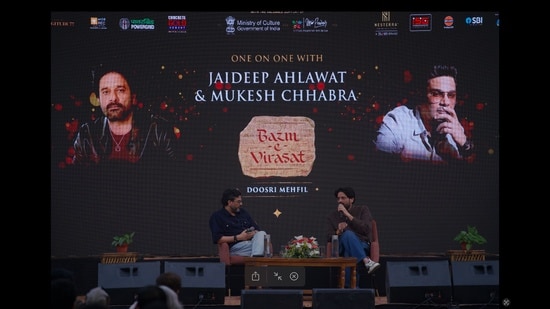
“Your struggle never finishes even when you might’ve become famous. I believe that every single role I have done, could’ve been done better. I keep on learning from fellow actors and directors as they all have something different to portray,” said Jaideep Ahlawat during a conversation with casting director Mukesh Chhabra,
The day ended with a film discussion in memory of Fareed and Nikhat Kazmi featuring directors Anurag Basu, Leena Yadav, Anubhav Sinha, and Tigmanshu Dhulia, and an energetic performance by the band Indian Ocean.
The concluding day began with a mesmerizing performance by the Pakshee band followed by a session dedicated to Suryakant Tripathi Nirala that had reputed academics like Pranay Krishna, Tarun Kumar and Avdesh Pradhan. Krishna highlighted the many hues of Nirala’s life. “Nirala faced a lot of difficulties to preserve the self. Death was a constant part of his life as he lost several of his family members to the Spanish flu. He vehemently criticized the caste system and every social ill, today he would’ve been called an urban naxal,” he said. “Nirala was a revolutionary poet. He was sternly against individualism and termed it dangerous,” said Tarun Kumar. “We are going through an era of darkness and that’s why it becomes important to remember Nirala,” said Avdesh Pradhan. “He faced a lot of difficulties because he defended a lot of writers and the genre of Chhayawaad (romanticism).” The next session titled Allahabad in Literature, though important, was somewhat hurried. Neelam Saran Gour read a few paragraphs recalling some personalities from the city; Anita Gopesh spoke about how Dharamveer Bharati’s Gunaho Ka Devta still sold very well at book fairs; and Ali Ahmed Fatmi remembered poets Firaq Gorakhpuri and Akbar Allahabadi. This was followed by Rashmi Agarwal’s ghazal recital followed by the much anticipated last session with actors Neena Gupta, Gajraj Rao, Vineet Kumar in conversation with casting director Mukesh Chhabra. Their points on nepotism were especially interesting. “If you’re not good at your art, you’ll not survive. Nowadays we pick and choose where we want to initiate the discussion around nepotism. It’s everywhere,” said Vineet Kumar. “I believe the conversation of nepotism comes from a place of insecurity,” said Chhabra. “Even when we scroll through Netflix, we check who the actors are before making a decision. It matters for the viewers as well,” said Gajraj Rao about the tendency to cast famous names instead of just good actors. Neena Gupta pointed out that no director has cast her and Gajraj together as a couple since Badhai Ho and that the role changed things for both of them. The festival ended with a bang with Voice & Trumpet, a band from Mumbai, belting out music from the 1970s.
Chittajit Mitra (he/him) is a queer writer, translator and editor from Allahabad. He is co-founder of RAQS, an organisation working on gender, sexuality and mental health.
One Subscription.
Get 360° coverage—from daily headlines
to 100 year archives.
Archives
HT App & Website