The first Sankat Mochan Sangeet Samaroh was held on Hanuman Jayanti in 1923 at the famous Sankat Mochan Hanuman Temple in Varanasi. Lord Ram’s greatest devotee, Hanuman, who is known for his knowledge and virtue, is worshipped here as Baba Sankat Mochan, the remover of all obstacles. A great musician and mridang player, he is exalted by musicians and art lovers.
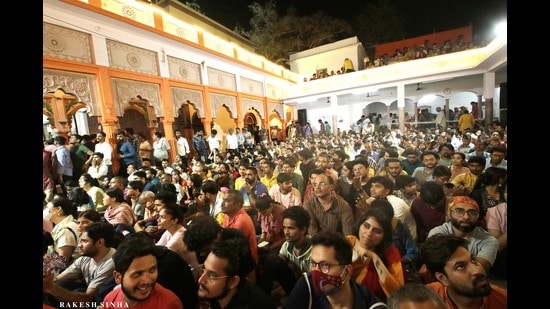
The festival, which celebrated its centenary this year, began on April 10 and continued for a week at the historical temple near Banaras Hindu University (BHU). Legend has it that the Hanuman statue at this temple was sculpted by Tulsidas (16th century), who wrote a big segment of his Ramcharitmanas in front of the idol.
Initially started as a one-day event by Pt Amar Nath Mishra, who was a pakhawaj player, the festival was curated by local musicians like Ashutosh Bhattacharya, sarodist Jyotin Bhattacharya and tabla maestro Pt Kishen Maharaj. The event became famous when Mahant Veerbhadra Mishra began inviting artistes from all across the country, beginning with Pt Maniram, the elder brother and guru of Pt Jasraj.
The current mahant, Vishwambhar Nath Mishra, has expanded the festival further by inviting artists like Ghulam Ali from Pakistan. Comparing it to the Ganga of Kashi where everybody is welcome, Mishra states: “Musicians and dancers come here at the behest of Baba Sankat Mochan. Here, they offer their musical tribute to Him, unlike at other music festivals, where they go to perform for audiences. It is He who calls them, and hundreds of music lovers throng the venue to enjoy the best of music and dance. The art exhibition is an added attraction. This is what makes the Sankat Mochan Sangeet Samaroh unique in so many ways.”
{{/usCountry}}The current mahant, Vishwambhar Nath Mishra, has expanded the festival further by inviting artists like Ghulam Ali from Pakistan. Comparing it to the Ganga of Kashi where everybody is welcome, Mishra states: “Musicians and dancers come here at the behest of Baba Sankat Mochan. Here, they offer their musical tribute to Him, unlike at other music festivals, where they go to perform for audiences. It is He who calls them, and hundreds of music lovers throng the venue to enjoy the best of music and dance. The art exhibition is an added attraction. This is what makes the Sankat Mochan Sangeet Samaroh unique in so many ways.”
{{/usCountry}}The greatest attraction of this festival is its devotional fervour and the ambience where the applause from rasik bhaktas is voiced in chants of “Hara Hara Mahadeva!” The atmosphere is democratic with individuals of every class, caste, creed and nationality gathering in the temple courtyard to focus on the music presented non-stop on the open air stage from dusk to dawn. Temple rituals like darshan, aarati, and pooja-archana continue alongside.
The 100th edition of the festival had a judicious mix of established and upcoming musicians and dancers. Young Bhaskar Nath opened with a shehnai vadan in Yaman and Purabi Dhun. This was followed by a melodious Bageshri rendition on the sitar by Supriya Shah, accompanied by Anuvrat Chatterjee on the tabla. Swar Ratan Sharma of the Mewati gharana presented vocals in Jaijaiwanti and Jog, and the popular “Hanuman Lala” composed by Pt Jasraj. There were vocals by Pt Nagraj Hawaldar from Bangaluru and Pt Ulhas Kashalkar from Pune, a sitar recital by Purbayan Chatterjee from Mumbai, a Kuchipudi performance by Gaddam Padmaja Reddy from Hyderabad, and songs by the popular folk singer Jasbir Jassi. A similarly sumptuous feast of music and dance by a variety of artistes was offered on every night of the festival.
The crowds poured in for star artistes like Rashid Khan and Pt Venkatesh Kumar, who offered different flavours of the same Kausi Kanhada raga on alternate nights. Classical musicians like Dr N Rajam, Pt Vishwa Mohan Bhatt, Pt Sajan Mishra, Dr L Subrahmanyam, Vidwan Yella Venkateshwara Rao, Shivamani, U Rajesh, Pt Ajay Pohankar, Niladri Kumar, and Basant Kabra and popular singers like Anup Jalota, Talat Aziz and Malini Awasthi too were part of the programme. Rising stars like Shakir Khan, who rendered a memorable Malkauns, Abhay Rustam Sopori, who proffered the Bhajaneshwari, a raag he created in memory of his guru and father Pt Bhajan Sopori, and Arman Khan all performed. The instrumental attractions included the flute recital by Pt Ronu Majumdar and Shashank Subrahmanyam, the santoor recital by Pt Tarun Bhattacharya, and the sarod recital by Indrayudh Majumdar. Thakur Chakrapani Singh played the guitar with Pt Samar Saha on tabla.
There were dance performances in a range of forms. Bharatanatyam dancer Rama Vaidyanathan was supported by Sudha Raghuraman’s melodious vocals accompanied by flautist G Raghuraman. Bharatanatyam dancer Shirisha Shashank from Chennai also performed. While Pt Rajendra Gangani presented a Kathak performance, Guru Ratikant Mohapatra and his Srijan ensemble from Bhuvaneshwar and Sanchita Bhattacharya from Kolkata performed Odissi pieces and Padmaja Reddy from Hyderabad presented a Kuchipudi recital.
Ram Ki Shakti-Pooja, a dance-drama based on Hindi poet Surya Kant Tripathi ‘Nirala’’s famous poem was presented by Vyomesh Shukla. “I’m happy to get this opportunity in a city like Varanasi, a venue like the Sankat Mochan temple and fortunate enough to offer it for the greatest rasika of all times, Hanuman, who is gyan-guna-sagar (ocean of knowledge and virtue),” said Shukla, founder director of Roopvani, a theatre group based in Varanasi. The performance, which incorporated movements from Chhau, Bharatanatyam and Kathak and had music based on the appropriate ragas and taals with glimpses of Pt Jasraj’s Hanuman Lala and Sitara Devi’s Bol-Padhant, was a memorable offering.
Art was also part of the attractions with hundreds of paintings displayed at the art gallery, Kala-Deergha. Apart from a collaborative canvas called Ashtha ki Deewar, which drew hundreds of visitors to add their strokes, Rajesh Kumar’s live wet mud sculpture of Pt Hari Prasad Chaurasia even as the master flautist performed compositions in raga Maru Bihag followed by a Pilu Dhun as dadra, was a wondrous sight.
All in all, the Sankat Mochan Sangeet Samaroh 2023 was a grand success.
Manjari Sinha is a senior music critic.