
 E-Paper



Review: A Billion Butterflies by Jagadish Shukla
The author, who was part of IPCC team that won the 2007 Nobel Peace Prize for its work on human-induced climate change, chronicles his life and work

 Prefer HTon Google


The butterfly effect or chaos theory is a concept that remains ingrained in popular culture more than six decades after the scientist Edward Lorenz proposed it. The term is thought to have originated from a lecture titled Predictability: Does the Flap of a Butterfly’s Wings Set Off a Tornado in Brazil? Interestingly, Lorenz had used the image of a seagull in his presentation, which another scientist mistook for a butterfly, resulting in the name we are familiar with today.
In the 1960s, Lorenz tried to determine if it was possible to model future atmospheric conditions using past data. He realised that rounding off just one variable in the model, from .506127 to .506, radically altered the results. His simulations suggested that the minutest changes in initial atmospheric conditions — due to a butterfly flapping its wings, for instance — could distort the results of forecasting models, making long-term weather predictions impossible.
And yet, today, scientists can predict not just the weather but a range of climatic events with reliable certainty. Whether it is the timing and intensity of the Indian monsoons or the El Niño (a global climate phenomenon that leads to droughts in some regions and heavy rainfall in others), we can now anticipate and prepare for them. One of the scientists responsible for these breakthroughs is Dr Jagadish Shukla.
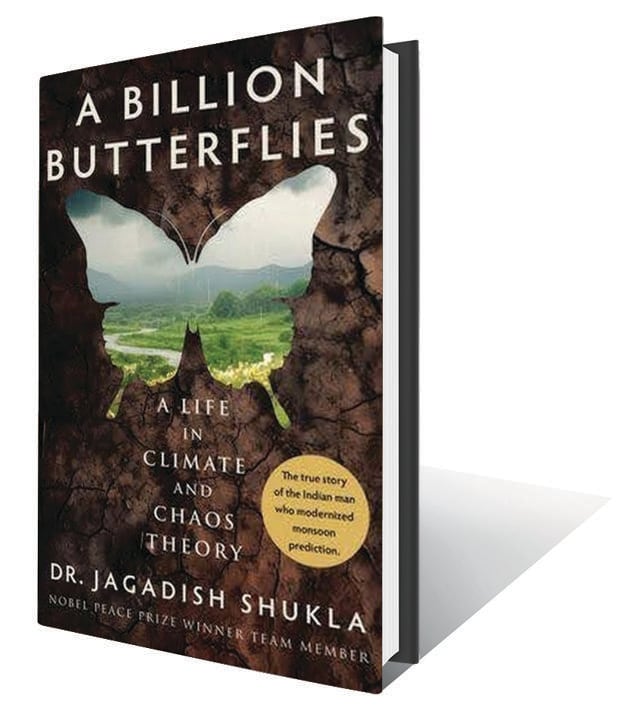
Born in 1944 in Mirdha, an Indian village near the Nepal border, Shukla trained in exploration geophysics, but subsequently worked in climate and weather science. He was part of the Intergovernmental Panel on Climate Change (IPCC) team that won the 2007 Nobel Peace Prize along with Al Gore for their work on human-induced climate change. Now in his eighties, Shukla has chronicled his life and work in the book A Billion Butterflies: A Life in Climate and Chaos Theory.
His village lacked electricity and proper schools. He was married off at a young age, did not know his wife’s name for many years, and lost his father when he was 17. Yet, he secured a job at the India Meteorological Department and left it to pursue a doctorate at the Massachusetts Institute of Technology.
The author challenged the prevalent beliefs in his field to build up the science behind seasonal prediction. He found that factors like sea-surface temperatures and soil moisture play such an overwhelming role in determining seasonal averages that the “chaos” or minute changes in initial atmospheric conditions become irrelevant in climate prediction. As he puts it, “...[the] effects can be so large that not even a billion butterflies could make them unpredictable.”
This insight brought him closer to his avowed lifelong dream — predicting the Indian monsoon to make a difference to the lives of millions in rural India. He notes that seasonal predictions have moved from research labs into the real world, with organisations using them to predict the onset of the rainy season, above-normal rainfall in flood-prone areas, and the outbreak of vector-borne diseases across the world.
While the author’s accomplishments are impressive in their own right, the book is as compelling for its science communication. Shukla’s explanations are lucid and his storytelling engaging, making it easy to understand concepts like numerical weather prediction and boundary-forced effects. The scientific explorations yield fascinating insights: Why does it get cooler at night? (The answer “because the sun sets” only gets a B in his class). Why do meteorologists have more confidence in climate predictions 100 years from now than in weather predictions 10 days ahead? Why do thunderstorms die after a few hours, but hurricanes last for days?
The book also highlights the importance of diversity and inclusion in science, though the author explicitly references it in only a few instances. While discussing his engagement with the IPCC, he talks about how he learnt, much later in life, that a woman was the first to demonstrate that higher carbon dioxide levels in the atmosphere would lead to a warmer Earth. Eunice Newton Foote, an American scientist and women’s rights advocate, made the discovery in 1856 — before the male scientist it has long been attributed to. He notes that while there has been progress since then, we remain far from gender equity in science even today.
The sway the Indian monsoon had on millions motivated Shukla to establish a scientific basis for seasonal prediction. His collaboration with Antonio Moura, a Brazilian colleague, led to the finding that when the tropical Atlantic Ocean was cool, northeast Brazil was rainy. High temperatures in the former, however, led to droughts in the latter.
One wonders how different weather and climate science would have been today without the contributions of people like Moura and Shukla. Science is often seen as an objective truth that remains hidden until someone uncovers it. But the kind of facts people are motivated to investigate is often shaped by their geographies and formative experiences.
And yet, today, not only diversity and inclusion but also immigration, science, and educational institutions are under attack in the US, Shukla’s adopted homeland. He too was at the receiving end of these attacks. He was hounded for a letter he wrote to President Obama, proposing legal action against organisations that knowingly deceived people about climate change. Threats followed, as well as an inquiry into his organisation’s work and finances. Right-wing websites ran with headlines like “Climate Alarmist Caught in ‘Largest Science Scandal in US History’” and deemed him the “Third Most Dangerous Person” of 2015. But this was not an isolated case. So widespread has been the harassment against scientists that an organisation was set up to counter it: the Climate Science Legal Defense Fund.
Interestingly, the author “started as something of a sceptic” about climate change, becoming a “strong believer” as the scientific evidence became incontrovertible. Despite worsening extreme weather events, he remains more optimistic about the future than one might expect a climate scientist to be. For as he says, the antidote to climate anxiety is climate action. His book is equally reassuring. That brilliant scientists are advancing our understanding of the world and sharing their discoveries so eloquently is one more reason to be hopeful.
Syed Saad Ahmed is a Boston Congress of Public Health Thought Leadership Fellow 2024. He speaks five languages and has taught English in France.


