My first tryst with the festival of Onam was in a college hostel, with a friend from Kerala distraught at the prospect of skipping the traditional sadya (feast) because of back-to-back classes. Grumbling in the back benches, he laid out not only the finery of the feast – my primary interest at that point – but also about the history of the occasion: the king cheated of his kingdom and banished, who comes back once a year to see his subjects.
In a country bursting with myths, festivals and forgotten strands of history, the myth of Onam is a particularly potent one. It speaks of a king who continues to be a modern-day hero of many lower-caste and adivasi communities in a society where faiths of marginalised communities are systematically erased.
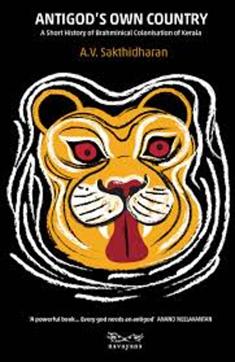
In his new book, Antigod’s Own Country, AV Sakthidharan goes a step further, using the motif of Onam and the many myths surrounding it to sketch the cultural and spiritual roots of festivals, deities and faiths, and underline the insidious ways in which Brahmanical traditions may have co-opted them.
The writer lays out the landscape of the tryst between marginalised communities and the mythical king Mahabali, and argues that the Brahmanical attempts at taking over the festival and re-imagining its history are part of a concerted, old process of erasing subaltern narratives.
The slim, 168-page book is breathless with information and the writer flits between many different stories, deities and kingdoms, which can be difficult to follow for the uninitiated. It is not an easy book to read for a casual reader, and some base knowledge of myths and Kerala’s history is assumed. Some of the best arguments made in the book are lost in the middle of chapters, as the writer quickly moves from one issue to the next.
{{/usCountry}}The slim, 168-page book is breathless with information and the writer flits between many different stories, deities and kingdoms, which can be difficult to follow for the uninitiated. It is not an easy book to read for a casual reader, and some base knowledge of myths and Kerala’s history is assumed. Some of the best arguments made in the book are lost in the middle of chapters, as the writer quickly moves from one issue to the next.
{{/usCountry}}Very little of this comes in the way of the book’s importance, however, as Sakthidharan lays out before us the majestic diversity of Kerala’s faiths, deities and myths, and, in the process, makes some poignant comments about contemporary debates.
The best example of this is the section on the Sabarimala temple. Over the past year, a debate over the entry of women of menstruating age to the temple has rocked India, triggered clashes and stoked discussions on religious beliefs and fundamental rights. The Supreme Court last year struck down the ban on the entry of women, but hundreds of devotees blocked the paths of women for months, often acrimoniously. In media and popular culture, this clash has been repeatedly framed as one between a modern, rights-based discourse and an ancient faith-driven belief.
Read more: Taking a stand for tribal rights: Why I am not celebrating Durga Pujo
But Sakthidharan points out that there are hundreds of temples of Ayappa dotting Kerala without any restrictions on entry, and illustrates the rich tapestry of varied beliefs and myths around the deity, who commands a following among the lower-caste communities. He also traces the slow spread of Brahmanical control over what was essentially a subaltern shrine, which culminates in the ban on women’s entry that was formalised only a few decades ago. And finally, he points out how the Brahmin priests and nodal body effectively pushed out the Mala Arayan tribal community, which not only lost touch with its deity but also found itself pushed out of the shrine’s management.
He takes many popular shrines, deities and stories, and attempts the provocation of re-imagining myths. He suggests that many of the things, stories and deities we automatically think of as Hindu today may have had very different origins, and were co-opted by brahmanical thought over the centuries – he gives the example of asuras, vilified during Durga Puja but held in high regard by many adivasi communities who worship them as kings. At a time when faith is both crucial and divisive, electoral and personal, it is important to remember that faith is neither singular nor monolithic and that many communities continue to fight to secure their beliefs and deities from an puritanical onslaught.