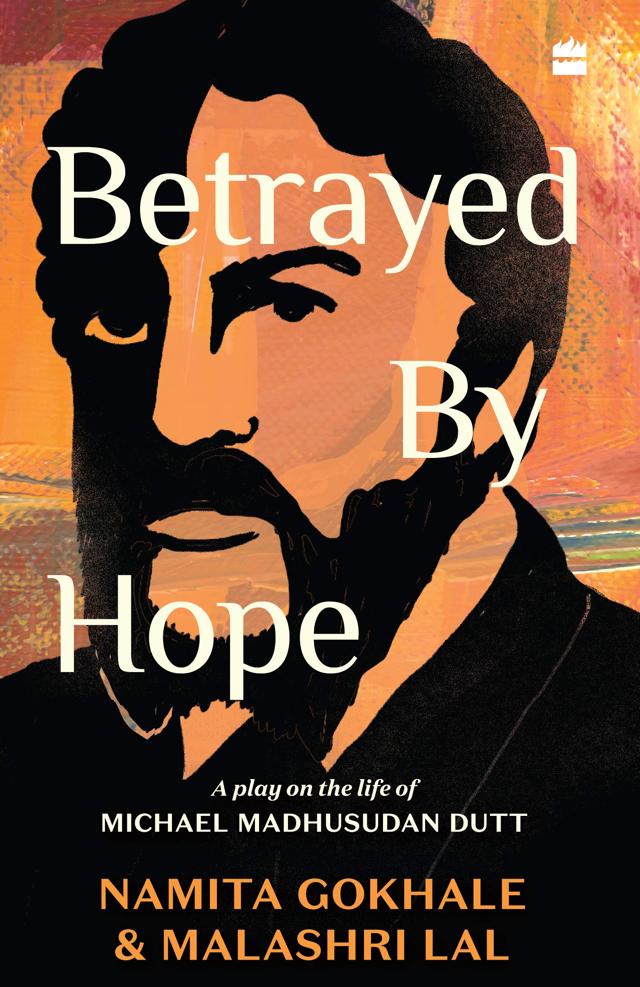
How does one engage with history without falling prey to the easy way of doing things; set the beginning, middle, and the end of a poet’s life one after the other like ducks in a row? Betrayed by Hope, a play on the life and work of the 19th century Bengali poet, Michael Madhusudan Dutt must, before all else, be commended for not being led by the relentless linearity of traditional history writing.
In their depiction of Dutt’s controversial life – enriched by his innumerable contradictions of being a “bad husband” and a literary powerhouse; an Anglophile who had to turn to his mother tongue to reach his full potential – and the mercurial movement of his work, authors of the play script, Namita Gokhale and Malashri Lal, have worked with two devices.
First, they freed the figure of the poet from historicism and second, invented the character of a sutradhar, Rubina Rahman. Rahman is a young, Bangaladeshi Dutt scholar planning to make the poet her PhD subject. She is a self-avowed cosmopolitan and she freely and often admits her incapability to deal with the richness of her material.
The first device is a good one. Instead of watertight compartments of the past and the present, the play works, instead, by having Dutt’s 19th century life – primarily represented by the poet himself in his many letters to his friends, literary companions and mentors – collide with the present. The desired aim of having both time periods interpenetrate one another throws a light on the past through the eyes of a modern woman. That works well. It also seems to suggest, not without truth, that some Bengalis are still charmed by the idea of a post-colonial Bengali identity.
The problem, however, is this: Miss Rahman is trite and irritating. “A researcher’s journey is like that of a psychologist’s; one sees the literary works and becomes curious about the writer’s hidden self,” she says towards the beginning of the play. All through it, the hidden self she is most keen on unearthing are the skeletons in Dutt’s closet. She reads about his life and work, especially as they stand represented in the letters, rather superficially as an identitarian search. This is why she seems to see Dutt’s interest in other world literatures as being “pretentious” rather than internationalist.
{{/usCountry}}The problem, however, is this: Miss Rahman is trite and irritating. “A researcher’s journey is like that of a psychologist’s; one sees the literary works and becomes curious about the writer’s hidden self,” she says towards the beginning of the play. All through it, the hidden self she is most keen on unearthing are the skeletons in Dutt’s closet. She reads about his life and work, especially as they stand represented in the letters, rather superficially as an identitarian search. This is why she seems to see Dutt’s interest in other world literatures as being “pretentious” rather than internationalist.
{{/usCountry}}A mapping of the twists and turns of his literary sensibility shot through with actual details of the poet’s life would have been more rewarding. In the second half of the book, Act III onwards, from the point when Dutt starts to mine his own language, the book starts to do that and the momentum picks up.
“Like Milton’s Satan, Madhusudan’s Meghnad [the reference is to Meghnadbadh Kabya, Dutt’s famous work on Ravana and the slaying of his son, Meghnad, by Lakshmana in the style of a Greek epic] drew up attention to his grand and heroic defeat but also opened up questions about power and justice being held by a privileged few. In the depths of his heart, did Madhusudan feel guilt towards the wife (his first wife Rebecca Thompson) he had abandoned in Madras...Was he turning his guilt into dramatic art by focusing on heroines, bold and accomplished in his shorter plays and poems?” asks the sutradhar.
In subsequent passages, Rahman also draws attention to Dutt – his mature work is a prefiguration of the post-Tagore wave of Bangla modernism -- giving Bengali its first sonnets and blank verse. But she redeems herself infrequently. One usually turns away in relief from what she has to say of him to what the poet says of himself in his letters.
There is not much the man hides. To his friend, Gour Das, Dutt gives examples of his fine European life and frequent changes of address from different cities of Europe; to his benefactor, Ishwar Chandra Vidyasagar, he writes of his empty pocket and the possibilities of mortgage of his family estate in Bengal.
The play is a montage. The montage emerges through an alternation of the epistolary mode – with Dutt’s letters being read out by an actor playing him through different moments of his life – with the interventions of Rahman. In doing so, she seeks to set up an encounter between the past that is Dutt’s life and her 21st century present.
Dutt’s letters reveal his tragic life, which is perennially driven by hope even as it’s bedeviled by distress and despair. These letters, together with his poems – both the early English verses that are callow imitations of the English Romantics and his later Bangla oeuvre that is packed with groundbreaking inventiveness and power -- have been marshalled well by Gokhlale and Lal. What is, therefore, indicated is a Bengali literary sensibility that seeks to situate itself in the Goethean universe of weltliteratur or world literature.
By the end of his life – Dutt, 49, died in 1873 in penury – the poet was a broken man. But he showed new ways of what it meant to write poems in Bengal in Bengali.
Paramita Ghosh is the author of In A Future April. An independent journalist, she lives in New Delhi.