In Burns Boy, the unnamed mother of Guru and Aparna says, “Then I thought maybe he [Guru] didn’t like my stories, and that thought terrified me, even more than him not liking me anymore.” Krupa Ge entangles a mother’s steadfast endurance against her child’s hatred for her with her writer self’s vulnerabilities and fear of rejection. She puts a woman’s creations at odds with each other in a family drama that unfolds through three narrators.
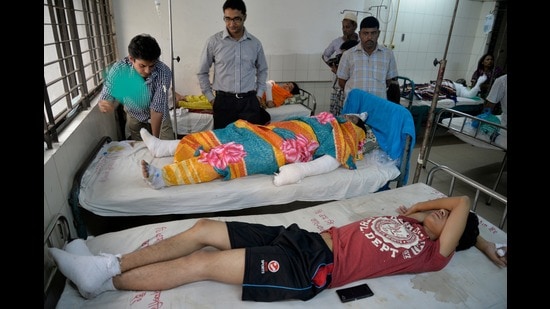
15-year-old Guru finds himself in the unusual position of being in a burns ward filled with women as victims of dowry demands, suicides, failed love —something that’s beautifully explored in Imayam’s A Woman Burnt, translated by GJV Prasad (2023). He was raised by his grandmother who poured all her love and attention onto him, moulding him to be the man of the house. And yet, when he finds himself in the burns ward, he is the one who needs looking after, even after being discharged. Meanwhile, his younger sister Aparna grows up in complete neglect, often longing for her mother and for love.
While the others in the ward are mostly victims of violence against women, Guru’s accident, in his narration, is part of a pattern of intended neglect. While his mother feels desperately helpless, his sister views it as unintended result of her petty revenge. All of it comes together to form a picture of deep family discord, secrets, shame and most importantly, the resentment that fractures their relationship. Ge’s description of a Madras of a by-gone era with its Sweet Karam Coffee and specific bus routes is visceral, extending itself to the burns ward: “That overwhelming scent of kerosene from all the other burns patients, the smell of disinfectant, and what would come to be the familiar and soul-crushing stench of dressing for burns survivors, all of it clung to the air, heavy like furniture in that sterile room.”
Narrated in first person by Guru, Aparna and their mother, this short novel presents the unfiltered thoughts of somewhat unlikeable characters. Readers are likely to recognize the ugliness of it all mirrored in their own thinking. This is true in Guru’s spitefulness as he shames his mother by peeing himself in public, Aparna’s longing for attention and love that manifests as petty actions to incite anger, or their unnamed mother’s schemes to get the man she loves to commit to her. Here, the children carry the shame of their mother who herself manages it by writing stories, creating platforms for alternate realities that could have happened had she chosen differently. Writing is her passion as well as a purging. And her children resent her for it.
{{/usCountry}}Narrated in first person by Guru, Aparna and their mother, this short novel presents the unfiltered thoughts of somewhat unlikeable characters. Readers are likely to recognize the ugliness of it all mirrored in their own thinking. This is true in Guru’s spitefulness as he shames his mother by peeing himself in public, Aparna’s longing for attention and love that manifests as petty actions to incite anger, or their unnamed mother’s schemes to get the man she loves to commit to her. Here, the children carry the shame of their mother who herself manages it by writing stories, creating platforms for alternate realities that could have happened had she chosen differently. Writing is her passion as well as a purging. And her children resent her for it.
{{/usCountry}}Guru complains that his mother is available to everyone, especially to her writing, but not to her children. Aparna despises her mother as everything she shares with her finds its way into her stories. The father is mostly absent from the scene, which further strains the family dynamic. Amma’s section speaks of the relationship between a mother and a child; she looks back at her relationship with her own mother as she describes her struggles after childbirth: “Most mothers I’ve met, aunties, friends, colleagues, grandmas and cousins, admit to being traumatised by childbirth, or its aftermath; if it’s not physical, it’s mental, if it’s not mental, it’s social, if it’s not social, it’s the child’s well-being; a pound of flesh motherhood wants, a pound of flesh it extracts. But we dare not talk about it. And our children, they can neither remember their own suffering from those months, nor ours. This is the former’s curse, and the latter’s blessing.”
Despite the direct burn marks on Guru’s flesh, the mother-daughter duo too metaphorically burn in the accident as is beautifully depicted in Chinmayee Samant’s cover illustration. But it is the mother’s writing that bears the most scrutiny. Is it fair for her to comment on her children’s experiences through her stories or to retreat to the mountains to find her writing voice, leaving her children behind? These questions become more pressing when the children bear absolutely no anger towards their father’s absence. They might miss him or wait for him but their hatred is set on the one who’s there for them; any attempt to prioritise herself is met with cruelty, in words and actions. More pressing is the question, why does Amma remain unnamed throughout the text despite her identity as a writer?
This tussle between a mother and her writer-self recalls the opening lines of Shashi Deshpande’s That Long Silence (1988), in which the narrator Jaya Kulkarni — a wife and mother — says, “To achieve anything, to become anything, you’ve got to be hard and ruthless. Yes, even if you want to be a saint; if you want to love the whole world, you’ve got to stop loving individual human beings first. And if they love you, and they bleed when you show them you don’t love them, not specially, well, so much worse for them! There’s just no other way of being a saint. Or a painter. A writer.”
Ge, in her turn, beautifully balances the perspective of a mother’s one-sided love for her children with their ignorance and innocence, that sometimes leads to fatal events.
Amma in Burns Boy walks with her head held high despite her past which often becomes a matter of shame for her children growing up — one decides to remain stuck in the narrative, the other breaks away to form her own happiness. This short fast-paced narrative with three distinct voices that covers the lifespan of a family leaves the reader hoping the characters grasp individual freedom if not filial reconciliation. It doesn’t ask who is to blame for Guru’s accident. It merely shows that multiple realities coexist, and that often, no one is to be blamed.
Akankshya Abismruta is an independent writer.