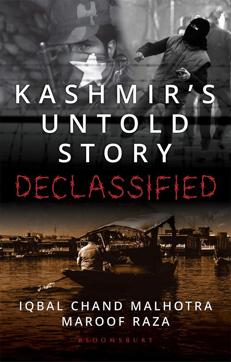
Kashmir’s Untold Story Declassified is an effort by two journalists, one of whom is a former soldier, in which they try to unravel the torturous history of Jammu and Kashmir. Importantly, the book focuses on Jammu and Kashmir around Partition and the independence of India on August 15, 1947.
Writing popular history can be burdensome. Historians who write for students can depend on their readers having some background information. In contrast, popular historians have the task of helping those who may not have the necessary knowledge of geopolitics, history and geography to understand, analyze and comprehend the sequence of complex events, and help them form an opinion. That burden is even heavier when the subject is Jammu and Kashmir, especially in the post-Article 370 era. Much of what is passed off as Jammu Kashmir history today amounts to propaganda and misinformation.
Iqbal Chand and Maroof Raza have tried to do a quick sweep of the history of Kashmir. They have devoted a considerable part of the narrative to exploring how areas like Gilgit and Pakistan-Occupied Kashmir were appropriated by Pakistan with British help even after Maharaja Hari Singh acceded to India. In that, they have been able to bring together some interesting pieces in the bigger jigsaw of the Great Game that started with the alleged thrust of Czarists Russia into Central Asia and intensified in the first part of the last century. The book makes no mention of the Great Game. Nor does it try to connect the manoeuvres of the British Raj in 1947 to the shadowboxing with mostly imaginary enemies in Soviet Russia. The result is a lack of clarity.
The book, however, does add to the existing literature on the British plan, in the future interests of the Anglo-Saxon world, to frustrate the smooth joining of Jammu and Kashmir to India. It examines the role of Major Onkar Singh Kalkat posted at the Bannu Brigade, and also looks at Operation Datta Khel, the coup led by British Army officers Captain William Brown and Colonel Roger Bacon against the then Maharaja of Jammu and Kashmir that led to the delivery of Gilgit to Pakistan. The authors accord considerable space to examining the role of British officers in the Indian and Pakistan armies who played a key role in frustrating New Delhi’s plans, and also to Nehru’s impatience with them. The narrative is thin. Other authors, using correspondence and records, have spun a more damning account.
{{/usCountry}}The book, however, does add to the existing literature on the British plan, in the future interests of the Anglo-Saxon world, to frustrate the smooth joining of Jammu and Kashmir to India. It examines the role of Major Onkar Singh Kalkat posted at the Bannu Brigade, and also looks at Operation Datta Khel, the coup led by British Army officers Captain William Brown and Colonel Roger Bacon against the then Maharaja of Jammu and Kashmir that led to the delivery of Gilgit to Pakistan. The authors accord considerable space to examining the role of British officers in the Indian and Pakistan armies who played a key role in frustrating New Delhi’s plans, and also to Nehru’s impatience with them. The narrative is thin. Other authors, using correspondence and records, have spun a more damning account.
{{/usCountry}}Malhotra and Maroof look at the role of Jagat Dev Singh, the estranged, and later deposed, brother of Maharaja Hari Singh. They take in the failed Poonch rebellion led by Mohammed Ibrahim Khan, once a recipient of Jagat Dev Singh’s largesse, and also study the role of George Cunningham the governor of the North West Frontier Province (NWFP). Concluding their narrative on Jagat Dev Singh and Mohammed Ibrahim Khan, the founder and first President of Pakistan Occupied Kashmir (PoK) the book comes to a somewhat contrived conclusion: “Maharaja Hari Singh should have thought through his actions… Had he chosen to study the works of the great Indian political scientist Chanakya and followed his directives, he would have never followed his personal vendetta against Raja Jagat Dev Singh.”
The authors insinuate things about George Cunningham, Col Roger Brown and Captain Brown but do not come up with evidence. In The Shadow of the Great Game; The Untold History of India’s Partition, Narendra Singh Sarlia deftly used correspondence, British official records, and US and European sources to show how the British cast their fortunes with Pakistan after Mohammed Ali Jinnah’s assurances that the newly formed Pakistan would ally with the British to dispossess India. Unlike the British, the US supported the Indian position of complete withdrawal of the raiders and the Pakistan Army from PoK. With aggressive pushing from India, matters came to a head at the United Nations in October 1948. On 27 October, 1948, British Foreign Secretary Ernest Bevin spilled the beans in a conversation with his US counterpart, George Marshal: “The main issue was who would control the main artery leading into Central Asia. Indian proposal would leave that in their hands,” Sarila writes.
Surprisingly, the authors also question why India did not sign the Stand Still Agreement with Jammu and Kashmir, unlike Pakistan. They suggest that if India had signed the agreement, a military intervention could have been possible even with the Instrument of Accession. There are perhaps two reasons for this: Their correspondence shows that Nehru and Patel were keen for the Maharaja to hand over power to Sheikh Abdullah before acceding to India. While Maharaja Hari Singh was dithering and continued to harbour plans for an independent Kashmir, Abdullah, a left-leaning politician, and his followers were ready to cast their lot with India. Road connectivity with Kashmir was through Pakistan. The Indian connect to Jammu and Kashmir was through dirt tracks and inhospitable mountains passes. Importantly, Pakistan, which had signed the Stand Still Agreement, first imposed an economic blockade and then sent in raiders backed by the regular Pakistan Army.
Read more: The Kashmir reading list: 11 books to understand the conflict
Finally, the authors also claim Dr Syama Prasad Mookerjee was “originally a Congressman, who held the portfolio of industry and supplies in Nehru’s dominion cabinet from 1947 to 1950”. That Mookerjee was in Nehru’s cabinet is true, but the assertion that he was “originally a Congressman” is callous and perhaps borders on misrepresentation of facts. Mookerjee was indeed the Indian National Congress candidate representing Calcutta University in the Bengal Legislative Council in 1929. In 1937, he was elected as an independent candidate and served a coalition government of the Krishak Praja Party and All India Muslim League as the finance minister of Bengal in 1941-1942. In 1939, he joined the Hindu Mahasabha. Aditya Mukerjee, professor of contemporary history and Director of Centre for Historical Studies, JNU, has said: “Nehru’s first cabinet was a representative government, claiming that Dr Mookerjee was a former Congressman would amount to stretching history.”
The authors do not make any addition to the broader geopolitical narrative of that time or today. The book has not broken new ground as its title claims it does.