For centuries, the Ramayana and the Mahabharata have been India’s most popular epics, told across geographies and tongues. Each version of the telling is different from the other, not just in incidents and inferences, but in their very fundamental casting of characters – in many cases, one version and tongue challenging the other, etching contrasting reasoning for the same war or birth or clash.
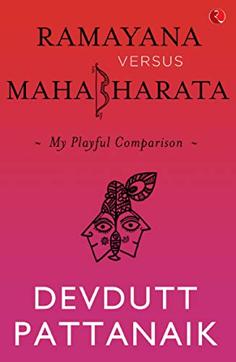
In his latest book Ramayana vs Mahabharata, My playful comparison, mythologist and author Devdutt Pattanaik attempts to compare and contrast the two Hindu epics, ease out themes that both stories share and argues that both of them have the same building blocks, structure and theme, complete with charts, tables and bite-sized takeaways.
Growing up in India, it is almost impossible to miss the motifs of these two epics – either in the form of televised serials, plays, books or in everyday references in popular culture. For the uninitiated with little formal reading of the Ramayana and the Mahabharata, the books serves as a succinct introduction that lay out over the course of 190-something pages the main themes in the two epics, compares their inspiration and the rationale behind each of them. No section exceeds five pages, and in Pattanaik’s characteristic engaging style, the book is a breezy read that doesn’t drown in facts.
In the opening section, Pattanaik categorises, somewhat controversially, the two epics as ‘itihasa’ (or history, written as witnessed) and attempts to place them both geographically and temporally, finally concluding that a version of the events must have happened 3,000 years ago in the Gangetic Plains.
{{/usCountry}}In the opening section, Pattanaik categorises, somewhat controversially, the two epics as ‘itihasa’ (or history, written as witnessed) and attempts to place them both geographically and temporally, finally concluding that a version of the events must have happened 3,000 years ago in the Gangetic Plains.
{{/usCountry}}Pattanaik argues that the two epics have “underlying feminist themes” and in the face of copious amounts of violence against women characters, points out that western, especially Greek myths, are replete with far worse, more blasé, violence.
But some of the reasoning used, like “choice” or “agency” appear retrofitted from the modern times to an epic, and, I am not sure does justice to contribute to a more complex understanding of what it meant to be a woman, or write about the travails of a female character.
Pattanaik lays out at length the concept of dharma, wisdom and the complexity of family life or exile. But For me, the most interesting part of the book was the fleeting references to the “snake people”, the “monkey people” and “rakshsas’.
Unfortunately, owing possibly to the structure of the book, the author doesn’t spend much time exploring who these mysterious yet important groups of people could be. There is some talk of them being tribes being subdued or assimilated by Vedic cultures, but as several Ambedkarite scholars have posited in the past few decades, assimilation was probably by violent means and the cultures of these tribes eclipsed strategically as an act of subjugation.
To resolve two other questions the book had raised in my head, I read it in conjunction with AK Ramanujan’s seminal essay, 300 Ramayanas, and BR Ambedkar’s 1948 treatise ‘The Untouchables Who Were They and Why They Became Untouchables?’
The first is about using the Sanskrit versions of the epics as the base for the comparisons. Ramanujan notes that it would be wrong to call the other versions as “retellings” because it suggests there is one original version, and that many versions, such as the Jain one, raise serious questions about the sequence of events in the Sanskrit one. Secondly, it also underlines that while written forms are usually given primacy, tribal and oral versions of the stories are no less old. It would have been great if more time had been spent on the non-Sanskrit versions in the book.
Read more: Book Review | Sita: An Illustrated Retelling of the Ramayana
The second has to do with that dreaded C-word: Caste. Pattanaik deftly lays out the plotlines of the Buddhist Jatakas and notes the differences the Hindu and Buddhist versions. But as Ambedkar notes, these two faiths were also engaged in a centuries-long fight for supremacy, which was also a proxy fight for the supremacy of the varna vyavastha, loosely translated as the caste system, and in the gradual assimilation and appropriation of Buddhist elements, its central anti-caste ideology was lost.
Pattanaik mentions the numerous incidents that reinforce the central tenet of the varna system: the inheritance of profession. He also notes the various killings and crimes against people considered lowly. But he mentions caste in passing, not as a central theme, and notes that the varna system made economic sense in old agrarian feudal economies. This is a pity because, possibly, in the contrasting versions of the two epics across tongues and faiths lies the true story.