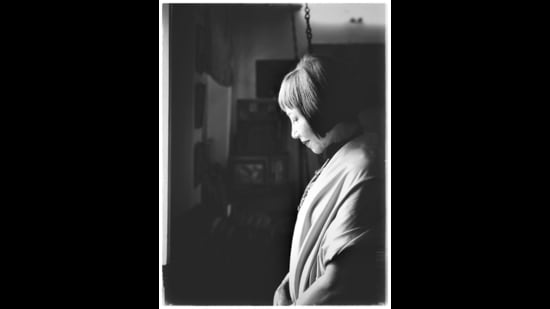
Jonathan Franzen said birding helped him stay more connected to his environment. Margaret Atwood believed that birding helped her achieve a ‘flow state’ which basketball players refer to as being ‘in the zone’. Amy Tan, whose new book The Backyard Bird Chronicles, started as a private nature journal of birds in her garden in Sausalito, came to birding as a response to American politics, specifically, Trump. Trump’s election energised his right-wing voter base into vile acts of racism, spoken as well as committed. As Asians were specifically targeted, widening a traditional net of white bias, a shocked Tan – who grew up in the famously multicultural Bay Area – resorted to drawing birds in her garden. The best forms of solitary activities engage with nature, as evidenced by Thoreau, who also appears to be a winking patron saint of a book that is both a delightful entry point into birding as well as glorious proof of our best artists as polyamorous of talent. (Tan has always been varied in her writing, which has included a memoir, a children’s book, and a television show). This book showcases her most recent skill – drawing, observing birds, living with nature like a companion in a betrayed world – an odd, single-minded and entirely wonderful addition to her canon.
While the drawings appear as a novice birder’s ‘journal entries’ they are luminous, precise suggestions of Tan’s subtle talents as a visual artist. This skill is presented as a kind of humble, folksy ‘journaling’ when, in fact, it summons forth the excellence of the kampani kalam (the Company School), portfolios of animal and botanical sketches by artists like Bhawani Das and Mazhar Ali Khan, from the 18th and 19th century. These were some of the most exquisite drawings of birds, transcendental as homage but emerging in the way that jazz did in America, (the kampani kalam portfolio were produced under a burden of colonialism, while jazz was a secret musical response to the weight of slavery). Tan’s sketches of the birds in her trees echo this dazzling precedent. Art as response to suffering, to political strife, a solo person’s response to events too baffling for a solo person.
When the book came out earlier this year, it immediately endeared itself to readers – it shot to the top of The New York Times Bestseller List. But as further proof of publishing’s decline, the house failed to print enough copies, and squandered a narrow, precious bandwidth of public attention. When The Backyard Bird Chronicles finally was restocked after months, word of mouth, the support of independent booksellers, and Tan’s massive public following pushed it back on the best seller lists. It’s easy to see why readers – even those who are not birders – reached for a copy. There is dry wit – drawings of the Great Horned Owls are represented as ‘Sexy Face’, a ‘Resting Face’, and a ‘Human Attack Face’ (are they going to attack us? Or is the look of horror from the sight of a human?) Tan’s writing is open, clean, contemplative, conversational, the atmosphere of a seeing woman, sage, detached, alert to time and mood, sitting by her window, drawing, considering mealworms in her fridge even as great fires cloud up her windows – wildfires that charred whole ridges in northern California. Even as the world is burning down, the artist must do her job – she cannot better the world, or save it, but she can record it, and while this is not balm, it is a kind of last rite.
{{/usCountry}}When the book came out earlier this year, it immediately endeared itself to readers – it shot to the top of The New York Times Bestseller List. But as further proof of publishing’s decline, the house failed to print enough copies, and squandered a narrow, precious bandwidth of public attention. When The Backyard Bird Chronicles finally was restocked after months, word of mouth, the support of independent booksellers, and Tan’s massive public following pushed it back on the best seller lists. It’s easy to see why readers – even those who are not birders – reached for a copy. There is dry wit – drawings of the Great Horned Owls are represented as ‘Sexy Face’, a ‘Resting Face’, and a ‘Human Attack Face’ (are they going to attack us? Or is the look of horror from the sight of a human?) Tan’s writing is open, clean, contemplative, conversational, the atmosphere of a seeing woman, sage, detached, alert to time and mood, sitting by her window, drawing, considering mealworms in her fridge even as great fires cloud up her windows – wildfires that charred whole ridges in northern California. Even as the world is burning down, the artist must do her job – she cannot better the world, or save it, but she can record it, and while this is not balm, it is a kind of last rite.
{{/usCountry}}Siddharth Dhanvant Shanghvi is the author of the novels, The Last Song of Dusk, The Lost Flamingoes of Bombay, and The Rabbit & the Squirrel, among others.