
 E-Paper



Review: The Girl from Fergana by Jonathan Gil Harris
Diving into his mother’s tea chest to look at family history, that of the Galician Jews, and the History of Things that traversed the old Silk Route

 Prefer HTon Google


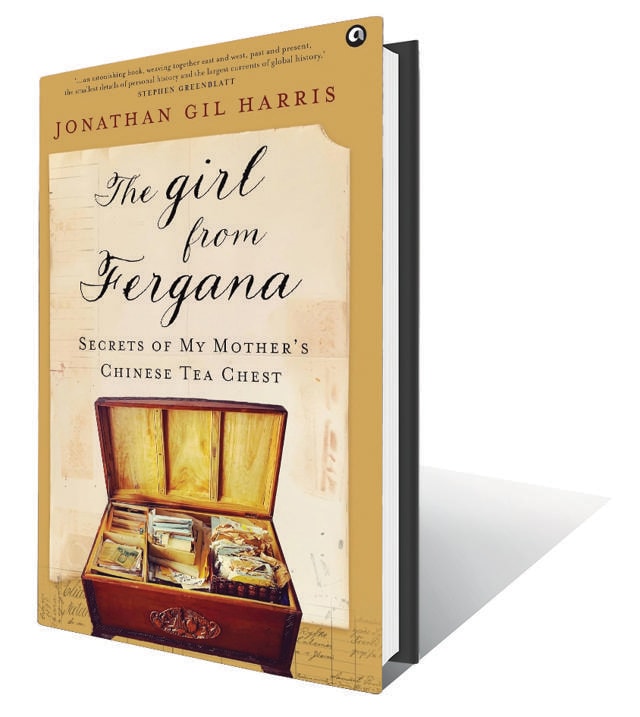
On the cover of The Girl from Fergana is a depiction of a wooden tea chest crammed with folded letters, a render from a photo that appears inside the book. Originally built to convey goods from China to the world, this tea chest had been repurposed to store paper that could not be thrown away. Letters, photographs, bills and bus tickets form the accidental archive of the author’s mother: Stella Freud. In the first snapshot of her, Freud is a magician-like folder of paper, viewed from the eyes of her children in front of whom folded paper lotuses materialize, inscribed with numbers that when unfolded reveal fortunes. Folding paper as a creative act becomes the author’s biographical methodology making connections to the stories of his mother’s life that were folded out of her conscious awareness.
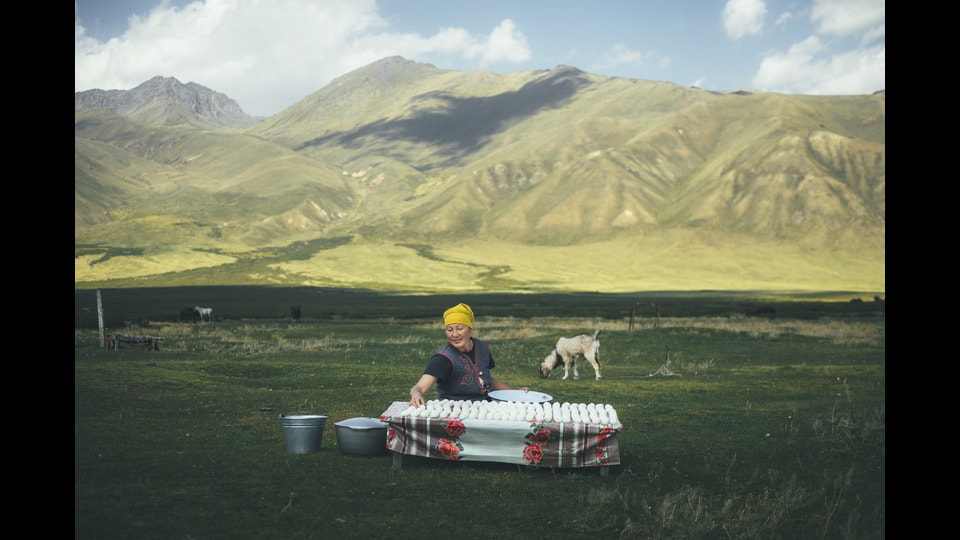
In the deepest fold, the author’s life in Delhi is connected with his mothers in New Zealand via a narrative circle whose centre is in the Fergana valley. “On an unfolded map”, Harris writes, “Europe and India are far apart. Fold the map and suddenly they kiss. They kiss in a place called the Fergana valley’. From this methodological passage-way, Harris folds the story of the Freud family into the history of the quarter million Polish Jews who were displaced to Central Asia during World War II. In turn, this folding unfolds the history and geography of the Fergana Valley that housed them. At every fold, real artifacts from the tea chest gain depth and technicolor vividness as Harris re-describes the five-year sojourn of the Freuds — Natan and Lola and their daughter Stella — in Emperor Babur’s birthplace, a thin green strip of mountain-encircled land between the Tien Shan, Pamir and Alai ranges, a fecund paradise of pomegranates, apricots and melons.
Harris plays memoirist and historian at once in this volume, examining the documents from his mother’s tea chest in the same way as historians examined the cache of Hebrew scrolls found in 2012 in a cave in northern Afghanistan, that detailed the activities of Jewish merchants on the silk roads trade route in contracts, legal agreements and poems written in Hebrew, Persian and Arabic. Stella Freud’s tea chest is reimagined as a Genizah, a sacred and ritual storage area for paper upon which God’s name was written (paper which could not be casually discarded but had to be gathered together and then ritually buried).
Stella Freud’s Genizah unfolds a syncretic spirit, less a personal deity and more a borderless symbol of a cross-faith current of goodwill and sharing; a forgotten spirit that needs to be resurrected for what is known in Hebrew as tikkun olam, the repair of the broken world. Harris interprets the broken world as one that has been fragmented by the toxic logic of nation states and partitions, a world — our world — in which the history of human unity and cross-pollination has passed into the unconscious making nation states possible. The ritual by which this syncretic spirit is resurrected is some combination of the hoarding fragments of personal and collective history — Throw Nothing Away — and the folding of them close together to unite fractures and disunities.
There are no static lines under the folding method: the Freuds of the Fergana valley are situated into the larger history of the Galician Jews and the History of Things that traversed the trade routes. Fold the Freud Copper Company where Stella’s father Natan worked with his brother Abraham trading between Europe and Asia before the war, and you have the story of copper itself. ‘Kypros’, is originally mined in Cyprus, Greece from where Copper got its name before it became a silk-routes commodity for which Jews served as middlemen in the Byzantine Constantinople. Pop out that same fold and you have the contemporary Freud Copper Bathroom Sink, a vestige of the pre-war Freud Copper Company, now a luxury brand sold mostly to Americans.
If Stella’s last name, Freud, piqued your curiosity — as it did mine — you do not have to fold very far into this book to find the father of psychoanalysis who is a reappearing character. Here, he is in Stella’s memory, one of her many ‘Uncle Freuds’, who then becomes differentiated in her mind from the flurry of animated adult chatter as Traumonkel: Dream Uncle. As Stella perches upon Dream Uncle’s knee, Harris reminds us, the famous man is folded out of view (because Stella has only eyes for her own father). As Harris unfolds Sigmund Freud, he recalls the first psychoanalyst’s collection of Oriental objects and Judaica, analysing these according to Sigmund Freud’s own method outlined in Constructions in Analysis, a work that was published around the time as his visit to Stella’s home in 1937.
Constructions in Analysis imagines the human psyche as the simultaneously ancient and modern city of Rome — the ancient parts being analogues of the unconscious parts of the mind — what psychoanalysts call ‘archaic’ elements (and what behavioural scientists would perhaps call the reptilian brain). Psychoanalysis would assign itself the task of unearthing the archaic elements to bring them into view so that they did not ambush their owners. Usurping Freud’s prescribed method of unearthing and turning it upon the founder of psychoanalysis himself, Harris views Freud’s collection of Asian baubles as dream objects. Redescribed as unconscious aspects of Freud’s ‘Royal Road’, his oriental collection symbolizes the buried histories of connection between the Jewish merchants and the silk routes.
A focal point of Harris’ family portrait is a depressed mother who emerges in an almost novelistic glory — the beautiful, glamorous and tempestuous Lola Freud for whom the narcissistic injury of displacement is too overwhelming. The darkness of Lola’s depression papers over the magic of the Fergana valley that her daughter Stella experiences in her bazaar education in Uzgen, its patterned tiles, its scent of red rice plov and its steel bowls, its carts and tables upon which Stella learned to barter small items like ribbons for basic staples like flour. In pages of images and stories, Harris re-constructs what was invisible to Lola by folding together scraps: a modern photo from the bazaar at Samarqand, the history of the Bukharan jews with ancestral links to the Fergana valley, the Kyrgyzian epic of Manas Dastani. Each of these is unfolded in detail, as if adding to Stella’s Genizah, to complete the archive before the ceremonial burial.
Of the fragments, one that endures is Stella’s affectionate recollection of her friendship with Kamrakhan — the girl from Fergana. Unfold that picture of friendship some more, and you uncover the buried histories of connection between Jewish merchants and the Silk Roads. Then, Stella too is the girl from Fergana, less person and more dream symbol, a star on the silk roads that holds a credo for ethical secular living: not by national boundaries but via an exercise of our imagination, a folding into the migrations of people and things, must we trace our ancestry and identity.
Amrita Narayanan is a clinical psychologist and psychoanalyst. She is the author of Women’s Sexuality and Modern India


